
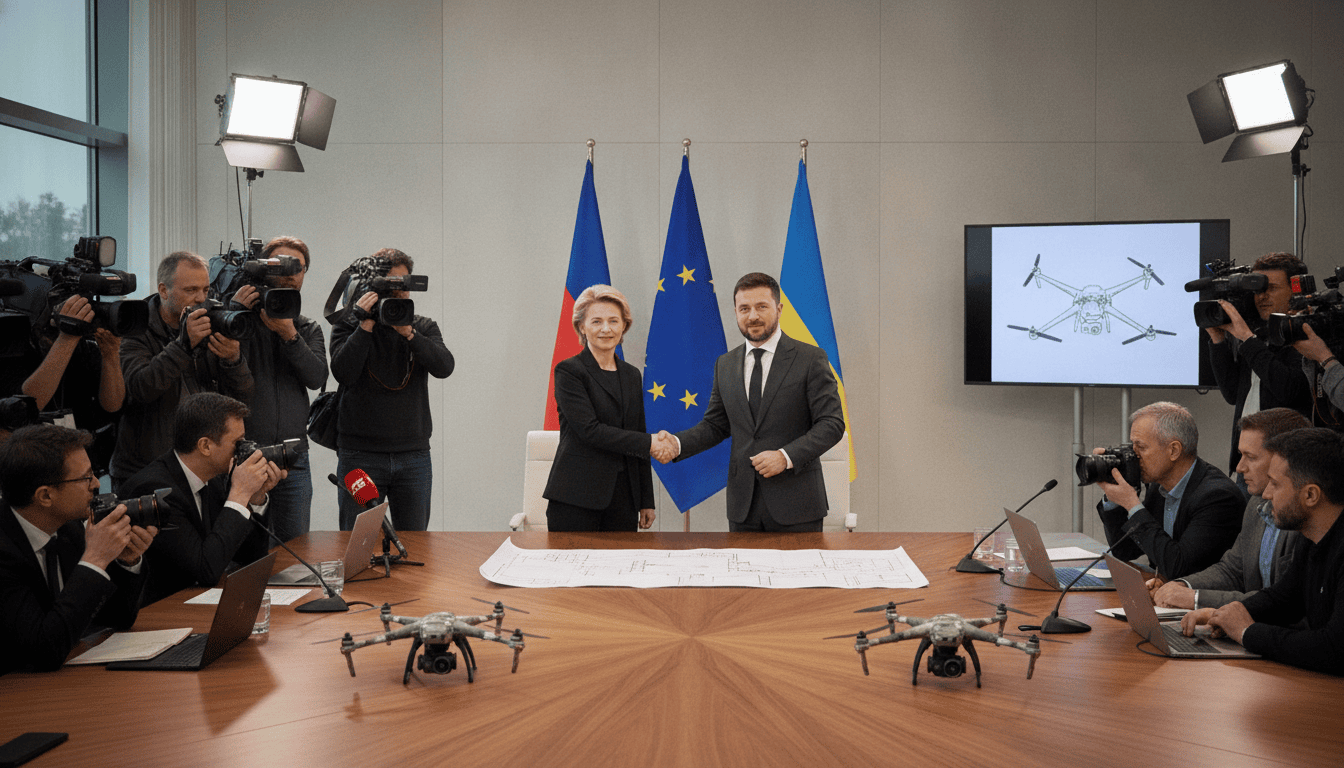
EU-Ukraine drone partnership launched to scale joint production
EU and Ukraine launch joint drone production partnership in Kyiv, Ursula von der Leyen says, aiming to scale operational drone systems amid regional conflicts.
The EU-Ukraine drone partnership was announced in Kyiv as European Commission President Ursula von der Leyen confirmed a new collaborative effort to produce drones jointly with Ukraine. The move aims to combine Ukraine’s battlefield-tested operational knowledge with Europe’s technological and industrial capacity to manufacture systems at scale. Von der Leyen said the expertise Ukraine has gained in both drone deployment and counter-drone operations is “truly unique,” and that secure European production sites could help deliver systems rapidly. The announcement frames the partnership as a response to urgent security needs highlighted by conflicts in Ukraine and in Iran.
EU and Ukraine sign agreement for joint drone production
The formal commitment was made during von der Leyen’s visit to Kyiv, where she presented the partnership as an industrial and security initiative. Officials described the arrangement as a framework for shared design, testing and production activities that will leverage existing Ukrainian operational lessons. The partnership aims to set up production lines across member states while integrating Ukrainian engineering under agreed safeguards. Authorities emphasized that arrangements will include measures for quality control, secure supply chains and coordinated procurement.
Von der Leyen framed the effort as a security imperative
During her remarks, von der Leyen underscored the strategic rationale for the partnership, noting that recent conflicts have made rapid access to proven drone systems vital for defence. She said Europe possesses “enormous technological and industrial capacities” and can offer “secure and protected production sites.” The commission president linked the initiative to resilience, arguing that domestically assured production reduces reliance on fragile international supply chains. Her statements framed the project not only as industrial cooperation but as a contribution to collective European security.
Ukraine’s operational experience to shape design and tactics
Ukrainian forces’ experience with both offensive drone operations and counter-drone systems will inform the partnership’s technical priorities. Ukrainian engineers and field units have accumulated practical knowledge about payloads, sensors, electronic warfare and survivability that Western developers lack. Planners expect Ukrainian input to accelerate development cycles and ensure systems are optimized for real battlefield conditions. The collaboration is designed to translate frontline lessons into standardized, scalable production models for allied use.
European industrial capacity and secure production sites highlighted
European officials pointed to the continent’s manufacturing base as a key advantage in scaling production quickly and securely. Existing aerospace and defence suppliers, semiconductor firms and systems integrators are likely to play central roles in supply chains. The partnership will reportedly prioritize production in facilities that can be secured against sabotage and cyber interference. Policymakers said locating assembly and testing within EU jurisdictions will also simplify regulatory oversight and export controls.
Supply, scale and export controls are central implementation questions
Meeting the partnership’s goals will require resolving procurement, financing, licensing and export-control issues across multiple governments and companies. Officials acknowledged the need for clear rules on technology transfer, component sourcing and end-use verification to prevent diversion. Financing will be another focus, with member states, EU funds and private industry all potential contributors to build production lines that can deliver at scale. Analysts say harmonizing standards for interoperability and certification will be necessary if produced systems are to be deployed widely among partners.
Timeline and next steps outlined by officials
Commission sources indicated initial steps will include joint technical assessments, pilot production projects and mapping of secure production sites across Europe. Working groups with Ukrainian experts are expected to define technical specifications and operational requirements in the coming weeks. Procurement authorities will need to establish contracting mechanisms that can move faster than traditional defence acquisition cycles. Officials said transparency about timelines and benchmarks will be important to maintain political and industry support.
The EU-Ukraine drone partnership marks a notable deepening of defence-industrial cooperation, coupling Ukraine’s frontline experience with European manufacturing capacity to accelerate delivery of operationally tested drones. As planning shifts to implementation, the success of the initiative will depend on resolving export rules, financing and certification while safeguarding sensitive technologies and supply chains.
