
Tour de France 2026 route and early battles: Barcelona start to Paris finale
Tour de France 2026 launches in Barcelona on July 4 and concludes on July 26 on the Champs-Élysées, featuring 21 stages, 3321 km and 54,450 m of climbing.
The Tour de France 2026 began in Barcelona with a team time trial and will finish in Paris on July 26, setting a 21-stage test that spans 29 départements and includes two time trials and two rest days. Twenty-three teams and 184 riders are competing across seven flat stages, four hilly stages and eight mountain days that include five summit finishes. The itinerary promises early time gaps, sprint opportunities and a decisive high-mountain finale that could determine the overall winner.
Barcelona opener sets early time gaps
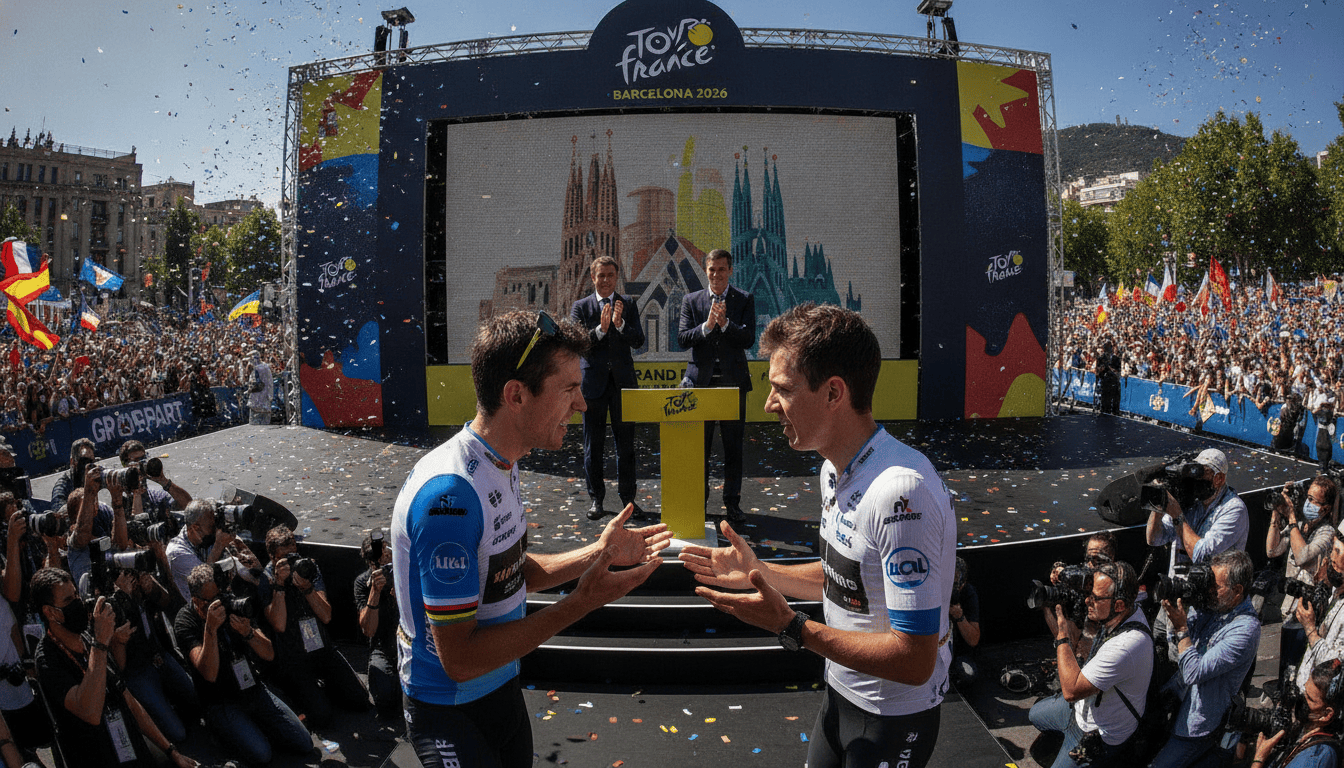
The race opened on July 4 with a 19.6-kilometre team time trial in Barcelona, routing teams over Montjuïc toward the Olympic stadium. The collective effort on this first day established the first general classification hierarchy and handed an early advantage to cohesive squads. Team Visma-Lease a Bike took the stage victory, immediately placing pressure on other title contenders and their support crews.
A short, technical course that finishes with a ramp up Montjuïc can create small but meaningful time losses for GC hopefuls, and the opening TT is likely to shape team tactics for the next weeks. Riders who lose seconds on Day 1 will need aggressive moves later, especially before the mountains arrive.
Sprinters seize flat days while classics stars take selective wins
The route’s flatter stages have offered sprinters multiple opportunities, and those stages were claimed by several prominent finishers in the opening week. Riders such as Olav Kooij and Tim Merlier secured stage victories on flat profiles, while Isaac del Toro and Mads Pedersen took wins on more selective parcours. These results underline the depth of the sprint field and the tactical importance of lead-out trains.
On hilly and medium-mountain days, punchy classics specialists and opportunists asserted themselves, with Mathieu van der Poel and others capitalizing on rolling terrain. Tadej Pogacar also converted his climbing form into stage wins on uphill finishes, keeping the overall picture dynamic as the race approaches the high Alps.
Alpe d’Huez double and Galibier crown the mountain battle
The high-mountain sequence is the defining test of this edition, with Alpe d’Huez hosting two summit finishes on stages 19 and 20 and the so-called king stage scheduled for July 25. That penultimate block includes the Col du Galibier at 2,624 metres, the highest point of the Tour, and a demanding 17.7-kilometre ascent averaging roughly 6.9 percent. Riders will tackle the Croix de Fer and Télégraphe earlier in the day before the Galibier and a final push toward Alpe d’Huez.
The back-to-back finishes on Alpe d’Huez will force teams to manage resources carefully and could produce dramatic shifts in the general classification. One of the two stages follows a less-traveled route through the Écrins national park and includes the Col de Sarenne, a climb that has rarely been used as an ascent in modern Tours.
Vosges stage near German border highlights local interest
The 14th stage on July 18 holds special significance for German fans: a mountainous day in the Vosges with three first-category climbs begins in Mulhouse roughly 20 kilometres from the German frontier. The finish at Le Markstein Fellering will be watched closely by supporters of Florian Lipowitz, who enjoyed a breakthrough performance in his first Tour and returns this year as a general classification contender for Red Bull – Bora-hansgrohe. The stage profile, which includes Grand Ballon and Ballon d’Alsace, suits aggressive climbers and could generate national headlines.
German participation across the peloton is notable, with a cohort that includes seasoned road captains, sprinters and several debutants. That mix provides domestic storylines throughout the race, from breakaway bids to roles as super-domestiques in the high mountains.
Pogacar and Vingegaard renew rivalry for the yellow jersey
The general classification narrative centers on a rematch between Tadej Pogacar and Jonas Vingegaard, who have dominated recent Grand Tours. Pogacar, the 2025 winner, has already taken multiple stage victories and shown continued form in shorter stage races and classics this season. Vingegaard, a two-time Tour winner, arrives with momentum from a successful Giro d’Italia campaign and a Paris–Nice victory, setting the stage for another high-stakes duel.
Beyond the headline pairing, young talents such as Paul Seixas — the French prospect who has shown top-level pace this year — plus Remco Evenepoel and last year’s podium finisher Florian Lipowitz, add complexity to team tactics. Support riders and time trial performances will be decisive in a race where seconds can separate the top contenders.
Logistics, teams and how to watch the race live
The 2026 Tour covers 3321 kilometres across 29 départements with a cumulative elevation gain of about 54,450 metres and features two rest days on July 13 and July 20. Two time trials — the opening team event in Barcelona and a 26.1-kilometre individual time trial between Évian-les-Bains and Thonon-les-Bains — offer specialized chances to gain time. Twenty-three teams are present, including UAE Team Emirates-XRG, Team Visma-Lease a Bike, Red Bull – Bora-hansgrohe and Décathlon CMA CGM Team, among others.
Television and streaming coverage is widely available: public broadcaster ARD is offering daily live transmission, while Eurosport and several paid streaming services provide extended feeds and on-demand highlights. Fans tracking the race should watch the mountain block in the third week and the final TT for the clearest signs of who will claim the yellow jersey.
With a demanding route that blends explosive classics-style finishes, flat sprint days and three brutal Alpine stages, the Tour de France 2026 is poised to deliver tactical drama and decisive mountain performances before the procession to Paris on July 26.
