
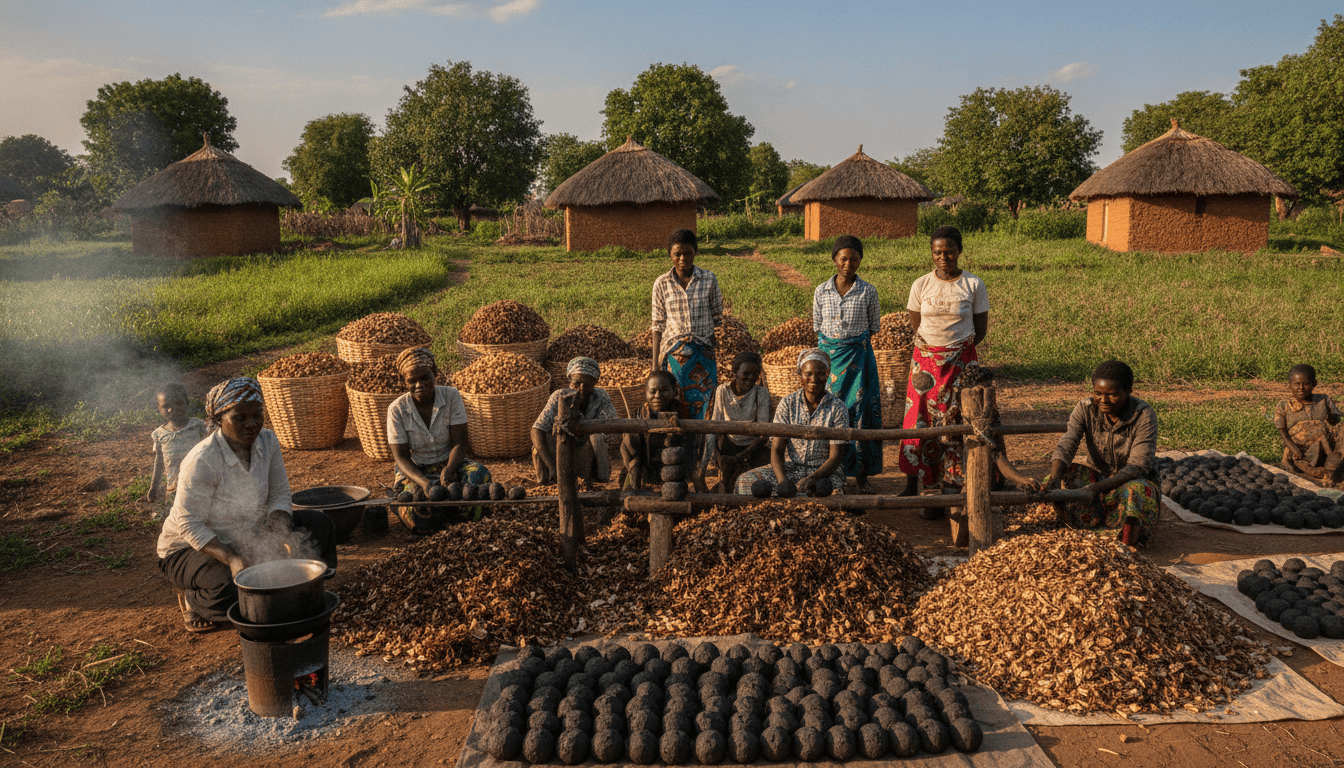
Shea briquettes offer alternative to charcoal as Ugandan women turn husks into fuel
A social enterprise in Alebtong, Uganda is converting shea husks into shea briquettes to replace charcoal, protect shea trees and boost incomes for more than 1,200 local women.
Lucy Everlyn Atim returned to Alebtong this year to find the shea tree of her childhood cut down, a loss that crystallized a broader crisis across northern Uganda where shea trees are being felled for charcoal. Her Moyao Africa Initiative now trains and organizes women to convert discarded shea husks into shea briquettes, a low-cost fuel alternative intended to reduce pressure on indigenous species while creating income. The effort links community training, small-scale processing and partnerships with research bodies as demand for cleaner, cheaper cooking fuel grows.
Shea Trees Cut for Charcoal Across Northern Uganda
Deforestation for charcoal and logging has been identified as a major driver of tree loss in Uganda, with tens of thousands of hectares cleared annually. Indigenous species such as shea and Afzelia africana are among those disappearing from fallow land and communal areas, according to field research by Makerere University. Environmental researchers warn that declines in mature shea numbers and gaps in data on sapling survival complicate efforts to quantify the full scale of the loss.
Field investigators say tracking declines is harder because charcoal producers often uproot trees completely, leaving few visible signs for post-harvest surveys. With roughly nine out of ten households relying on charcoal for cooking, households’ fuel choices remain tightly linked to land degradation. Local activists contend that protecting remaining trees requires both conservation measures and viable fuel substitutes.
Community Training Turns Shea Husks into Fuel
Moyao Africa Initiative runs hands-on sessions in Alebtong where women’s group leaders learn to transform shea husks into briquettes. Trainees follow a step-by-step method: collect husks, dry and crush them, mix with clay and cassava binder, mould the paste, and sun-dry finished briquettes. The process is intentionally low-tech so it can be adopted at village level with basic tools and collective labor.
Practical training moves quickly from demonstration to production, with participants pounding husks in wooden mortars and preparing cassava paste that serves as an adhesive. The initiative also operates environmental clubs in local schools and distributes seedlings in partnership with national agricultural research bodies to promote reforestation and landscape recovery.
Economic Impact for Women Collectives
Moyao Africa Initiative works with more than 1,200 women organized in savings groups to collect husks, produce briquettes and process shea butter, creating multiple income streams. Members say using waste material increases household energy security and reduces expenditure on charcoal, while sales of butter and briquettes provide emergency savings and small profits. Local group leaders report immediate benefits in reduced fuel costs and growing demand from neighbors.
Beyond household savings, participants emphasize the social value of collective enterprise. Women who formerly discarded shea husks now treat them as a resource, and the initiative’s income-sharing model helps cover school fees, medical bills, and other expenses that hinge on small, reliable cash flows.
Equipment Needs and Production Goals
Current production is constrained by seasonality: shea harvests concentrate raw material to a few months, limiting year-round briquette output. Moyao Africa’s plan to expand includes purchasing a carboniser, crusher, and briquette press—equipment estimated to cost about $530—to standardize production and enable cleaner, more efficient briquettes. Organizers project that improving butter processing from 600 litres to 6,000 litres annually would also generate far more husks for fuel manufacture.
Access to affordable machinery would allow the enterprise to move from hand-moulded units toward denser, smokeless briquettes produced by carbonisation, which experts say burn hotter and cleaner. Fundraising and small capital investments are therefore central to scaling operations and meeting rising local demand.
Experts Urge Policy Backing and Local Support
Renewable energy specialists and development practitioners describe the shea husk model as a practical, waste-based substitute for charcoal that can reduce tree felling if scaled. Technical advisers note that carbonisers improve briquette quality and reduce smoke, making them more acceptable to household cooks. However, experts caution that community initiatives need coordinated support to reach impact at landscape scale.
Development analysts argue that Uganda’s existing policy frameworks are sound but implementation gaps limit access to clean energy for rural households. They call for targeted support to grassroots organizations that understand local dynamics and command community trust, suggesting that seed grants, access to machinery, and market linkages would amplify the effect of village-level innovations.
The shea tree that defined Lucy Atim’s childhood may be gone, but her initiative reframes the tree’s waste as a tool for conservation and livelihoods. By converting discarded husks into shea briquettes and expanding butter processing, the Moyao Africa Initiative aims to reduce charcoal demand, keep more trees standing, and provide a steady income to women who collect and process shea—an approach local leaders and experts say could form part of a broader strategy to reconcile energy needs with forest protection.
