
Volkswagen restructuring sparks nationwide worker protests as supervisory board meets
VW restructuring prompts waves of demonstrations at multiple German plants as unions and management prepare for a major overhaul on July 9, 2026.
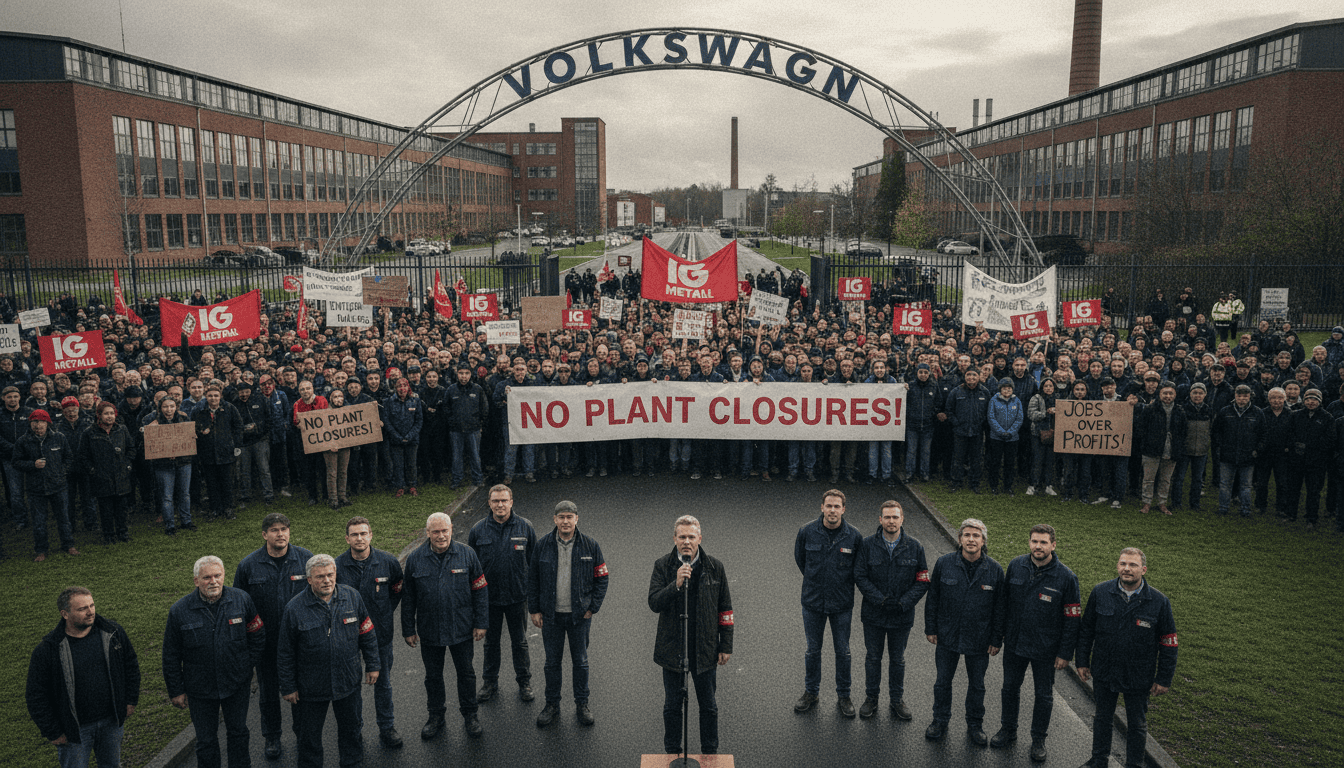
The first day of widespread worker actions unfolded on Thursday, July 9, 2026, as protests cropped up at Volkswagen and Audi sites across Germany in response to a proposed Volkswagen restructuring that could shutter factories and cut tens of thousands of jobs. Union-organized demonstrations began modestly at individual gates but quickly signaled broader unrest as employees demanded clarity and guarantees about plant futures. The unrest coincides with a supervisory board meeting convened to debate a deep organisational overhaul that management says is necessary to restore competitiveness.
Protests mobilize outside Volkswagen and Audi gates
A series of coordinated actions on Thursday saw around one hundred union members gather at Volkswagen’s Osnabrück site to protest threatened production cuts and the possibility of converting automotive lines to defence manufacturing. Flashmob-style demonstrations and vehicle convoys appeared at Audi’s Ingolstadt plant and in Stuttgart, while solidarity pickets formed at multiple VW locations across Germany. Organisers said these initial events were intended to show unity and to escalate pressure if concrete assurances are not provided.
Union leaders framed the demonstrations as a rehearsal for sustained resistance rather than isolated outbursts. Local IG Metall officials called for collective action to protect jobs and plant operations, urging workers across brands and sites to coordinate their responses. The mood among rank-and-file employees ranged from anxious to defiant as many await decisions that may decide the long-term viability of their workplaces.
Supervisory board meets to consider broad corporate overhaul
Volkswagen’s supervisory board convened on Thursday afternoon to discuss a sweeping restructuring plan that management has described as essential to making the group faster and more competitive. Company spokespeople signalled that the meeting would tackle proposals affecting brands, manufacturing footprints and corporate strategy, emphasizing that some capacity reductions are likely. Board deliberations were expected to be lengthy and could extend into the evening as directors weigh options amid intense public and employee scrutiny.
Management has declined to provide full details before the meeting, prompting criticism from employee representatives who decry the lack of transparent communication. Union officials and council leaders said they would be present at worksites and public fora while the board debates the proposals, demanding a seat at discussions that will determine plant destinies and workforce outcomes.
Four German plants and up to 60,000 jobs under review
Internal scenarios under consideration reportedly place four German factories—Hannover, Emden, Zwickau and Neckarsulm—at risk of closure, and suggest up to 60,000 further job reductions could occur worldwide. The affected plants are described by management as oversized and costly relative to future product plans, which has fuelled management’s push for consolidation and efficiency gains. For many workers, the prospect of closure is existential: entire communities and supplier networks could feel the ripple effects.
Audi’s Neckarsulm site, which employs more than 15,000 people, has been highlighted as particularly vulnerable because current model programs there are centered on internal-combustion vehicles and the plant lacks the infrastructure to produce pure electric models. Company planners are said to be assessing timelines that could see production of certain lines phased out over coming years, leaving employees uncertain about retraining, redeployment or severance arrangements.
Unions and works councils escalate solidarity actions
IG Metall and Audi works councils launched coordinated solidarity measures under slogans such as “United to fight for our future,” with prominent union figures appearing at key worksites to rally employees. Local union chiefs criticised the speed and secrecy of management’s planning and demanded detailed transition plans, including retooling, retraining, and concrete timelines before any closure announcements. Union rhetoric has stepped up to warn of a concerted attack on jobs across the entire German automotive sector.
Employee representatives at busy corporate and software units, including those connected to the embattled Cariad software division, said they would not accept unilateral cuts without consultation. Protest organisers signalled that actions could intensify in the coming days if the supervisory board’s decisions fail to protect sufficient job and site guarantees.
Management points to global market pressures and strategic shift
Volkswagen’s leadership, led by CEO Oliver Blume, has framed the restructuring as a response to mounting global pressures, overcapacity and sharply changing demand patterns, arguing that consolidation is needed to ensure the group’s long-term health. Strategic moves under consideration include tighter cooperation with external partners in markets such as the United States, where Volkswagen is building capacity for the Scout brand and exploring local production partnerships with other automakers. Such shifts could reduce export dependence from some German factories.
At the same time, management faces the dual challenge of securing competitiveness while managing the political and social fallout of plant rationalisations. Executives have signalled willingness to accept painful short-term measures to stabilise the company, but have offered limited public detail about the scale and timing of workforce adjustments.
Recent sales data amplify urgency for a course change
Fresh interim figures from group companies have intensified the sense of urgency within the boardroom. Porsche reported a near 20 percent year-on-year drop in deliveries for the first half of the year, marking the lowest six-month delivery volume since 2020 and underscoring demand softness in core segments. Executives cite such performance indicators as part of the rationale for rethinking capacity allocation and accelerating strategic pivots.
Analysts and industry observers say the combination of shifting consumer demand, electrification challenges and rising competition has narrowed the window for incremental adjustments, pushing Volkswagen toward a more radical reshaping of its operations.
The supervisory board’s conclusions and the management plan expected to be unveiled to senior leaders on Friday will determine whether the demonstrations escalate into prolonged industrial action and set the timetable for any plant conversions, closures or job reductions. The outcome will be closely watched by employees, local authorities and international partners as Volkswagen seeks to reconcile competitive pressures with social and political expectations.
