
EU emissions trading reform to slow cap cuts and introduce a flexible price ceiling
EU emissions trading reform will ease near-term industry CO₂ costs with slower cap reductions, a dynamic price ceiling and conditional free allowances.
The European Commission will present a package of changes to the EU emissions trading reform intended to relieve heavy cost pressure on industry while preserving long-term decarbonisation incentives. The proposal, prepared under tight confidentiality, would slow the pace at which emission allowances are withdrawn, create a mechanism to temper price spikes and extend targeted free allocations tied to investment conditions. The package aims to balance concerns from member states and sectors such as chemicals and steel while keeping the EU on a trajectory to reduce emissions.
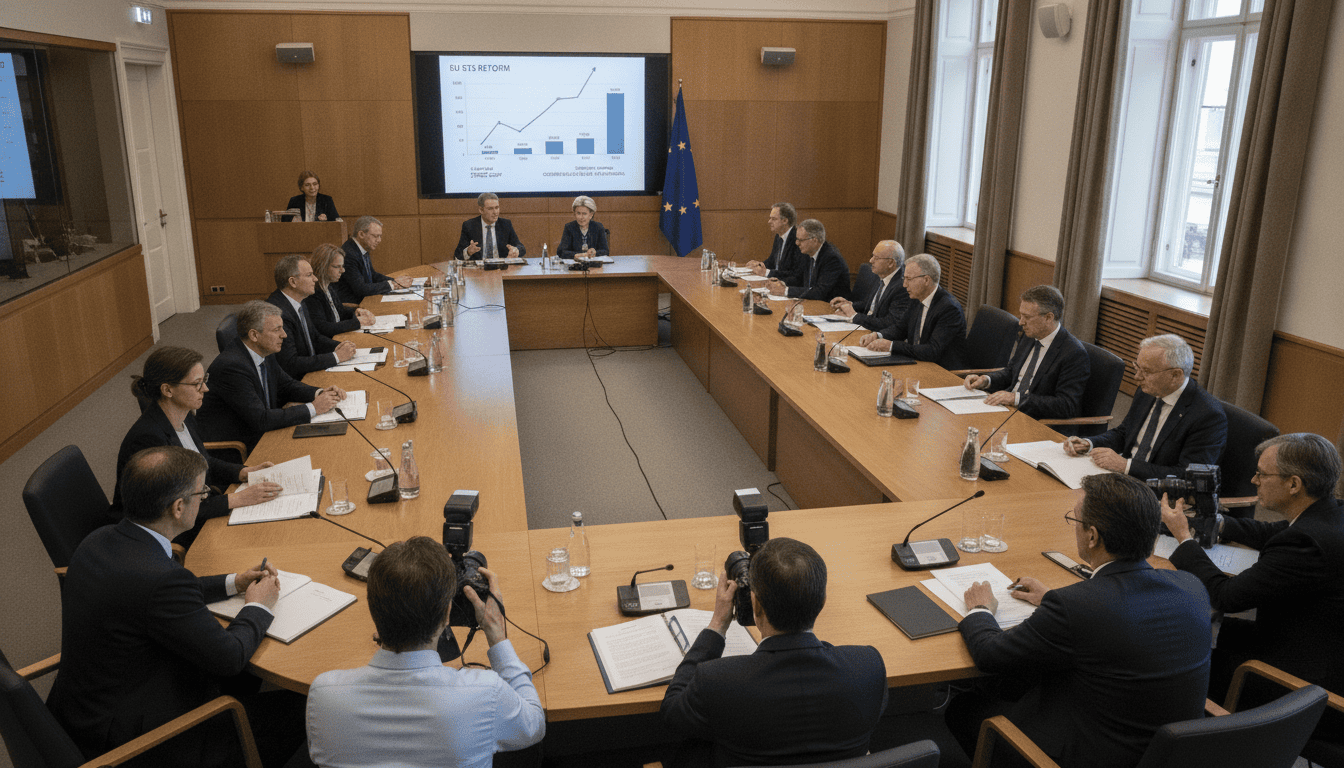
Commission to present ETS reform proposal
The Commission has shielded the draft text from leaks, requiring some officials to review proposals in secure rooms without taking documents away. That secrecy underscores the political sensitivity: several central and eastern member states are pressing for relief while other capitals urge protection for pioneering firms.
President Ursula von der Leyen has urged member states to dedicate a larger share of emissions trading revenues to industrial decarbonisation, pointing to Commission data that only a small fraction of national receipts currently supports clean-industry investments. Brussels wants those funds channeled into grid expansion, hydrogen networks and other enabling infrastructure to make low-carbon production viable.
Three policy levers to ease industry costs
According to the Commission’s plan, three main levers would be adjusted to soften near-term price pressure on carbon-intensive producers. First, the linear reduction of allowances would be moderated so the market receives fewer, more gradual cuts. Second, a new, flexible price ceiling tied to the market-stability reserve would be introduced to limit extreme price spikes. Third, the volume and duration of free allocations to industry would be increased, subject to conditions.
The proposal would reduce the current annual reduction factor — now set at 4.4 percent from 2028 — toward a lower figure expected to be around 3.4 percent, though some member states favour an even milder path. Brussels gained room to manoeuvre after it effectively adjusted the EU’s 2040 CO₂ reduction ambition last autumn, lowering a previous target and easing the pace of allowance withdrawal.
How the “breathing” price ceiling would work
The Commission plans to repurpose the market-stability reserve so it can both absorb and release allowances depending on market conditions, creating what officials describe as a “breathing” price ceiling. Rather than permanently cancelling surpluses, the reserve would retain them as a buffer that can be returned to the market to dampen abrupt price rises.
This design differs from the separate reserve in the new Emissions Trading Scheme II, which will cover buildings and transport from 2028 and is already calibrated to release allowances when prices exceed a fixed threshold. The existing industrial scheme currently trades around €80 per tonne, and the new mechanism aims to prevent sudden spikes that would threaten competitiveness without nullifying carbon-market incentives.
Free allocations and tightened product benchmarks
A core question for industry is how many free certificates will continue to be granted. Under the current framework, sectors exposed to international competition receive roughly 85 percent of entitlements for free to prevent carbon leakage. These allocations are conditional on meeting product-specific CO₂ efficiency benchmarks.
Recent benchmark revisions have been tightened, increasing compliance costs for many producers by an estimated 10 to 20 percent and prompting vociferous appeals from the chemical sector. At the same time, steelmakers that invested early in low-carbon processes warn that broad relaxations would erode the value of their investments and undermine incentives for decarbonisation.
Conditionality, incentives and the risk of bureaucracy
Brussels wants any relief to be conditional: companies that benefit from extended free allocations should reinvest part of the saved funds into decarbonisation projects. Climate Commissioner Wopke Hoekstra has signalled support for tying relief to measurable green investments, but experts caution about implementation complexity.
Analysts from research institutes warn that overly prescriptive rules could replace market-driven incentives with heavy administrative controls, weakening competitiveness and slowing deployment of capital. Policymakers are considering complementary instruments — including the Innovation Fund and a proposed industry decarbonisation bank reportedly backed by €100 billion — to co-finance projects and reduce the need for micromanagement.
Legislative timetable and expedited benchmark review
The Commission intends to fast-track reform of the product benchmarks, with a separate, accelerated proposal designed to take effect quickly and potentially suspend the most recent tightening. That expedited measure could be applied retroactively to September of this year, according to the draft planning, while the remainder of the reform package would require separate votes in the European Parliament and the Council.
Negotiations in Brussels are likely to be intense as member states weigh short-term industrial relief against long-term climate commitments. Any compromise will need to reconcile demands from economies with different energy mixes and industry profiles while ensuring a credible trajectory toward deep emission cuts.
The outcome will reshape how the EU balances industrial competitiveness and climate ambition: a more gradual cap reduction and a dynamic price buffer could ease immediate pressure on vulnerable sectors, but conditionality and targeted spending will determine whether the reform accelerates or delays the transition to low-carbon production.
