
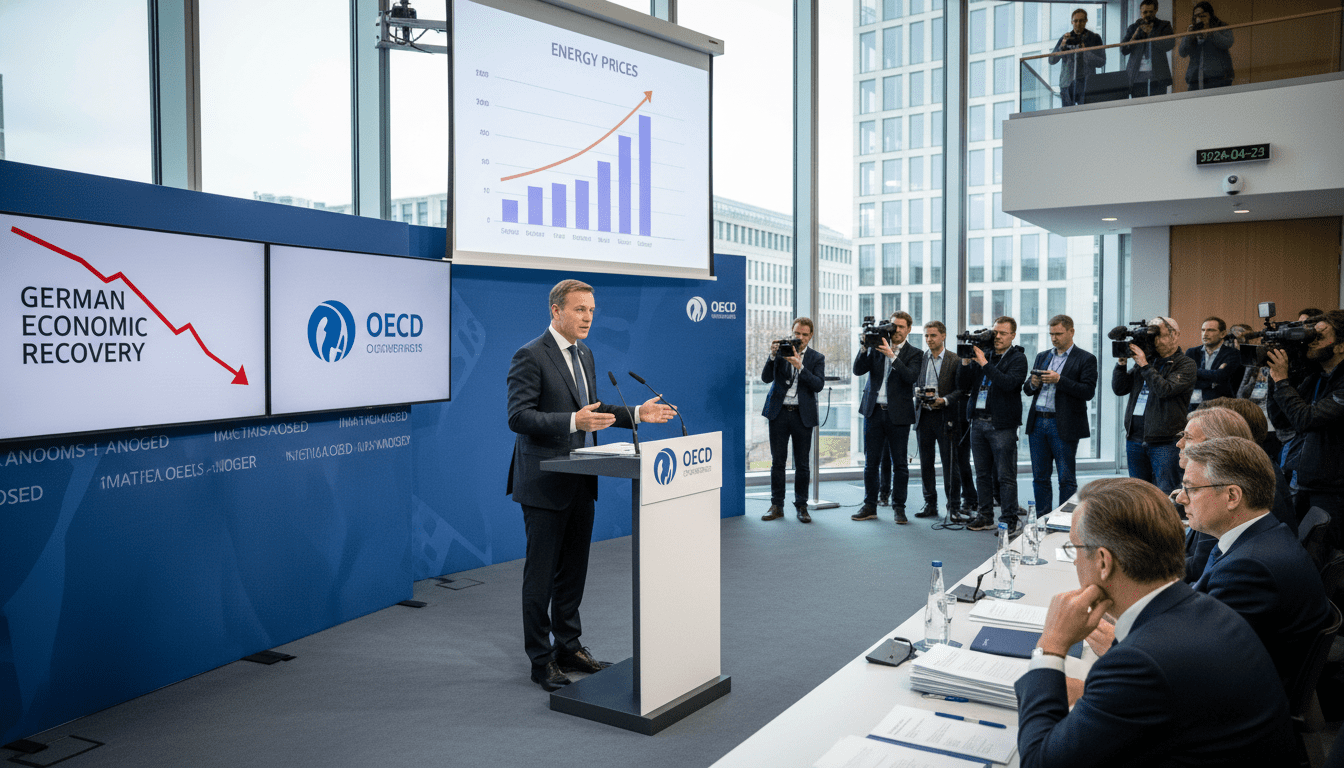
OECD forecast trims Germany growth to 0.7% as energy costs squeeze recovery
OECD forecast lowers Germany’s 2026 growth outlook to 0.7% as rising energy prices threaten the country’s fragile recovery and global growth slows to 2.8%.
The OECD forecast released this week downgrades Germany’s economic expansion to 0.7% for the year, shaving 0.1 percentage point off its projection from the end of March and citing rising energy prices as the primary headwind. The organisation also expects global growth to decelerate from 3.4% last year to 2.8% in the current year, with a modest rebound to around 3.1% in 2027. The report warns that an extended conflict in the Middle East, particularly the war in Iran, would amplify economic and social costs worldwide.
OECD Forecast Lowers Germany Growth Outlook
The OECD forecast signals a clearer slowdown for Europe’s largest economy than previously anticipated, attributing the revision largely to energy market pressures. Germany’s projected 0.7% growth implies a subdued recovery from the shocks of recent years and a weaker pace than many policymakers had hoped for.
Analysts say the downgrade reflects a mix of lower industrial output and softer domestic demand as firms and households digest higher energy bills. The OECD’s adjustment underscores the fragility of the current expansion and raises questions about how quickly momentum can be restored.
Energy Prices Pinch Economic Recovery
Rising energy prices are the central factor cited in the OECD forecast, weighing on manufacturing competitiveness and squeezing household incomes. Firms facing higher production costs may delay investment or pass expenses onto consumers, which in turn dampens consumption and slows growth.
For households, elevated energy bills reduce disposable income and curb spending on non-essential goods and services, putting additional strain on sectors that had been relying on a post-pandemic rebound. The interaction between persistent energy costs and weak demand means the recovery is likely to be uneven across sectors and regions.
Global Growth Outlook and Middle East Risks
Alongside the national figures, the OECD forecast paints a softer global picture, with world GDP expected to slow to 2.8% this year before edging up next year. The organisation highlights geopolitical tensions, particularly in the Middle East, as a major downside risk that could ripple through energy markets and trade channels.
The report cautions that a prolonged war in Iran would magnify economic and social costs globally, disrupting energy supplies and increasing volatility in commodity and financial markets. Such scenarios could force central banks and governments to reassess policy stances and contingency plans in order to stabilise markets and protect vulnerable populations.
Consequences for German Households and Industry
The revised outlook carries tangible implications for families and businesses across Germany, where higher energy costs are already contributing to inflationary pressures. For households on fixed incomes, the squeeze may limit spending and increase reliance on government support programs or targeted subsidies.
Manufacturers and energy-intensive industries face narrower margins and may postpone hiring or capital projects until costs normalise. Small and medium-sized enterprises, which have less capacity to absorb shocks, could be particularly exposed if higher input prices persist and demand remains muted.
Policy Options and Fiscal Challenges
Policymakers will confront difficult choices as they balance support for growth against fiscal sustainability and inflation control. The OECD forecast does not prescribe a single path, but it underscores the need for targeted measures that shield the most affected households and firms without fuelling long-term imbalances.
Options on the table include temporary relief for vulnerable consumers, incentives for energy efficiency investments, and targeted support for industries undergoing structural change. At the same time, authorities must remain mindful of public finances and the risks of prolonged stimulus that could complicate future policy flexibility.
Markets and Business Reactions
Financial markets and corporate leaders are likely to interpret the OECD forecast as a signal to reassess risk and investment plans for the near term. Lower growth expectations typically prompt more cautious capital spending and can influence borrowing costs if market sentiment shifts.
Businesses are already adapting by accelerating energy-saving measures, renegotiating supply contracts, and exploring hedging strategies to limit exposure to volatile fuel prices. The pace and extent of such adjustments will be critical in determining how quickly the economy can regain momentum.
The OECD forecast places a spotlight on the delicate balance between energy markets, geopolitical tensions and economic policy, showing how external shocks can quickly alter a country’s growth trajectory. Policymakers and businesses will need to coordinate responses that stabilise the short-term outlook while fostering resilience for the longer term.
