
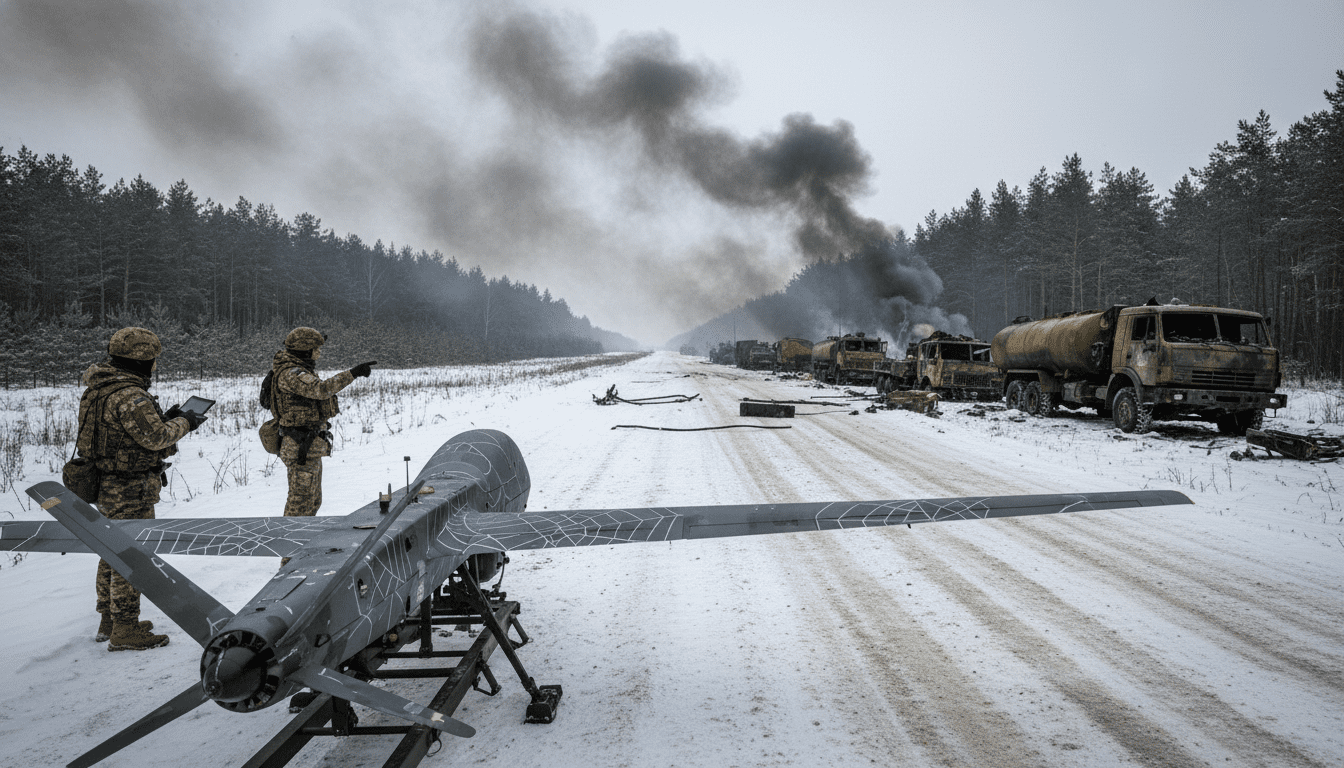
Ukraine’s Operation Spinnennetz Marks Year of Deep Strikes on Russian Logistics
Zelensky says Operation Spinnennetz reshaped the battlefield with long-range drones and commando raids, disrupting Russian logistics, oil and arms production.
Zelensky Frames Operation Spinnennetz as a Turning Point
President Volodymyr Zelensky said Operation Spinnennetz, launched roughly one year ago, has significantly altered battlefield dynamics in the conflict with Russia. He made the statement in an evening video address, describing a campaign that combines long-range unmanned strikes with targeted commando actions behind enemy lines. Zelensky declined to provide operational specifics but emphasized that the effort has forced meaningful disruptions to Russian supply chains.
The president characterized the campaign as asymmetric warfare designed to hit deep into territories temporarily under Russian control. He said Ukrainian forces can now strike Russian military logistics “to the full depth” of occupied zones, leaving few safe supply routes for occupiers in the south and east. The result, according to his remarks, has been mounting shortages in occupied eastern regions and on the Crimean peninsula.
Long-range Drones Target Refineries and Munitions Factories
Ukrainian officials have highlighted development of drones capable of penetrating several thousand kilometers to reach strategic industrial targets on Russian soil. According to Zelensky’s account, primary targets for these systems include oil refineries and facilities involved in the production of weapons and ammunition. The emphasis on energy and arms infrastructure signals a focus on degrading the opponent’s capacity to sustain military operations.
Such strikes, when feasible, aim to create cascading effects across fuel supplies, transport networks and munitions availability. Analysts note that attacks on refinery and arms-production nodes are intended to slow resupply, raise operational costs and complicate logistics planning for Russian commanders. Ukrainian authorities have framed these operations as a calibrated effort to erode the occupier’s military-industrial base without escalating to direct confrontation beyond those targets.
Disruption of Logistics in Occupied South and East
Zelensky specifically described a shrinking of secure lines of communication for Russian forces operating in occupied areas of southern and eastern Ukraine. He said “there are practically no safe roads” for the occupying forces, a claim that points to sustained interdiction of transport routes. Ukrainian officials have linked these interdictions to shortages of fuel, spare parts and ammunition reported in parts of the occupied east and on Crimea.
Military logistics experts say persistent interdiction can stall frontline reinforcements and complicate rotation and resupply plans. When supply corridors are degraded, forward units may be forced to conserve munitions or reduce operations, which in turn reshapes tactical options on the battlefield. The cumulative effect can be attritional, favoring forces that can maintain flexible, dispersed supply ecosystems.
Coordinated Commando Actions Complement Drone Campaign
Beyond aerial strikes, Zelensky noted that Operation Spinnennetz includes coordinated commando raids conducted behind enemy lines. He attributed to these units a role in striking key nodes and creating confusion within enemy rear areas. The combined use of air and ground actions is presented as a force multiplier that amplifies the disruptive effect on logistics and infrastructure.
Special operations forces acting in concert with drone strikes can seize or sabotage critical junctions, destroy matériel and gather intelligence for follow-up attacks. Military commentators say this blend of kinetic and clandestine activity increases the operational reach of Kyiv’s forces while complicating the occupier’s ability to secure rear areas. Zelensky declined to disclose specific operations, citing operational security.
Potential Risks and Regional Security Concerns
Efforts to strike deeply into the territory of a neighboring state carry risks of escalation and legal scrutiny, and those risks are central to assessments of the campaign. Observers warn that sustained attacks on industrial and military infrastructure can prompt political, diplomatic and military responses that must be managed carefully. International reactions to operations that cross recognized borders are likely to factor into Kyiv’s planning calculus.
At the same time, proponents of the campaign argue that degrading an adversary’s capacity to wage war reduces future threats and can shorten conflict duration. The balance between achieving military objectives and avoiding wider escalation remains a persistent theme in commentary from analysts and officials tracking the campaign.
Operational Secrecy and Claims of Effectiveness
Zelensky’s public remarks were notable for both their assertiveness and their restraint on detail, reflecting a pattern of strategic ambiguity. Officials publicly claim significant effects on the adversary’s logistics and production, while withholding granular information that could reveal tactics, timelines or capabilities. That combination seeks to signal capability and intent without compromising operational security.
Independent verification of specific strikes and their long-term impact is difficult in contested areas, where access is limited and information is managed by multiple parties. Still, the combination of long-range drones and commando actions described by Kyiv marks a tactical shift toward deeper, disruptive operations designed to exploit vulnerabilities in supply and infrastructure networks.
One year on, Ukraine presents Operation Spinnennetz as a deliberate campaign to undermine the occupier’s ability to sustain forces across occupied regions and beyond. The operation’s mix of remote aerial strikes and on-the-ground actions reflects a broader evolution in Kyiv’s approach to striking strategic targets while managing the political and military risks of doing so.
