
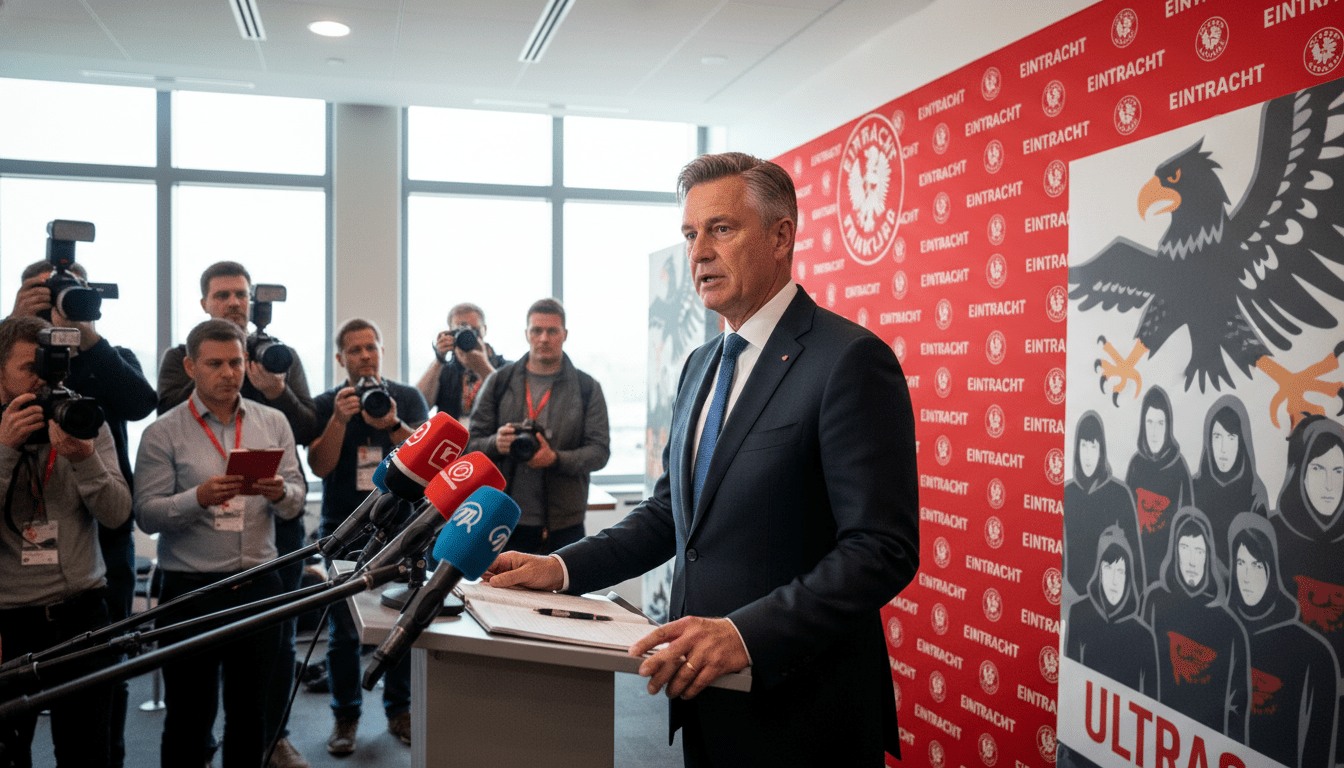
Axel Hellmann Reappointed to Lead Eintracht Frankfurt for Five More Years
Axel Hellmann reappointed to lead Eintracht Frankfurt for five years, tasked with restoring on-field success, stabilizing finances and limiting Ultra influence.
Axel Hellmann will remain at the helm of Eintracht Frankfurt’s football operations for another five years, the club confirmed on Monday. The reappointment places Hellmann at the center of a complex mandate: revive sporting performance, secure financial stability and address a rising concentration of influence among the club’s most vocal supporter groups. The decision intensifies scrutiny of how the club’s executive leadership will balance short-term results with long-term governance reforms.
Hellmann Reappointed for Five-Year Term
Axel Hellmann’s extension formalizes a continuation of the current board’s strategy and gives him a multi-year horizon to implement change. The five-year term signals confidence from the supervisory bodies but also transfers political responsibility to Hellmann for the club’s immediate trajectory. Stakeholders inside and outside the organization will use the length of the mandate as a metric for accountability.
The reappointment followed internal deliberations about leadership stability after a season that fell short of expectations on the pitch. Club officials emphasized continuity as important for negotiations with players, coaches and commercial partners. Still, public and member scrutiny is expected to remain intense as results and governance measures are monitored.
Sporting Agenda and Squad Renewal
Restoring on-field success ranks highest among Hellmann’s priorities and will shape transfer and coaching decisions this summer. The technical staff and sporting director will be tasked with rebuilding a squad that showed inconsistency in league and cup competitions. Early-season preparation, targeted signings and a clear tactical identity are likely to be the pillars of the sporting agenda.
Performance decisions will also be influenced by budgetary constraints and UEFA competition prospects. Hellmann’s team must balance urgent improvements with sustainable roster planning to avoid the financial pitfalls that can follow short-sighted spending. The next transfer window will be a revealing test of how the club translates strategy into action.
Financial Pressures and Strategic Planning
Financial stability is a parallel imperative for the new term and will shape investment in personnel and facilities. The club faces the recurring challenge of funding competitiveness while maintaining a responsible wage structure and adhering to licensing rules. Hellmann is expected to emphasize diversified revenue streams, including sponsorship, matchday income and international commercial initiatives.
Longer-term projects such as academy development and stadium enhancements will remain on the agenda, but their timing may be adjusted to reflect cash flow and sporting needs. Investors, lenders and governing bodies will watch the club’s budgetary discipline closely, making transparent financial reporting a priority in the months ahead.
Governance and the Challenge of Ultra Influence
One of the most sensitive tasks for Hellmann is addressing the growing influence of the Ultras within club decision-making and public discourse. The reappointment statement acknowledged the need to maintain open dialogue with supporters while preventing any single group from exerting outsized power. That balance will require a mix of formal governance measures and sustained engagement on matchday culture.
Club management must navigate legal, ethical and safety considerations when responding to fan pressure on issues ranging from stadium access to political statements. Strengthening institutional governance and clarifying channels for supporter input will be central to reducing tensions. How Hellmann handles this matter may reshape relations between the club and its most committed followers for years to come.
Cooperation with Markus Krösche and Technical Leadership
The tandem leadership at Eintracht — with Markus Krösche prominent in sporting operations — will be crucial to delivering on the board’s objectives. Hellmann’s role is to steer the organizational strategy while coordinating closely with Krösche on recruitment and player development. Clear delineation of responsibilities will be important to avoid internal friction and ensure coherent decision-making.
Observers will look for early signs of alignment in scouting priorities, contract policy and the integration of youth prospects into the first team. The success of the partnership will be measured quickly by summer moves and preparation ahead of the new season. Effective collaboration could accelerate the club’s return to competitive form.
Immediate Tests: Preseason, Transfers and Public Confidence
The weeks ahead represent an immediate test of Hellmann’s renewed mandate, beginning with transfer market activity and preseason planning. Results in friendlies and early competitive matches will shape public perception and the board’s room for maneuver. Restoring confidence among members, partners and sponsors will require visible progress on both the pitch and in governance.
Public statements from fan groups, former players and political stakeholders are likely to increase pressure on the club to demonstrate decisive leadership. Hellmann’s communications strategy will matter as much as policy changes, since transparency can help defuse disputes and rebuild trust. The club’s ability to deliver measurable steps in the short term will determine whether the five-year term is seen as an opportunity or a gamble.
The next chapter for Eintracht Frankfurt under Axel Hellmann will hinge on delivering improved results, strengthening institutional checks and maintaining a constructive relationship with its supporters. The board’s extended mandate provides time to pursue structural reforms, but it also raises expectations that concrete progress must follow quickly.
