
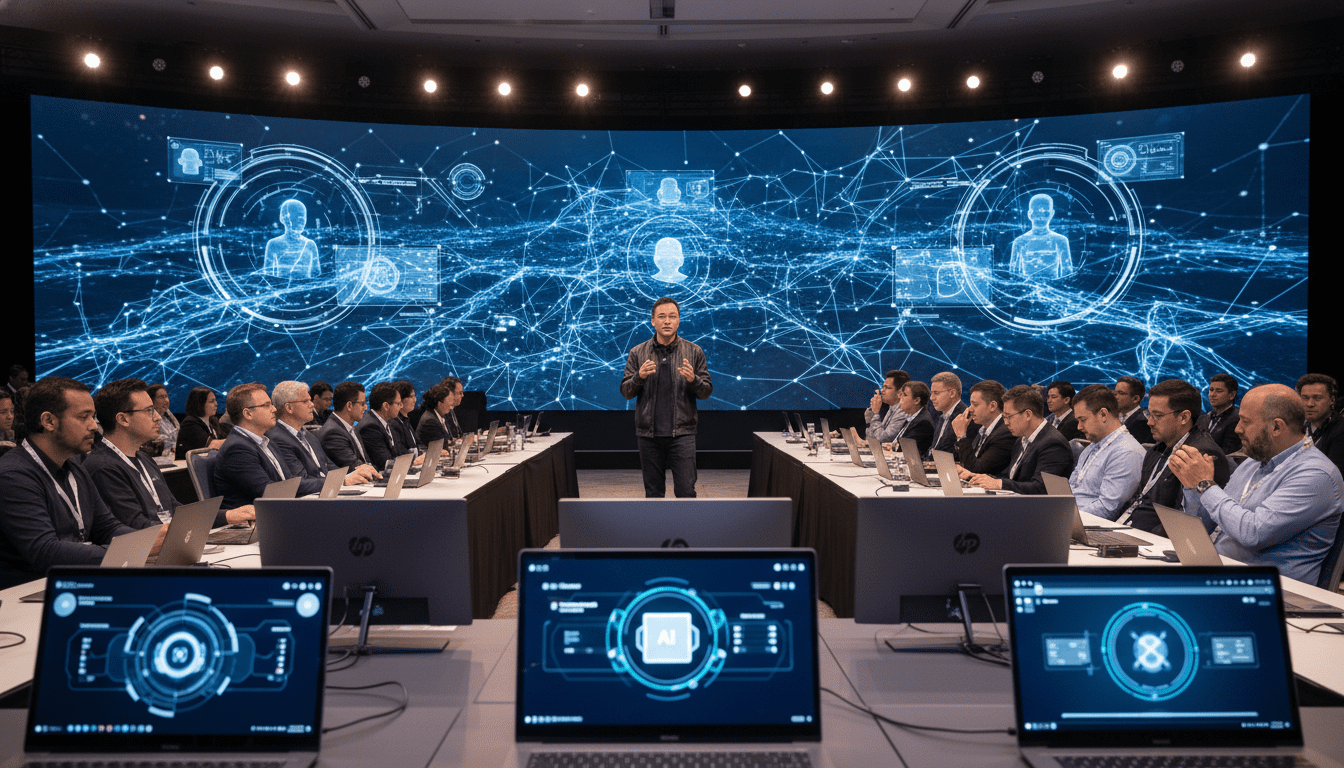
Nvidia unveils PC designs with Dell, MSI, Asus and Acer to bring personal AI agents to consumers
Nvidia showcased reference PCs from Dell, MSI, Asus and Acer designed to run personal AI agents, promising devices that could arrive this autumn and reshape everyday computing.
Nvidia demonstrated a lineup of partner-built machines intended to make personal AI agents available to ordinary users. The company displayed prototype desktops and laptops from Dell, MSI, Asus and Acer and said the systems are optimized to host on-device AI assistants. Executives described the effort as the next step in moving generative AI from cloud experiments into everyday personal devices.
Partner devices on show
The company placed finished systems from major original equipment manufacturers on stage to illustrate how its hardware will be used in practice. Models from Dell, MSI, Asus and Acer were shown side by side, with Nvidia stressing they represent reference designs rather than final retail configurations. Company representatives said these partner systems will be tailored by each vendor for different form factors and price points.
Each OEM will integrate Nvidia’s chips and software stack to support local AI workloads, the company said during the demonstration. The machines were presented as examples of what consumers can expect when manufacturers begin shipping later this year. Executives emphasized that the goal is broad availability across mainstream PC categories rather than niche premium devices.
Autumn launch window and availability
Nvidia indicated a general timeline for the new devices, suggesting partners aim to ship consumer models starting this autumn. The vendor-level schedule anticipates staggered rollouts, with some manufacturers releasing products earlier in the season and others following at retail. Availability will vary by market and model, and pricing decisions remain with the OEMs.
Retail timing will also depend on software maturity and regional certification processes, company spokespeople noted. Consumers should expect initial inventory to focus on higher-tier machines capable of running advanced models locally, with more affordable options following as ecosystems and supply chains adjust.
Vision for personal AI agents
Nvidia framed the initiative around its vision for “personal AI agents”—autonomous, privacy-aware assistants that run on a user’s own hardware. The company argued these agents can perform tasks without constant cloud connections, allowing faster responses and greater control over personal data. Jensen Huang, Nvidia’s chief executive, described the move as enabling digital helpers that can act on behalf of users across applications.
The proposed agents are intended to handle a range of chores, from drafting messages to managing household schedules, and to learn user preferences over time. Nvidia’s strategy pairs specialized chips with optimized models and tools so OEMs can deliver a consistent experience across different hardware.
Industry reaction and Qualcomm’s stance
Other chipmakers and industry leaders have framed similar ambitions around on-device intelligence. Qualcomm’s chief executive, Cristiano Amon, reinforced the broader industry shift by saying agents will form the core of the “new digital experience.” That comment highlights how multiple suppliers see autonomous assistants as a foundational element for future computing platforms.
Analysts note the market is evolving from cloud-centric AI services toward hybrid approaches that balance local processing with cloud resources. Competitors and partners alike are recalibrating product roadmaps to accommodate models that can run efficiently on personal devices while still leveraging cloud services for heavier workloads.
Technical and privacy considerations
Running capable AI agents on consumer PCs raises technical demands for power, cooling and model optimization, industry engineers say. Manufacturers will need to balance raw performance with battery life in laptops and design thermal solutions that support sustained AI workloads. Software frameworks and model compression techniques will be key to delivering practical performance on a range of hardware.
Privacy and data governance are central to the pitch for personal AI agents, since local execution reduces the need to send sensitive information to remote servers. Still, experts caution consumers should scrutinize vendor privacy policies, local storage handling and update mechanisms to ensure that on-device agents deliver the promised advantages without creating new risks.
Nvidia also highlighted tools for developers to build and tune agents, stressing interoperability with existing applications and cloud services. The company expects a growing ecosystem of third-party software and services that will adapt agents to specific tasks and industry needs.
The devices shown from Dell, MSI, Asus and Acer are intended to demonstrate how mainstream PCs will evolve to host these capabilities. The broader market response will depend on pricing, battery and thermal engineering, and the availability of applications that make agents genuinely useful to everyday users.
Consumer adoption will hinge on how convincingly OEMs and software partners can translate the technical potential into reliable, easy-to-use experiences. If manufacturers meet the promised autumn timelines and developers deliver compelling agent-based applications, personal AI agents could become a visible feature in the next generation of consumer PCs.
