
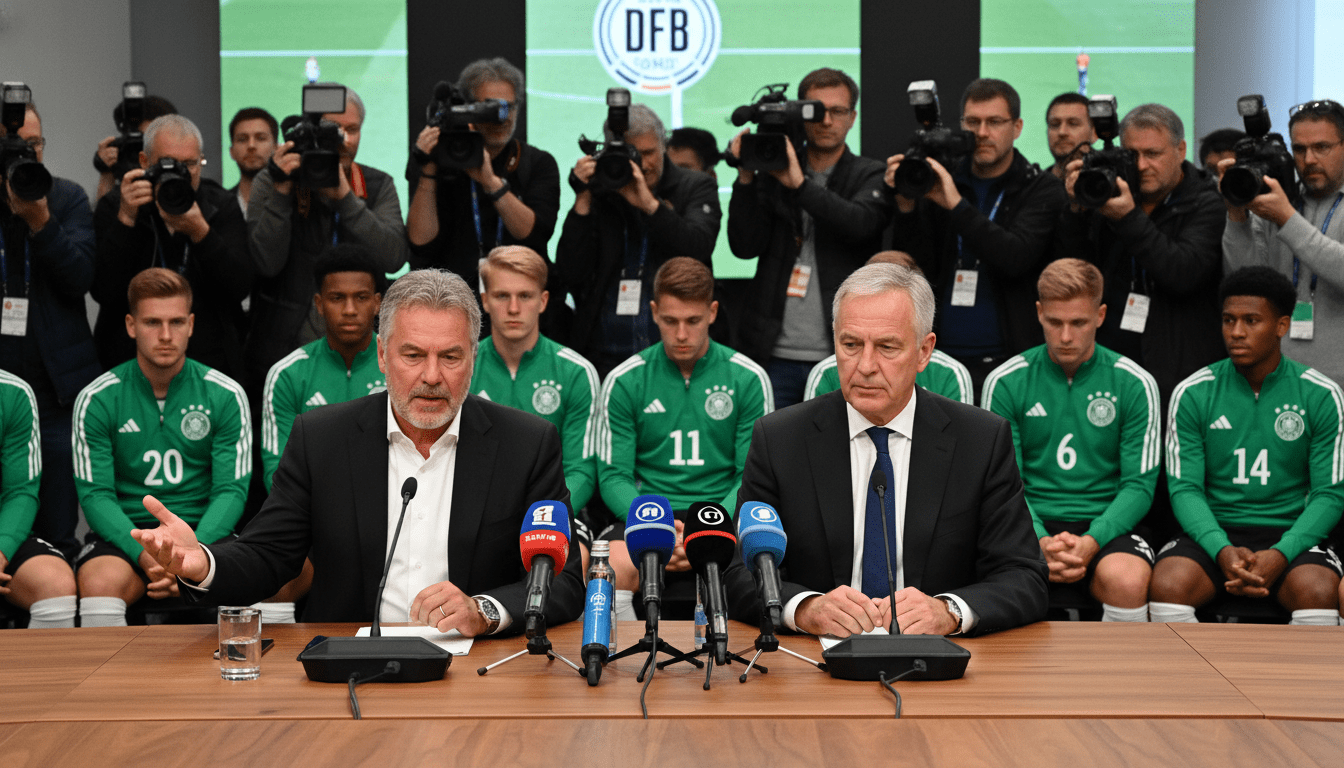
DFB controversy intensifies after press conference remarks by Rudi Voeller
Rudi Voeller’s remarks at a DFB press conference sparked a renewed DFB controversy over the federation’s handling of politics, player conduct and ties to FIFA ahead of the 2026 World Cup.
The German Football Association (DFB) found itself at the center of a new controversy after sport director Rudi Voeller was pressed by reporters during the national team’s media day in Herzogenaurach. Voeller’s response to a question about only two players stopping for children at the team arrival drew attention, and his broader comments about political expression and the federation’s stance have revived public debate. The episode has widened into scrutiny of the DFB’s relationship with FIFA and the role of President Bernd Neuendorf, whose limited public appearances have raised additional questions.
Voeller’s response at Herzogenaurach
Voeller was asked whether the DFB expects players to stop and greet fans after team arrivals, and he initially deflected with an offhand remark before acknowledging the question. His tone and a pointed aside to the reporter — praising the counting of players — were seized on as emblematic of a federation uneasy under pressure. Observers noted that Voeller attempted to balance a light-hearted public persona with a defensive posture on behalf of the squad. The exchange has left commentators asking whether the DFB is prepared to insist on clearer standards of conduct from players in public settings.
Player conduct and public expectations
The immediate trigger for the exchange was the observation that only two of 27 players paused to greet children waiting at the team arrival, a detail that quickly became symbolic. Critics argued that small gestures matter for public relations and for a national side that claims to value community engagement. Supporters of the players countered that arrivals are logistically complex and that not every moment can be scripted without disrupting team routines. The incident, however minor on its face, has amplified demands for consistent guidance from the DFB about how players should behave at public events.
Politics, FIFA and the limits of neutrality
Beyond the anecdote about fan interaction, Voeller was asked about political expression by players ahead of the 2026 World Cup, and he reiterated that there were “no muzzles” on players’ speech. Yet he also suggested that, to date, public criticism by players had not been an issue and implied that such restraint was likely to continue. That apparent hedging reopened a long-standing debate about whether football federations can, or should, separate sport from politics. Critics point to FIFA decisions and awards that tied football institutions to contentious political figures as natural catalysts for the politicization of the game.
Neuendorf’s limited visibility and FIFA ties
Bernd Neuendorf, the DFB president and a member of the FIFA Council, has faced questions about his limited media engagement since taking a higher profile in the run-up to the tournament. In a recent interview he defended procedural aspects of FIFA’s decisions but fell short of outright criticism of controversial choices, a stance that has frustrated some observers. The contrast between Neuendorf’s guarded public posture and the more candid exchanges allowed of Voeller has prompted calls for greater transparency from the federation’s leadership. Critics have urged Neuendorf to answer substantive questions about the DFB’s influence within FIFA and about the federation’s principles on human rights and political expression.
Media and public reaction ahead of the World Cup
The press exchange quickly circulated through German media and social platforms, with commentators using the episode to revisit broader concerns about governance and moral clarity in football. Op-eds and pundits have questioned whether the DFB is sufficiently assertive in defending player autonomy while also maintaining a coherent public image. Fans, meanwhile, expressed a mix of annoyance and indifference: some demanded symbolic gestures by players, others prioritized on-field performance over choreographed arrivals. The debate has underscored how quotidian moments can be amplified into national conversations in the months before a major tournament.
Implications for DFB governance and messaging
The unfolding DFB controversy poses a communications challenge for the federation as it readies the national team for competition in 2026. Clearer policies on public appearances, and more consistent messaging from the president’s office and sporting directors, would reduce uncertainty and defuse media-driven disputes. The federation also faces a strategic choice about how it engages with FIFA decisions that carry political weight, balancing institutional relationships with public expectations. How the DFB addresses these questions in the coming weeks will shape perceptions of its leadership well beyond the immediate episode.
Whatever immediate steps the DFB takes, the incident has made plain that routine interactions and evasive answers can quickly accumulate into larger questions about transparency, conduct and the political responsibilities of sporting bodies as the World Cup approaches.
