
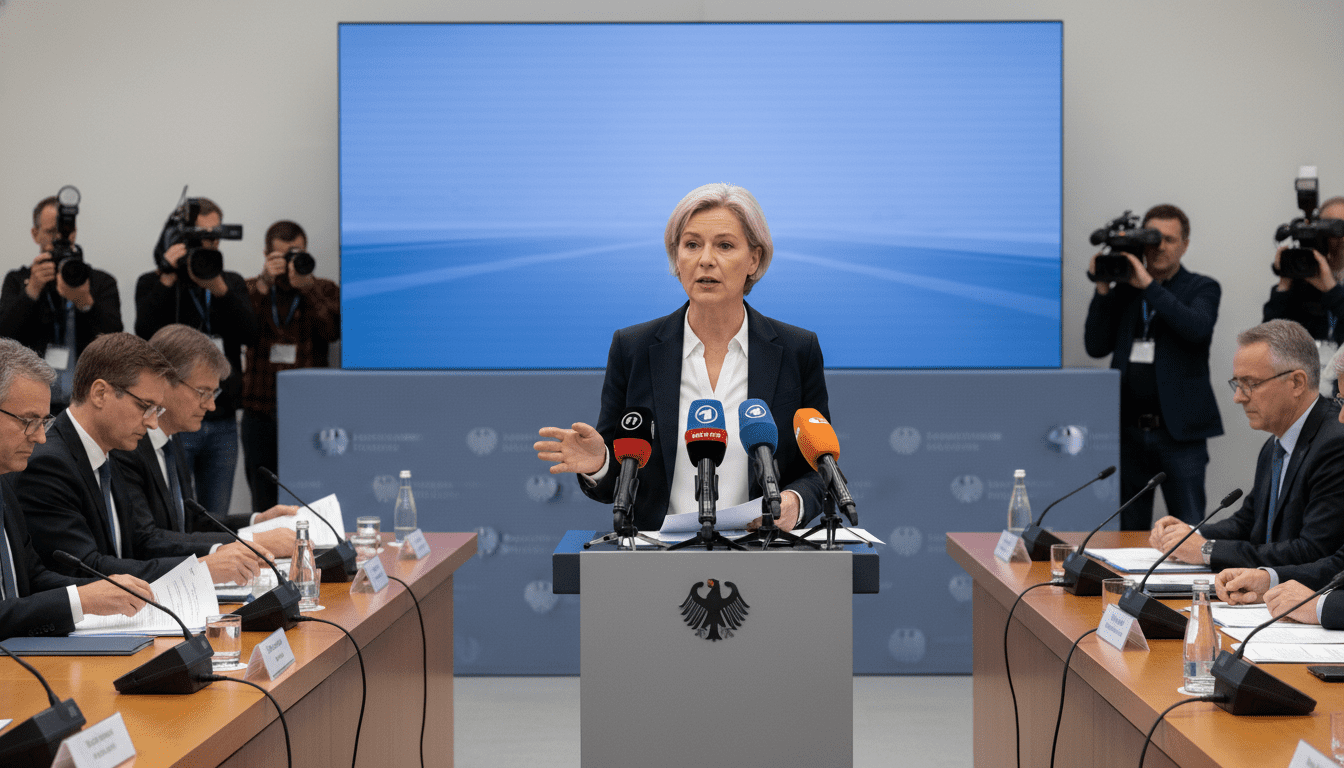
Germany’s Environment Minister Defends Renewable Energy Amid Coalition Rift
Environment Minister Schneider defends renewable energy, warns of offshore wind uncertainty, and outlines climate, circular-economy and grid plans amid coalition tensions.
Environment Minister Schneider on Sunday defended Germany’s renewable energy agenda while navigating a series of political and technical obstacles that have slowed legislative progress within the coalition. Schneider, speaking after a Bundestag parliamentary football match in which he suffered an ankle ligament injury, reiterated that renewables remain the most secure and cost-effective route to break energy dependence and protect national interests. The minister framed recent disputes with Economy Minister Reiche over solar support and a proposed “redispatch” rule as part of a broader effort to balance investor certainty, grid stability and local acceptance.
Bundestag team victory and minister’s ankle injury
Schneider said he did not score in the parliamentary team’s European championship match because he plays in defence and sustained a ligament tear early in the game. He described wearing comfortable sneakers and limping after the injury, noting that the incident was lightheartedly met by family warnings to avoid further exertion.
The anecdote served as a preface to a longer interview in which Schneider used the match to underscore the need for pragmatism: small setbacks should not derail broader objectives, he said, and political debates over policy must remain focused on outcomes rather than headlines.
Coalition tensions rooted in economic expectations and global shocks
Schneider acknowledged that optimism about the coalition’s economic prospects had outpaced reality, attributing shifting expectations in part to domestic campaign promises and misreadings of the economic landscape. He singled out external pressures — changes in U.S. trade policy, geopolitical tensions in the Middle East, and China’s evolution into a competitor — as factors that have reshaped market conditions and Germany’s strategic position.
He warned that reliance on cheap energy from countries such as Russia exposed the country to undue leverage and argued that renewable energy offers both strategic security and economic opportunity. Despite the setbacks, Schneider said Germany still commands international respect for its efficiency and governance, and that many partners look to emulate German approaches.
Dispute over solar support and the case for citizen participation
The minister pushed back on proposals in Economy Minister Reiche’s draft of the Renewable Energy Act that would scale back solar subsidies, calling the move counterproductive in a time of fossil-fuel volatility. Schneider argued that withdrawing support risks sidelining the very households and communities that can and should participate in the energy transition.
He emphasized that photovoltaics are not solely the province of the affluent, citing examples from rural Thuringia where rooftop installations are common and house values remain modest. To boost acceptance, Schneider advocated for participatory models such as citizen cooperatives and local revenue-sharing for wind projects, which he said have demonstrably increased community support in areas like Gießen.
Offshore wind uncertainty and earmarked auction revenues for marine protection
Schneider addressed reports that major energy firms including TotalEnergies and BP were considering withdrawing from offshore wind leases because projects had become less economically attractive. He warned that companies must honour contractual obligations, saying that penalties should apply if firms pulled back from projects critical to the national energy mix.
The minister also outlined the intended use of auction proceeds, noting that a portion of the revenues has been allocated to marine conservation. He said that 400 million euros would be placed with the Deutsche Bundesstiftung Umwelt as an endowment to fund ocean protection, with roughly ten million euros a year earmarked for concrete projects, and acknowledged the auction landscape has been uneven, with some 2025 bids failing and 2026 rounds suspended.
Redispatch concerns, grid expansion and investment risk
Schneider cautioned that a proposed “redispatch” safeguard in current grid legislation could undermine investor confidence by removing predictable revenue streams when projects are curtailed. He argued that higher perceived risk leads to higher financing costs and could stall planned expansions, including the minister’s target to support thousands of new wind turbines onshore.
To mitigate those risks, Schneider pointed to planned upgrades to transmission capacity expected in 2027 as a key enabler for integrating more renewable generation. He said the government must align support mechanisms with the grid expansion timeline to avoid creating stop-start dynamics that would deter private capital.
Climate targets, circular economy action, and nature restoration plans
Responding to expert criticism that current plans may fall short of climate goals, Schneider said the government stands by its ambitious targets and is prepared to monitor and adjust measures where necessary. He highlighted wind deployment, an electric vehicle incentive programme, and an asserted aim to deepen emissions reductions by 2030 as central pillars of the climate strategy.
On the circular economy, the minister promised a forthcoming action programme that will leverage public procurement to create demand for reused and recycled materials. He also defended plans to prioritize restoration on roughly 20 percent of land and sea through habitat renewal and larger biotope networks, stressing collaboration with farmers and local stakeholders rather than coercive measures.
Schneider framed these initiatives as complementary: stronger natural infrastructure, accelerated renewable deployment and economic incentives for circular industries together underpin Germany’s long-term resilience and competitiveness.
The minister said resolving the outstanding legislative and technical issues will require continued negotiation within the coalition, with a focus on preserving momentum for the energy transition while ensuring social participation and investor certainty. He urged all parties to avoid abrupt policy reversals that would increase costs and delay the deployment of renewable energy across the country.
