
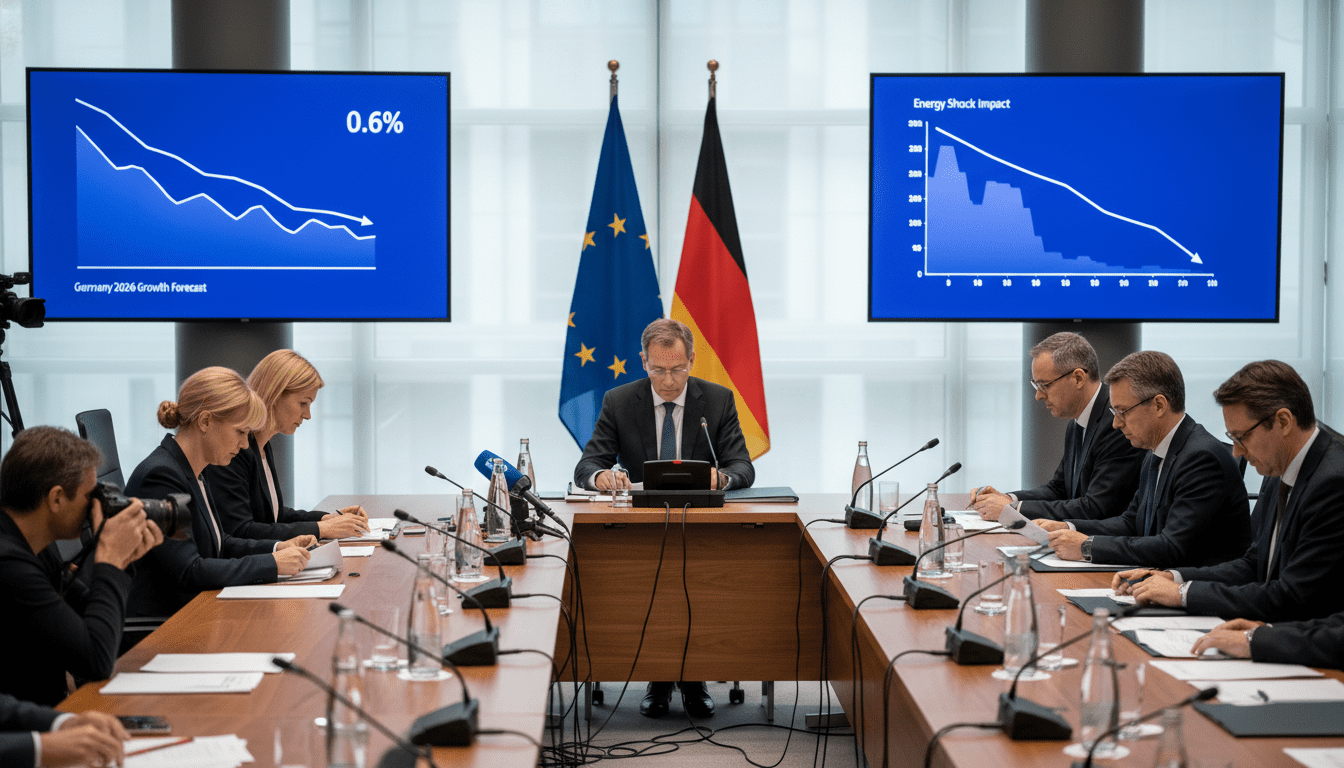
EU Commission halves Germany growth forecast to 0.6% amid energy price shock
EU Commission cuts Germany’s 2026 GDP growth forecast to 0.6%, citing high energy prices after Iran conflict; EU and eurozone forecasts also slightly trimmed.
Germany faces a substantially lower growth outlook after the EU Commission halves Germany growth forecast, projecting just 0.6% GDP expansion for 2026. The revision marks a sharp reduction from last autumn’s 1.2% projection and signals elevated downside risks for Europe’s largest economy. The Commission links the downgrade to rising energy costs triggered by the late-February outbreak of the Iran conflict and its impact on global markets.
EU Commission halves Germany growth forecast
The European Commission’s economic team cut its forecast for German GDP growth by 0.6 percentage points compared with its autumn estimate, leaving a 0.6% projection for 2026. That magnitude of revision is larger than for most member states and highlights Germany’s sensitivity to external shocks, according to the Commission statement. Officials noted the contrast with expectations for the wider EU and the eurozone, where revisions were smaller.
Germany now projected to grow 0.6% in 2026
Under the revised outlook, Germany’s economy is expected to expand modestly next year, with weak domestic demand and higher energy bills weighing on activity. The Commission said forecasts had previously assumed a moderate recovery and easing inflation before the conflict began. Analysts warn that persistent energy price volatility could suppress household spending and business investment, tempering the pace of recovery.
EU and eurozone outlook also revised downward
The Commission trimmed its growth projection for the European Union as a whole from 1.4% to 1.1% for 2026, while the 21-country eurozone is now seen expanding by 0.9%. Those reductions reflect a region-wide exposure to elevated import costs for energy and commodities following the Middle East disruption. Despite the downgrades, the Commission indicated that some member states with lower energy dependence or stronger domestic demand may still outperform the regional averages.
German government forecast was already lower
Germany’s federal government had signalled an even more cautious view at the end of April, when it halved its own 2026 forecast to around 0.5%. The government’s estimate and the Commission’s 0.6% projection together suggest a broad consensus that growth will be much weaker than assumed late last year. Policymakers face a narrowing set of options: stimulating demand risks feeding inflation, while tightening budgets could deepen the slowdown.
Energy shock from the Iran conflict behind downgrade
The Commission attributed the revisions primarily to an energy shock tied to the conflict that began in late February, saying EU economies—which import more energy than they export—are particularly vulnerable. Higher oil and gas prices raise production costs and reduce real incomes for consumers, a combination that typically slows GDP growth. The statement stressed that the degree of impact will depend on how long price pressures persist and whether supply routes stabilise.
Market and policy implications for Germany and the EU
Financial markets and businesses are likely to revisit investment plans in response to the weaker growth outlook, especially in sectors with heavy energy intensity. Euro-area policymakers will monitor inflation and employment data closely to balance support for the economy against the risk of reigniting price pressures. The Commission’s update leaves room for further revisions if the geopolitical situation or energy markets change materially in the coming months.
Taken together, the Commission’s downgrade underscores the fragility of the current recovery and the outsized role of energy costs in shaping near-term growth prospects. Observers say the pace of rebound in Germany and across the EU will hinge on whether energy markets calm and whether fiscal and monetary authorities can steer policy without undermining stability.
