
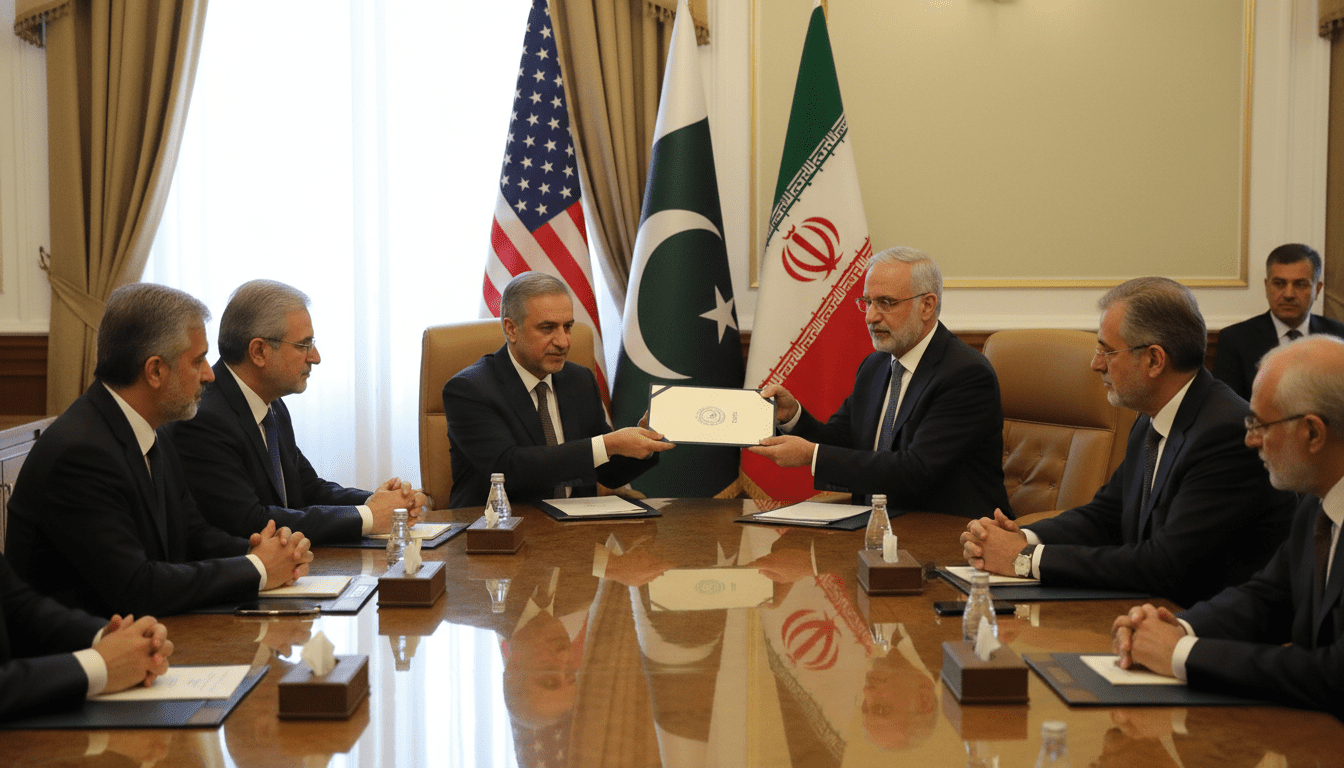
Iran sends response to US proposal via Pakistan, agency says
Iran has sent its response to the latest US proposal through Pakistan, the Islamic Republic News Agency reported on May 10, 2026, saying negotiations at this stage will focus on ending the war.
The Iran response to US proposal was delivered through a third-party channel, IRNA said, without providing further public details about the contents of the reply or the precise mechanisms of transmission. Officials in Tehran framed the move as a step toward negotiations that would prioritize measures to stop active hostilities.
State news agency reports dispatch and focus on ending the war
IRNA published the brief dispatch on May 10, 2026, stating that Tehran had forwarded its reply to what it described as the “latest US proposal” via Pakistan. The report said current negotiations would concentrate on ending the war, but offered no text of the response or a timeline for follow-up talks.
The agency gave no information about whether Washington had acknowledged receipt or whether Pakistan had formally confirmed its role in relaying the message. Independent confirmations from other diplomatic channels were not immediately available at the time of the report.
Pakistan identified as the transmission channel
IRNA’s account named Pakistan as the intermediary through which Iran sent its answer to the US. The report did not indicate whether Pakistani officials had been briefed publicly or whether the transmission was conducted through diplomatic, intelligence or back-channel routes.
There was no immediate public comment from Islamabad in response to the IRNA report. Historically, third-party states often serve as conduits for sensitive exchanges between rival capitals, but the specific arrangements for this transmission were not described in the agency dispatch.
What ‘ending the war’ could encompass
IRNA’s statement that negotiations would “focus on ending the war” leaves room for a range of diplomatic objectives, from a temporary ceasefire to negotiated steps toward de-escalation and humanitarian relief. Such language commonly signals interest in talks on cessation of hostilities, civilian protections, and mechanisms for delivering assistance.
Analysts note that the phrase can also cover phased arrangements — for example, pauses in fighting tied to aid corridors, exchange of prisoners, or verification measures — though IRNA did not specify which of these, if any, were under discussion. The absence of detail means observers will be watching for subsequent clarifications or ancillary announcements.
Context of indirect communications between Tehran and Washington
Direct diplomacy between Iran and the United States has long been limited, with both sides frequently relying on intermediaries to exchange proposals and responses. Third-party intermediaries have been used in the past to convey offers, test parameters and preserve plausible deniability while keeping channels open for more substantial negotiations.
The brief IRNA report fits within that pattern: a terse public confirmation of contact without disclosure of the substance. Such disclosures can be intended to shape domestic political narratives as much as to communicate with foreign capitals.
Potential next steps and international implications
If Washington acknowledges receipt and signals willingness to pursue talks, practical next steps could include setting terms for face-to-face meetings or continuing mediated exchanges through Pakistan or other intermediaries. International organizations and regional governments are likely to monitor developments closely, particularly if the stated aim is an end to active hostilities.
Independent verification from other parties involved, including a response from the US, will be crucial to determine whether the exchange represents a substantive shift or a preliminary diplomatic probe. Observers will also look for indications of timelines, negotiating venues, and any linkage to humanitarian operations.
The unfolding exchange places pressure on both capitals to clarify intentions and on intermediaries to manage logistical and confidentiality concerns. How the process proceeds will affect regional stability and the prospects for immediate humanitarian relief where fighting persists.
Public and diplomatic expectations hinge on confirmation and details that have yet to appear, leaving the international community awaiting further signals from Tehran, Islamabad and Washington.
For now, IRNA’s May 10, 2026 report provides the first official public notice of an Iran response to US proposal sent via Pakistan and frames the moment as an opening for negotiations centered on ending the war.
