
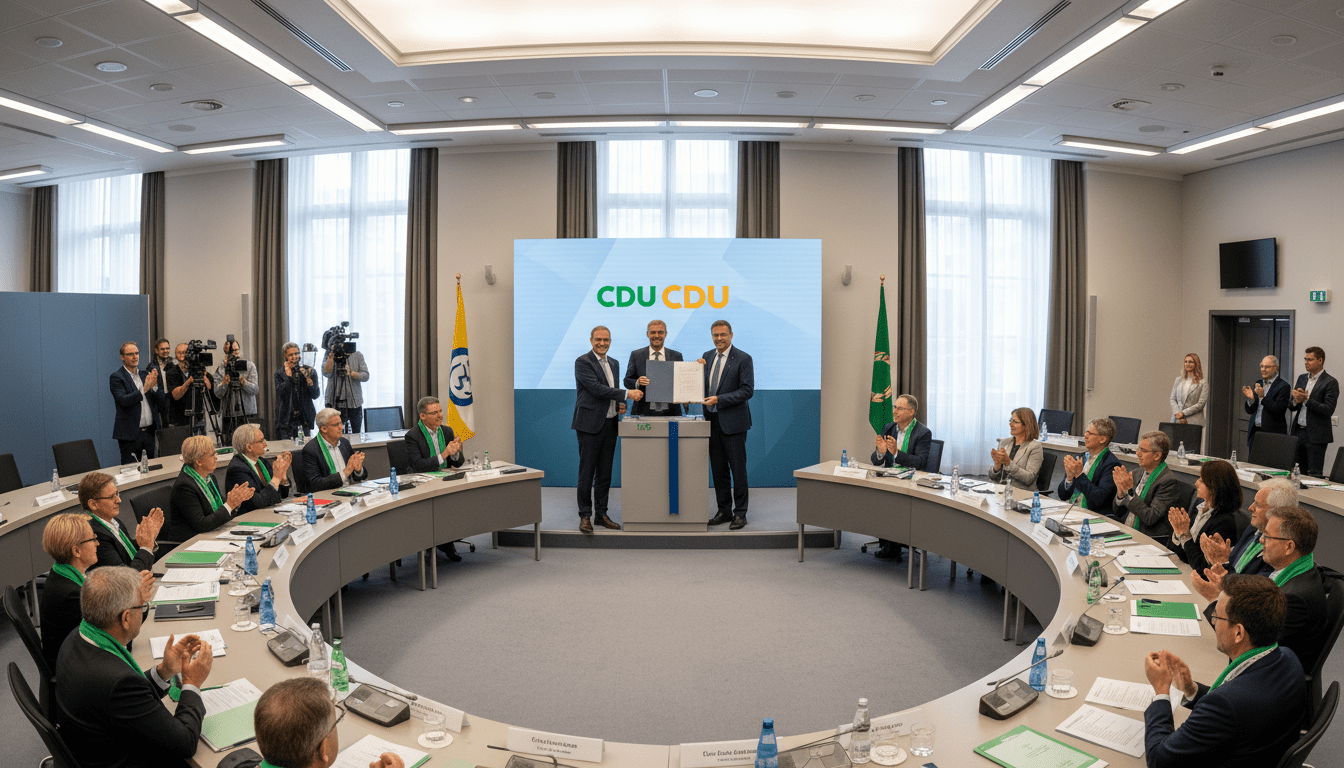
Baden-Württemberg coalition renewed as Greens and CDU approve 160-page agreement
Greens and CDU in Baden-Württemberg have approved a 160‑page coalition pact, clearing the way for a renewed Baden-Württemberg coalition and a fast‑track vote on Cem Özdemir next week.
Green and Christian Democratic delegates on Saturday voted in favour of a coalition agreement that paves the way for a new state government in Baden-Württemberg, ending weeks of negotiation and internal debate. The coalition document, which covers a five‑year agenda, received majority approval at separate party conferences in Stuttgart and Korntal‑Münchingen, even as youth and grassroots critics called the deal insufficiently ambitious.
Party ratifications and internal debates
The Greens endorsed the agreement at a state party congress in Stuttgart, while CDU delegates in Korntal‑Münchingen gave their backing after speeches from senior leaders. CDU state chair Manuel Hagel urged members to accept the pact, framing the arrangement as a partnership of distinct parties rather than a merger.
Hagel told delegates the two sides had “hardly shied away from dispute” in negotiations and emphasised the pact represented a “coalition on equal footing” focused on the interests of Baden‑Württemberg. Dissent came largely from the Green Youth, which criticised the agreement as falling short of the party’s programmatic ambitions and urged stronger climate and social commitments.
Major policies in the 160‑page agreement
The coalition agreement runs to more than 160 pages and outlines measures the partners say will govern the state for the next five years. Among the headline commitments is a plan for a free and compulsory final year of kindergarten, a point highlighted by the Greens as central to early education reform.
The pact also sets out broad administrative and economic measures, including a package to reduce bureaucracy for businesses and streamline public services. CDU figures noted the inclusion of promises they campaigned on during the election, presenting their pact with the Greens as a fulfilment of prior commitments while adapting them to shared governance.
Parliament arithmetic after the March election
The state election on March 8 left the Greens narrowly ahead of the CDU but produced a parliamentary stalemate in terms of seats. Both parties hold 56 seats each in the Landtag, creating a situation in which their cooperation is decisive for forming a stable majority.
Smaller groups hold the balance: the AfD holds 35 seats and the SPD controls ten. The even split between the two largest parties made cross‑party compromise essential and increased the strategic importance of the coalition pact’s detail on budgetary, education and economic policies.
Leadership transition and scheduled votes
The new Landtag is scheduled to convene on Tuesday, May 12, 2026, with a formal vote to elect Cem Özdemir as minister‑president expected on Wednesday, May 13, 2026. If elected, Özdemir would succeed Winfried Kretschmann of the Greens, who stepped aside and did not stand for re‑election due to his decision to retire from frontline politics.
Party leaders framed the change as a generational shift while stressing continuity on core policy goals for the state. The upcoming votes will test the formal strength of the coalition and provide the first parliamentary check on the agreement approved at the party conferences.
Opposition response and prospects for implementation
Opposition parties were quick to critique the pact from different angles: right‑wing voices faulted the government on fiscal restraint and regulatory policy, while left‑of‑centre critics argued the agreement did not go far enough on social redistribution and climate ambition. The Green Youth’s public criticism signals potential friction within the Greens as the new government moves from negotiation to implementation.
Observers caution that translating a lengthy agreement into concrete legislation will be the coalition’s most demanding task, particularly given the narrow margins in the Landtag. Areas such as education reform, administrative deregulation and budget priorities are likely to face both parliamentary scrutiny and public debate as detailed measures are tabled.
The coalition partners have signalled a commitment to regular coordination and dispute resolution mechanisms intended to preserve stability. Both sides stress that remaining cooperative will be essential to deliver on campaign promises and to manage tensions that naturally arise in cross‑party governments.
Final paragraph
With party ratification complete, Baden‑Württemberg now moves into a decisive week that will determine whether the Green–CDU coalition can convert negotiated ambitions into a functioning government, starting with the Landtag session on May 12 and a minister‑president vote on May 13, 2026.
