
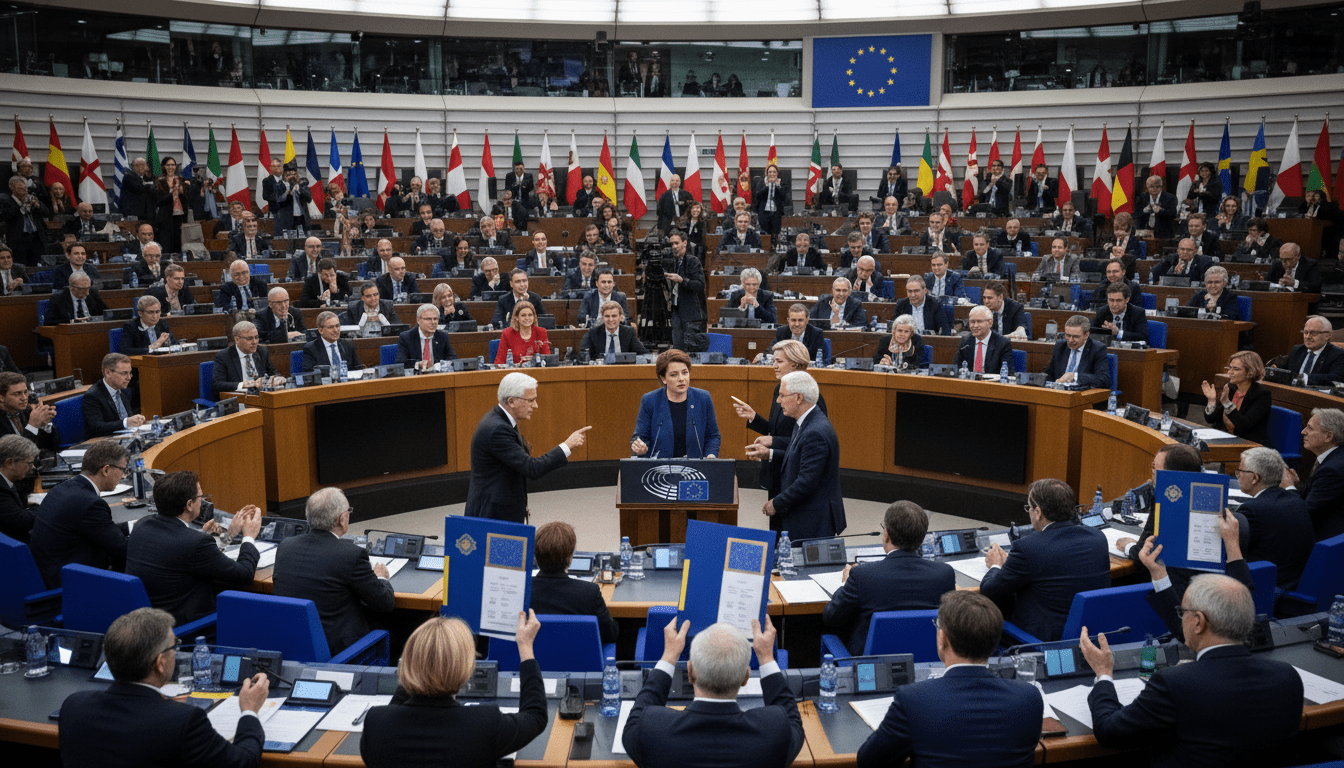
EU MEPs Push for Rapid European Defence Union to Reduce Reliance on the United States
A cross-party group of EU Members of the European Parliament has called for the swift establishment of a European defence union to allow the bloc to act autonomously in crises and to lessen dependency on the United States. The appeal, issued on Europe Day, was signed by dozens of MEPs including Germany’s Marie-Agnes Strack-Zimmermann, Michael Gahler and Tobias Cremer, and lays out specific military and procurement priorities.
MEPs say the proposed European defence union should include permanent command structures and a standing rapid reaction force capable of independent operations when NATO support is not available. The declaration argues that current national short-termism and fragmented procurement undermine the EU’s ability to respond to fast-moving threats.
Cross-party MEP alliance demands rapid European defence union
The declaration was presented as a transnational parliamentary effort that spans political groups and member states, reflecting growing concern about strategic dependence on Washington. Signatories contend that relying exclusively on US-led NATO guarantees can leave Europe exposed if American priorities shift or capabilities are constrained.
Lawmakers framed the demand as pragmatic rather than ideological, emphasizing operational readiness and political will as prerequisites. They urged EU institutions and national governments to translate repeated rhetoric about strengthening defence into concrete capabilities and interoperable structures.
Proposed military structures: permanent command and rapid reaction force
The MEPs specify that a European defence union should incorporate dedicated command structures able to plan and lead operations without NATO oversight when necessary. They also call for a “quick reaction” unit that could be deployed at short notice to deter or respond to crises on the EU’s periphery.
Advocates argue these elements would provide strategic autonomy for the EU while still allowing cooperation with NATO and partner states. The proposal stresses interoperability, shared training, and integrated logistics as essential to a credible collective force.
Savings and procurement reforms central to the proposal
The declaration criticizes fragmented national procurement as a major barrier to capability development and argues that joint acquisition programs could yield substantial savings. The MEPs estimate that coordinated procurement might save up to €100 billion annually through economies of scale and reduced duplication.
They also warn that short-term national interests and political cycles continue to obstruct multi-year investment plans. The text calls on the European Commission and member states to set procurement rules and pooled funding mechanisms that prioritize capability gaps and resilience.
Nuclear deterrence question omitted from the declaration but under discussion
The public statement deliberately avoids a formal position on nuclear deterrence, a politically sensitive topic across the EU. Nevertheless, some members of the new parliamentary grouping, including German MEP Lukas Sieper, indicated privately at the launch that nuclear policy could become part of future debates.
Sieper said he believes nuclear issues will need to be addressed if the EU intends to develop a full-spectrum defence posture, arguing that control by the Union could be preferable to unilateral national ownership. Other signatories, including Green MEP Hannah Neumann, favor conventional strengthening and arms control commitments instead.
Political obstacles: national interests and varying threat perceptions
MEPs acknowledged that longstanding national prerogatives and divergent threat assessments among capitals pose the biggest hurdles to a European defence union. Smaller states frequently prioritize niche capabilities or domestic defence industries, while larger militaries balance national projects with alliance obligations.
The declaration explicitly criticizes the gap between political declarations and follow-through, noting that collective action requires binding commitments and mechanisms to resolve procurement disputes. Lawmakers appealed for greater parliamentary oversight and clearer timelines to translate plans into deployable capabilities.
Timing and symbolism of the Europe Day announcement
The group chose Europe Day, commemorating the Schuman Declaration of 9 May 1950, to underline the link between deeper integration and peace. Organizers said the timing was deliberate, invoking the founding argument that shared institutions can prevent conflict and strengthen collective security.
By framing defence integration as a continuation of the postwar project, proponents seek to broaden public acceptance beyond narrow military constituencies. They argue that strategic autonomy is both a geopolitical necessity and a logical extension of the EU’s economic and diplomatic integration.
The MEPs called on the European Commission, the European External Action Service and national governments to open immediate talks on command arrangements, pooled procurement and financing for a rapid reaction force. They said detailed proposals and timelines should be presented within months, not years.
If implemented, the measures proposed by the parliamentary alliance would reshape the EU’s security architecture and its relationship with NATO, requiring careful negotiation to preserve transatlantic ties while enhancing European capabilities.
