
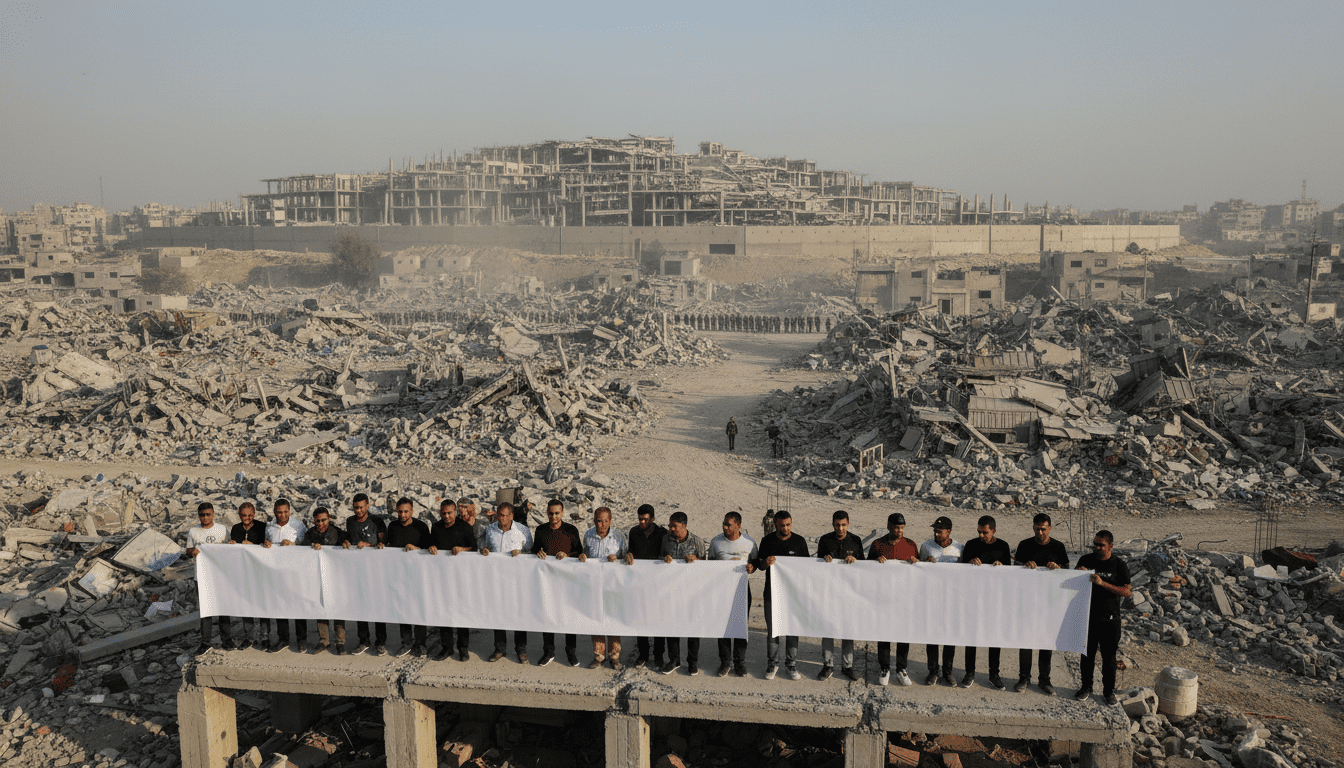
Gaza reconstruction under scrutiny as Palestinians push for political renewal
Gaza reconstruction plans face scrutiny as Palestinian groups demand urgent political renewal, leadership reforms, sovereignty over recovery and accountability, urgently.
The international debate over Gaza reconstruction has shifted from emergency relief to a contested blueprint for the territory’s political and territorial future. Critics and Palestinian civil society groups warn that reconstruction talks risk cementing external control unless Palestinians secure genuine authority over how rebuilding proceeds. The phrase Gaza reconstruction now captures not only rubble and contracts but also questions about sovereignty, accountability and long-term governance.
International actors advance Gaza reconstruction agenda
Diplomatic activity in recent months has focused on coordinating donors, aid corridors and post-conflict logistics for Gaza reconstruction. Western governments and regional partners are proposing frameworks that combine funding, security guarantees and technical assistance to restore basic services. Palestinian stakeholders and rights groups argue those proposals often treat Israel as a central arbiter of the process rather than a party subject to review and accountability.
Human rights concerns over normalization of control
Legal and rights organizations caution that reconstruction efforts risk normalizing a status quo that critics describe as occupation and settler colonial control. They say projects framed as humanitarian or developmental can become mechanisms for altering demographics and administrative boundaries. Observers emphasize the need for independent oversight to ensure rebuilding does not precondition Palestinian returns or governance on external political outcomes.
Political fragmentation weakens Palestinian bargaining power
Three decades of diplomatic accords and internal divisions have, according to analysts, eroded Palestinian institutional coherence and negotiating leverage. The fragmentation of political leadership has left a vacuum that external actors are poised to fill during reconstruction planning. Many Palestinians and civil society groups call for a broad national dialogue and restructuring of representative institutions to provide a unified interlocutor for recovery and state-building.
Civil society outlines demands for recovery and sovereignty
Palestinian civil society has published a set of core demands that prioritize steadfastness, an elected national leadership and a temporary, accountable mechanism to manage relief and reconstruction. The movement calls for a model that preserves Palestinian agency and ensures that reconstruction does not become an instrument of imposed political arrangements. Civil society leaders also stress the importance of transitional mechanisms that are non-custodial and that operate under Palestinian political ownership.
Territorial and governance implications of rebuilding plans
Reconstruction proposals that include changes to territorial lines, urban footprints or the location of administrative centers carry significant governance implications. Experts warn that technical decisions on infrastructure, zoning and border controls can have lasting political consequences if not subject to transparent debate and agreement. For Palestinians, control over reconstruction means control over planning, land use, and the parameters that shape everyday civic life after rebuilding is completed.
Regional dynamics and the risk of external imprint
Shifting regional alliances and diplomatic initiatives influence which actors can shape Gaza reconstruction and in what ways. Some states and international institutions view post-conflict rebuilding as an opportunity to stabilize the area, while others see it as a chance to reconfigure regional influence. Palestinian advocates insist that external involvement should be supportive rather than prescriptive, and that regional strategies must not override Palestinian priorities for sovereignty and justice.
Restoration of infrastructure and homes in Gaza will be measured not only in concrete and electricity but also in who decides the rules that govern recovery. Gaza reconstruction debates have become a proxy for larger questions about accountability, political legitimacy and the right of Palestinians to determine their future. The outcome will hinge on whether reconstruction is conducted with meaningful Palestinian ownership, independent oversight and a commitment to restore—not redefine—rights and remedies.
