
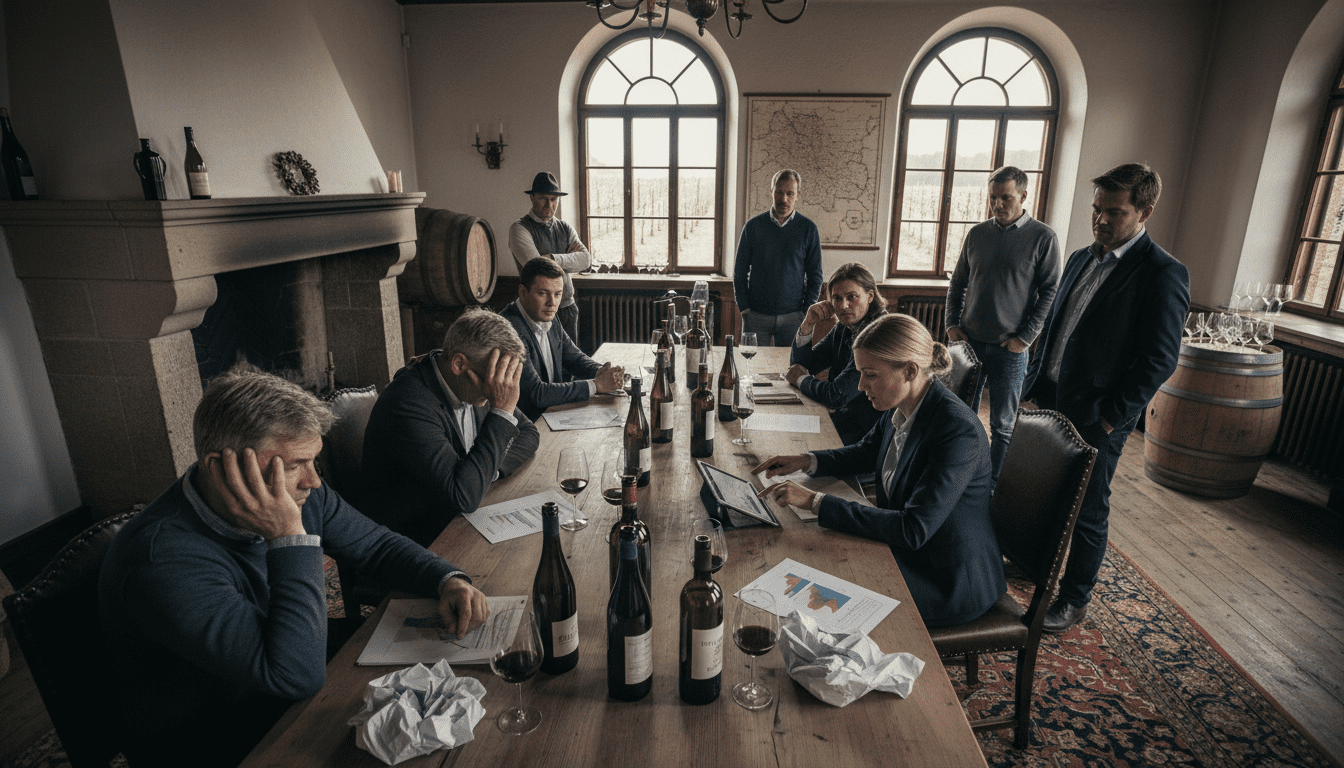
German winemakers face collapsing prices and rising costs as demand falls
German winemakers confront collapsing bulk prices, surging input costs and declining domestic demand, forcing consolidation, mechanisation and painful staff and production changes.
The sky over many estates in Rheinhessen mirrors the mood among German winemakers: long-established producers are grappling with sharply lower bulk prices while input costs have jumped, squeezing margins and forcing rapid structural change. Producers who once relied on scale and steady domestic consumption now find themselves racing to cover costs, sell large volumes and adapt cultivation and staffing to survive. The crisis combines falling per-capita wine consumption, aggressive price competition from southern Europe and a cost shock that began in 2022.
Price collapse hits bulk producers
Bulk wine prices have plunged in recent years, disproportionately affecting producers who sell wine tank‑wagon volumes to cooperatives and bottlers. One Rheinhessen grower who last year delivered roughly six million litres says his average return per litre fell from about €0.90 in 2023 to €0.64 in 2024 and then to €0.53 in 2025. That decline wiped out significant revenue overnight for producers with thin margins and large volumes, leaving some producers operating below break‑even levels.
Many bulk suppliers report that economies of scale are no longer sufficient to offset the price slide, because higher volumes now mean greater exposure to a market where demand is shrinking. For some, the result is a rapid search for new buyers, direct marketing models or costly storage until prices recover—options that are not feasible for every farm.
Rising costs and tighter margins since 2022
At the same time, production costs have risen sharply since 2022, driven by energy, glass, packaging, fuel, fertiliser and labour expenses. Researchers at a German wine institute tracking more than 700 self‑marketing estates say costs climbed by more than a third after 2022, shrinking margins even when output held steady. Many growers now calculate that they need at least €0.70 per litre for bulk wine just to cover operating costs, a threshold that large parts of the market have not met in recent seasons.
Those cost pressures have coincided with wider inflation in grocery spending, meaning consumers are more likely to buy cheaper imported bottles or to forgo wine purchases altogether. The combination of higher costs and lower obtainable prices has intensified decisions about workforce, cultivation intensity and which parcels remain economically viable.
Domestic consumption and import competition
Domestic wine consumption in Germany has fallen in recent years, a trend that amplifies pressure on the home market. Average per‑adult wine consumption has dropped from about 24.3 litres five years ago to roughly 21.5 litres today, reflecting demographic change, health considerations and shifting drinking patterns among younger adults. Producers say Gen Z’s lower alcohol intake and health‑focused choices are reshaping long‑term demand forecasts.
At the same time, surplus production in France, Italy and Spain has led to competitive pricing on retail shelves, effectively exporting downward price pressure into Germany. Observers warn that foreign producers are often prepared to sell at very low margins to maintain market share, undercutting domestic grapes and making it harder for German growers to raise prices without losing shelf space.
Mechanisation and variety shifts reshape vineyards
Faced with economic necessity, many estates have shifted cultivation practices to reduce labour and input costs. Some growers have accelerated planting of fungus‑resistant varieties—so‑called PIWI cultivars—that can require up to 80 percent less plant‑protection treatment. Others have adopted mechanised “minimal pruning” and tractor‑mounted cutting systems that cut manual labour from roughly 180 to about 70 hours per hectare annually.
Those technical changes lower immediate expenses but carry agronomic risks: mechanised pruning and reduced manual canopy management can be harder to calibrate for optimal yields and grape quality, and over time some vineyards show reduced production per vine. For producers aiming to maintain volume sales, the trade‑offs between cost savings and yield control are becoming central to survival strategies.
Staff reductions and estate consolidation
The squeeze is visible on the payrolls. Where some estates once employed dozens of seasonal workers alongside a dozen or more permanent staff, many have trimmed teams to an essential core. One long‑established operation that once relied on about 60 seasonal workers and 19 permanent employees now plans to start the season with just 13 permanent staff. The shift toward fewer hands, longer hours for remaining employees and greater mechanisation is accelerating consolidation across regions.
Official statistics show a pronounced structural shift: the number of wine businesses in Germany fell by roughly a quarter between 2013 and 2023 to about 14,150 operations. Industry analysts warn that consolidation may continue, with some forecasting the market could halve over the next two decades if current trends persist.
Short‑term coping and longer‑term questions
Many growers are responding with a mixture of short‑term coping measures—cutting costs, shrinking workforces, selling into foreign markets—and longer‑term bets on direct sales, premiumisation or new grape varieties. Some hope that investments in branding and consumer engagement can offset bulk price pressure, while others argue that wholesale producers will need structural support or new cooperative models to remain viable.
The human and economic toll is already visible: multi‑generation estates now face decisions about scaling back or selling off parcels that were handed down for decades. As margins compress and demand shifts, the German wine sector is entering a phase where common practices, grape portfolios and business models will be tested and, in many cases, redesigned.
For many producers, the immediate challenge is financial survival, while the larger question is whether Germany’s wine landscape will reconfigure into fewer, higher‑value estates or continue to fragment under price pressure.
