
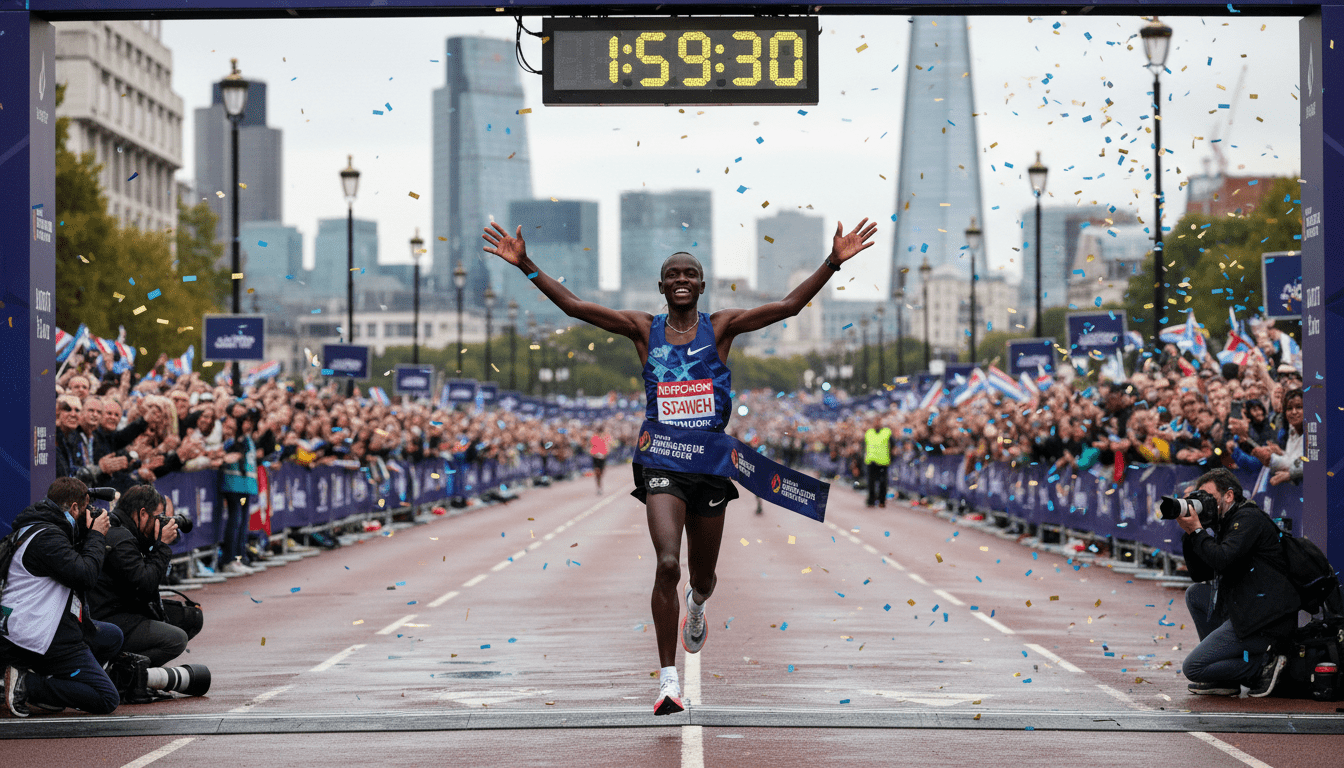
Sabastian Sawe Breaks Two-Hour Barrier with 1:59:30 at London Marathon
Sabastian Sawe became the first man to run an official marathon under two hours, posting 1:59:30 in London as rivals chased him to a historic finish on Sunday.
Sawe seals victory in front of Buckingham Palace
Sabastian Sawe accelerated through the final corners in central London and crossed the finish before Buckingham Palace with his arms raised and the clock reading 1:59:30. The 31-year-old Kenyan held off a late challenge from Ethiopia’s Yomif Kejelcha and finished amid scenes of astonishment and celebration. Sawe’s recorded time makes him the first runner to complete a sanctioned marathon in under two hours, a milestone that rewrites elite distance running history.
Tactical duel and split-second margins
The race developed into a prolonged duel, with Kejelcha pressing Sawe through long stretches of the course and Uganda’s Jacob Kiplimo remaining in contention until the closing stages. Kejelcha clocked 1:59:41 and Kiplimo crossed in 2:00:28, times that underline the exceptional depth of the field on the day. Organizers and athletes pointed to well-calibrated pacing, a fast early tempo and a decisive push in the final kilometres as keys to the outcome.
Course, weather and pacing combined for speed
London’s route is not usually cited as the most record-prone marathon circuit, but conditions on the day— including a favourable tailwind along the Thames and an aggressive pace plan—favoured fast times. Organisers and pacemakers executed a strategy aimed at a rapid tempo from the outset, keeping the leading group on or ahead of target splits. Athletes and coaches noted that the race dynamics, rather than a single advantage, produced the platform for multiple athletes to approach or beat previous benchmarks.
Context within marathon record history
Sawe’s 1:59:30 enters a lineage of barrier-breaking performances, from Roger Bannister’s four-minute mile to modern sprint and endurance milestones. The official marathon record had stood at 2:00:35, set by Kelvin Kiptum in Chicago three years earlier, and the sub-two-hour mark had only been surpassed in a non-record-eligible experiment in Vienna in 2019. Sawe’s time, recorded in a championship setting and accepted under competition rules, therefore represents a new official high-water mark for the sport.
Technology, footwear and ongoing debate
The role of advanced running shoes—so-called “supershoes”—remained a prominent discussion point after the race, as critics and biomechanists weigh the devices’ contribution to faster times. Experts have warned about changes in running mechanics and a potential rise in injuries as a consequence of altered force patterns. Manufacturers argue the innovations are a legitimate evolution in performance equipment, while regulators and scientists debate where to draw limits to preserve fair competition.
Doping scrutiny and governance questions
Kenyan distance running has faced extended scrutiny over doping controls and governance, and the performance will renew calls for rigorous testing and transparency. International bodies have previously identified elevated risk levels and compliance issues in the country’s anti-doping infrastructure. Sawe himself has not been implicated in doping violations; his trainer Claudio Berardelli, who has worked with him for years, has faced past controversy but has not been convicted in relation to those matters. Authorities and athlete representatives emphasized that comprehensive testing and open processes will be essential to authenticate the result and maintain public confidence.
Reactions from the sport and the athlete
Prominent figures in athletics expressed amazement at the achievement, with veteran commentators describing the moment as unimaginable until it happened. Sawe responded to his victory with measured joy, calling the result a memory he will carry for life and thanking competitors and support staff. His trainer highlighted Sawe’s late development and steady rise through the ranks, noting a trajectory that had seen rapid improvement at major marathons in recent seasons.
The sub-two-hour official marathon now shifts the conversation in elite distance running to questions of sustainability, governance and the next frontier of human performance. Observers say athletics bodies will face pressure to refine rules on equipment and testing while celebrating an athletic landmark that many regarded as decades away.
