
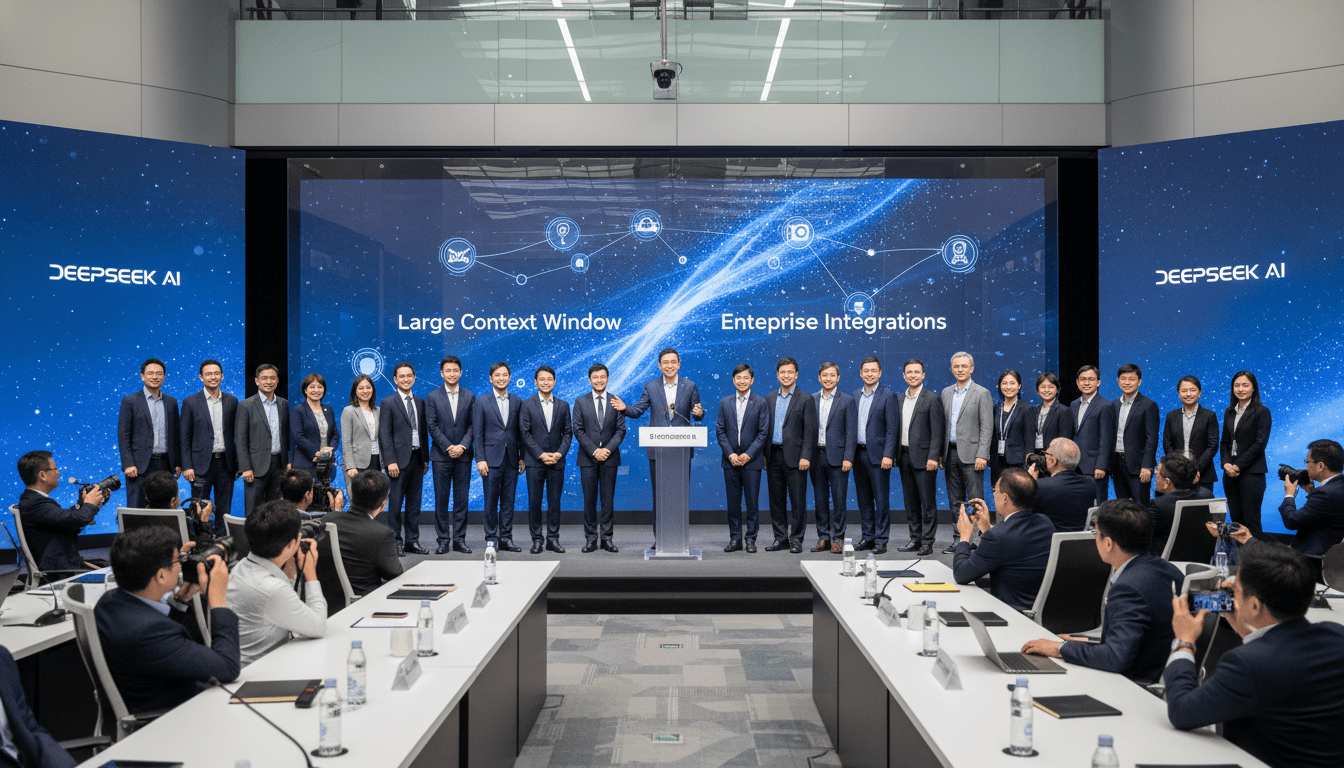
Deepseek V4 Debuts with Massive Context Window to Court Developers and Enterprise Customers
Deepseek launches V4 with a large context window, low prices and integrations with Claude Code, OpenClaw and OpenCode to attract developers and enterprises.
Deepseek announced the commercial release of its Deepseek V4 model, positioning the system as a cost-competitive option for developers and enterprise customers. The company is emphasizing low pricing, broad availability and a notably large context window to support processing of extensive codebases and long-form documents. Deepseek also highlighted built-in compatibility with third-party tools such as Claude Code, OpenClaw and OpenCode to ease integration into existing development workflows.
Deepseek launches V4 with expanded context window
Deepseek V4 introduces a substantially larger context window than previous versions, enabling the model to analyze and generate output across longer sequences of text and code. The expanded context is designed to reduce the need for external chunking or repeated prompts when working with lengthy repositories or multi-file projects. According to the company, this capability aims to improve developer productivity by maintaining more of the project state in a single session.
Pricing strategy and market availability
Deepseek is marketing V4 with lower-tier pricing options intended to lower the barrier to entry for independent developers and small teams. The company says it will offer a range of subscription tiers and pay-as-you-go plans to accommodate different usage patterns. Availability will be rolled out across major cloud regions and direct sales channels to ensure enterprises can procure capacity at scale.
Tool integrations: Claude Code, OpenClaw and OpenCode
One of Deepseek’s selling points for V4 is its interoperability with established developer tools and specialist code assistants. The system is designed to work alongside Claude Code, OpenClaw and OpenCode, allowing teams to combine Deepseek’s context handling with other tools for testing, static analysis and code generation. These integrations are positioned to simplify adoption for organizations that already rely on those toolchains.
Technical capabilities for large codebases and documents
Beyond context size, Deepseek V4 includes optimizations aimed at code understanding, multi-file reasoning and document summarization. The company reports improvements in memory handling and inference stability when processing interconnected files and long documentation sets. Those technical changes are intended to reduce truncation errors and improve the model’s ability to follow cross-references in large projects.
Targeting developers and enterprise customers
Deepseek’s go-to-market approach explicitly targets individual developers, platform teams and enterprise engineering groups that need cost-efficient models for code-centric tasks. The vendor is emphasizing developer-friendly features such as API access, SDKs and prebuilt integrations with continuous integration pipelines. For enterprises, Deepseek is promoting stronger governance controls and deployment options compatible with private cloud and on-premises environments.
Positioning against competitors and ecosystem fit
By combining competitive pricing, a large context window and tool interoperability, Deepseek aims to carve a niche between high-cost general-purpose models and specialized code assistants. The company positions V4 as complementary to existing stacks rather than a wholesale replacement, arguing the model’s strengths lie in long-form context handling and operational flexibility. Observers will watch how Deepseek’s performance and ecosystem partnerships translate into adoption compared with incumbent providers.
Deepseek’s V4 release underscores a broader industry push toward models that prioritize extended context, developer workflows and simpler toolchain integration. The vendor’s claims about pricing and availability will face scrutiny as customers test real-world performance on large codebases and enterprise workloads.
