
German SPD urges Bundestag to consider suspending the debt brake amid Middle East shock
SPD urges Bundestag to consider suspending the debt brake amid Middle East war, igniting a political and economic fight over debt, inflation and growth risks.
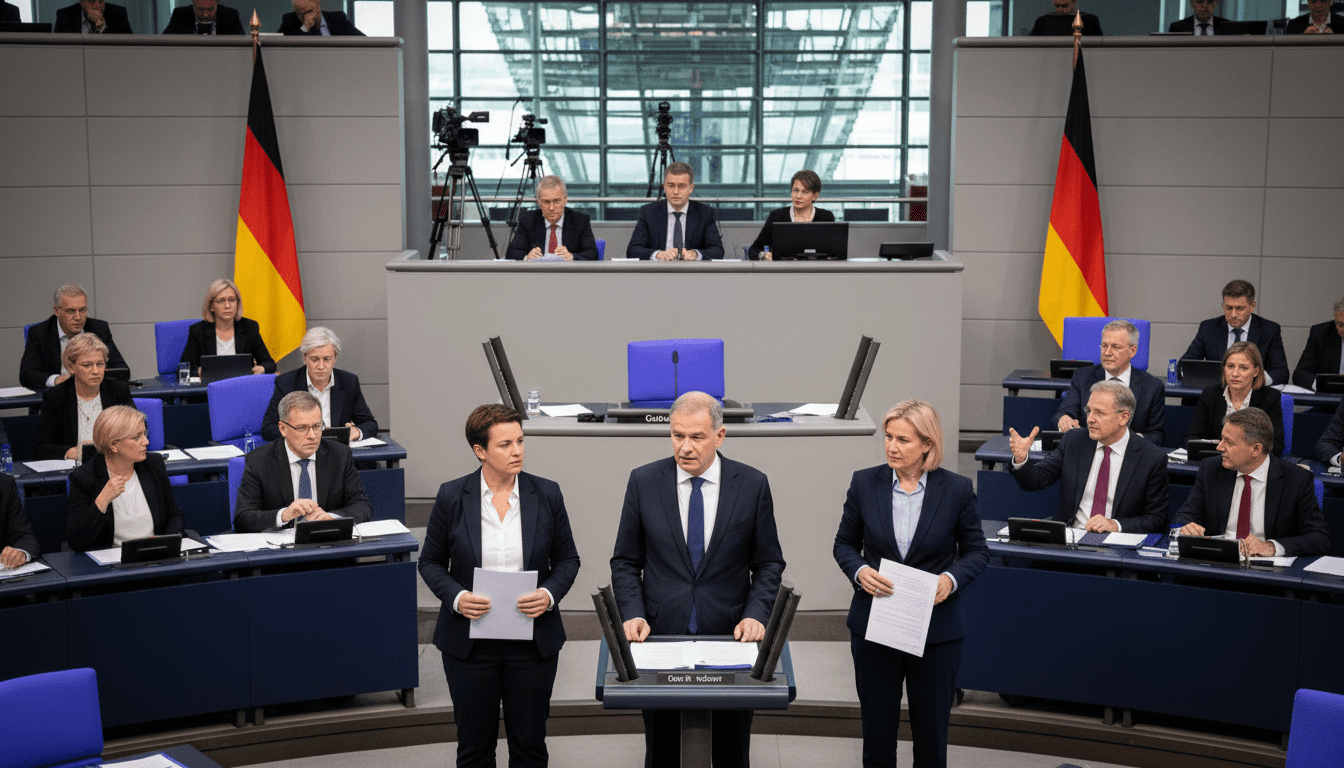
Germany’s political debate over whether to suspend the debt brake has intensified after SPD figures suggested the Bundestag should prepare for a parliamentary vote to declare a budgetary emergency if the Middle East conflict seriously disrupts the economy. The proposal, floated by SPD parliamentary leader Matthias Miersch, frames a possible suspension as a measure to prevent an economic collapse driven by rising energy costs and mounting uncertainty. Chancellor Friedrich Merz acknowledged on the CDA conference floor that the conflict’s effects extend beyond fuel prices and could threaten Germany’s economic substance. Parties, ministers and leading economists are now publicly at odds over whether invoking the constitutional exception would stabilize the economy or compound inflationary pressures.
SPD proposal and party pressure
Miersch told the Neue Osnabrücker Zeitung that a worst‑case scenario might require the Bundestag to vote to exceed the statutory borrowing limits, an extraordinary step permitted under Article 115 of the Basic Law in cases of natural disaster or exceptional emergencies. Several SPD state premiers have since urged a crisis meeting of federal and state leaders with the chancellor to assess immediate needs and possible fiscal measures. SPD officials say preparing the parliamentary pathway for a debt brake suspension is prudent contingency planning rather than a fixed commitment.
The SPD’s framing stresses the state’s role in preventing a systemic economic breakdown and preserving jobs and business continuity. Finance Minister Lars Klingbeil has not endorsed a specific timetable, but advisers close to the ministry have publicly suggested that prudent emergency options should remain on the table as the geopolitical situation evolves.
Constitutional threshold and legal precedent
Article 115 of Germany’s constitution allows the government to exceed borrowing limits only in cases of severe and unforeseeable emergencies that the state cannot control. The provision was used during the COVID‑19 pandemic and after Russia’s attack on Ukraine, enabling large fiscal packages and emergency spending. Legal scholars and some politicians caution that invoking the clause requires a clear demonstration that the crisis fundamentally impairs the state’s financial stability and cannot be addressed through existing budgetary flexibility.
Proponents of restraint argue that the current situation does not yet meet the high legal bar. They note that previous uses of the debt brake were tied to sharply defined emergencies with immediate and direct impacts on the domestic economy. Any attempt to stretch that precedent, critics say, risks politicizing constitutional safeguards designed to ensure long‑term fiscal discipline.
Economic forecasts and current fiscal space
The government and leading economic institutes have revised growth expectations downward, reducing optimism for 2026. Economic Minister Katherina Reiche (CDU) has lowered the forecast to about 0.5 percent growth for the year, reflecting weaker investment and elevated energy costs. Analysts point out that last year’s debt‑financed investment programs for infrastructure and defense are currently cushioning the economy and keeping output from contracting.
Despite slower growth, many economists emphasize that a modest slowdown is not synonymous with the extraordinary fiscal emergency required to suspend the debt brake. They also highlight that lower growth automatically relaxes the numerical debt limit under current fiscal rules, giving the federal government some additional borrowing capacity without triggering constitutional exceptions.
CDU and Union warn against new borrowing
Senior figures in the governing Union reacted sharply to SPD suggestions. CDU General Secretary Carsten Linnemann called proposals for fresh debt “political laziness,” arguing that Germany needs policies to boost labor participation, cut bureaucracy and spur innovation rather than new deficit spending. Former Health Minister and Union parliamentary leader Jens Spahn warned that the government’s “bazooka” of fiscal ammunition is largely spent and cautioned against indiscriminate borrowing.
Union youth and party organizations echoed those concerns on social platforms, insisting the debt brake should not be further loosened. Chancellor Merz, while acknowledging the economic risks stemming from the Middle East, did not explicitly endorse or reject the SPD’s emergency vote proposal, instead emphasizing the need for reforms “with measure and direction” and calling for cross‑party cooperation.
Economists predict risks from premature suspension
Leading independent economists have publicly cautioned against using the constitutional exception preemptively. Monika Schnitzer, chair of the Council of Economic Experts, said the clause requires an “extraordinary emergency” that she does not see today, and warned that a preemptive debt suspension could reduce political willingness to undertake necessary structural reforms. Clemens Fuest, president of the Ifo Institute, argued that expanding fiscal demand after a sharp energy‑price spike would primarily fuel inflation and invite monetary tightening rather than deliver durable economic relief.
Both Schnitzer and Fuest stressed that targeted measures — such as temporary support for vulnerable households and businesses — can be financed within existing instruments or by reallocating budget priorities, avoiding a broad constitutional override that could have long‑term fiscal consequences.
Advisers, politics and the policy timetable
Jens Südekum, an economist advising Finance Minister Klingbeil, sought to calm immediate fears by saying Miersch’s scenario‑planning was a discussion of contingency options rather than a declaration of intent. Südekum acknowledged that a substantially worsened energy price shock could change the calculus, but he did not see grounds for an immediate emergency vote. Political leaders are watching domestic indicators and international developments closely: the cabinet is scheduled to set budgetary parameters for 2027 and debate a health reform package that includes savings and higher co‑payments.
The debate underscores a wider tension in German policy: balancing short‑term crisis management against the imperative of long‑term fiscal sustainability and structural reform. With cross‑party echoes for both caution and readiness, the coming weeks are likely to produce further political tests of whether the Bundestag will view the Middle East shock as a constitutional trigger for emergency borrowing.
As the economic and geopolitical situation evolves, lawmakers face a choice between expanding immediate fiscal space through constitutional means or relying on targeted instruments and reform commitments to preserve stability without setting a precedent for broader debt increases.
