
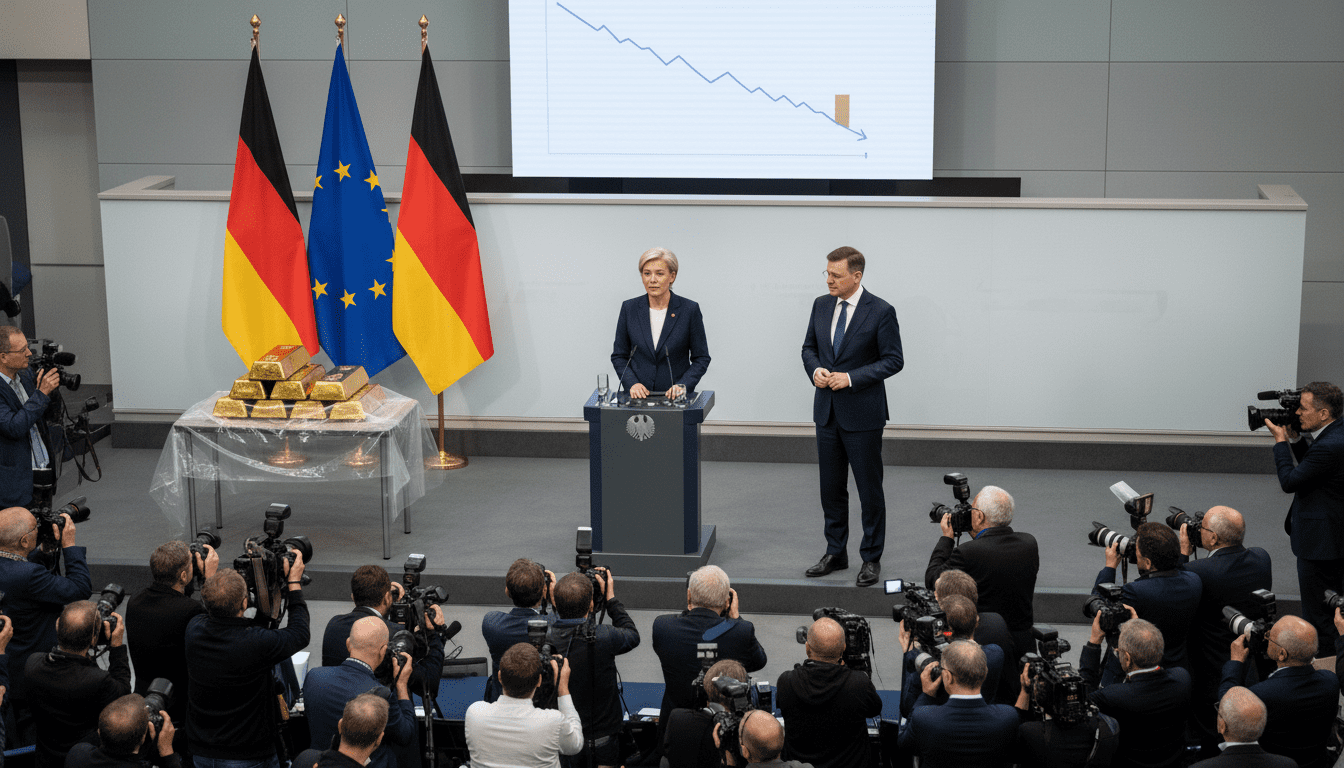
Economist Marcel Fratzscher Urges Sale of German Gold Reserves to Fund Crisis Measures
Marcel Fratzscher urges Germany to sell part of its gold reserves to fund crisis relief and invest in education and infrastructure amid energy shortfalls.
Germany’s leading economic researcher Marcel Fratzscher has publicly proposed that the country consider selling a portion of its gold holdings to finance emergency relief and investment programs. Fratzscher, head of the German Institute for Economic Research (DIW), told t-online that the nation’s gold — which he values at roughly €440 billion — represents a large, underused buffer in the current crisis and could be tapped to support households, businesses and public projects. The suggestion breaks with long-standing political taboos around the stewardship of central bank gold and immediately sparked debate among policymakers and financial analysts.
Fratzscher frames sale as targeted crisis financing
Fratzscher told reporters that releasing only a small slice of the reserves could provide immediate fiscal space without jeopardizing monetary stability. He recommended directing proceeds toward targeted relief measures, and also floated using funds for long-term investments in education and infrastructure that would boost productivity. The economist framed the proposal as pragmatic: a redistribution of an existing public asset rather than an increase in borrowing.
Scale and location of Germany’s holdings
Germany holds one of the world’s largest official gold stocks, totaling about 3,350 tonnes, second only to the United States. According to figures cited by Fratzscher, roughly 1,710 tonnes are stored in Frankfurt, 1,236 tonnes in New York and 404 tonnes in London. Those holdings underpin a significant portion of the Bundesbank’s balance sheet and have long been seen as a centerpiece of national financial security.
Bundesbank custody and legal constraints
Fratzscher acknowledged the legal and institutional barriers to any sale, emphasizing that the Bundesbank manages the physical reserves and that a chancellor cannot unilaterally order a disposal. Any move would require formal procedures, broad political consensus and adherence to central bank statutes that limit direct political intervention. Observers note that the Bundesbank’s independence and the international nature of custody complicate both the mechanics and the optics of liquidating bullion.
Valuation, market impact and fiscal trade-offs
Putting a precise market value on the entire stock depends on current gold prices and the mix of reserves held, but Fratzscher’s estimate places the asset at close to €440 billion. Selling even a fraction could produce substantial one-off revenue, yet economists warn that sizeable disposals risk moving market prices and could erode future cushions against shocks. There would also be accounting consequences for the Bundesbank and for public debt metrics; policymakers would need to weigh the short-term fiscal relief against the long-run loss of a safe-asset buffer.
Selling gold could be structured to minimize market disruption, for example through staged auctions or swaps, but critics argue that proceeds should be spent with strict transparency and defined objectives. Fratzscher proposed dedicating revenues to areas with high social returns — citing education and infrastructure — and to temporary relief for households and firms hit by the current energy and economic strains.
Energy policy criticism and conservation proposals
In the same interview, Fratzscher criticized recent government measures to lower fuel taxes — the so-called tankrabatt — arguing the subsidy insufficiently reduces fuel consumption and therefore fails to address supply tightness. He said the policy risks encouraging continued high driving levels at a time when global oil and gas supplies are under pressure, estimating a current global shortfall of roughly 10 to 15 percent. To curb demand more effectively, Fratzscher advocated for behavioral and regulatory measures such as car-free Sundays and national speed limits.
Those recommendations reopen sensitive political debates about mobility and individual freedoms in Germany. Proponents of conservation measures argue they deliver rapid demand relief and emissions benefits, while opponents warn of disproportionate effects on commuters, rural residents and the logistics sector unless compensatory measures are introduced.
Political landscape and likely reactions
The proposal to tap gold reserves faces political headwinds from parties that view the stock as a symbol of fiscal prudence and national security. Opposition is likely to converge around concerns about precedent, Bundesbank independence and the potential for one-off sales to be used as a recurring fiscal patch. Supporters, including some fiscal conservatives and parts of the business community, may back targeted disposals if paired with strict governance rules and transparent allocation to productive investment.
Parliamentary debate would be necessary, and any legislation would have to clarify the scale, purpose and safeguards for sales. International partners and investors will also watch closely, as visible changes to official reserve management could influence perceptions of Germany’s fiscal strategy and the European monetary framework.
Germany now faces a choice between preserving an intact gold stock as a long-term insurance asset or mobilizing part of it to ease an acute social and economic burden. The coming weeks are likely to see intensified discussion among the Bundesbank, finance ministry officials, lawmakers and independent economists over whether breaking the longstanding taboo is fiscally prudent or politically fraught.
