
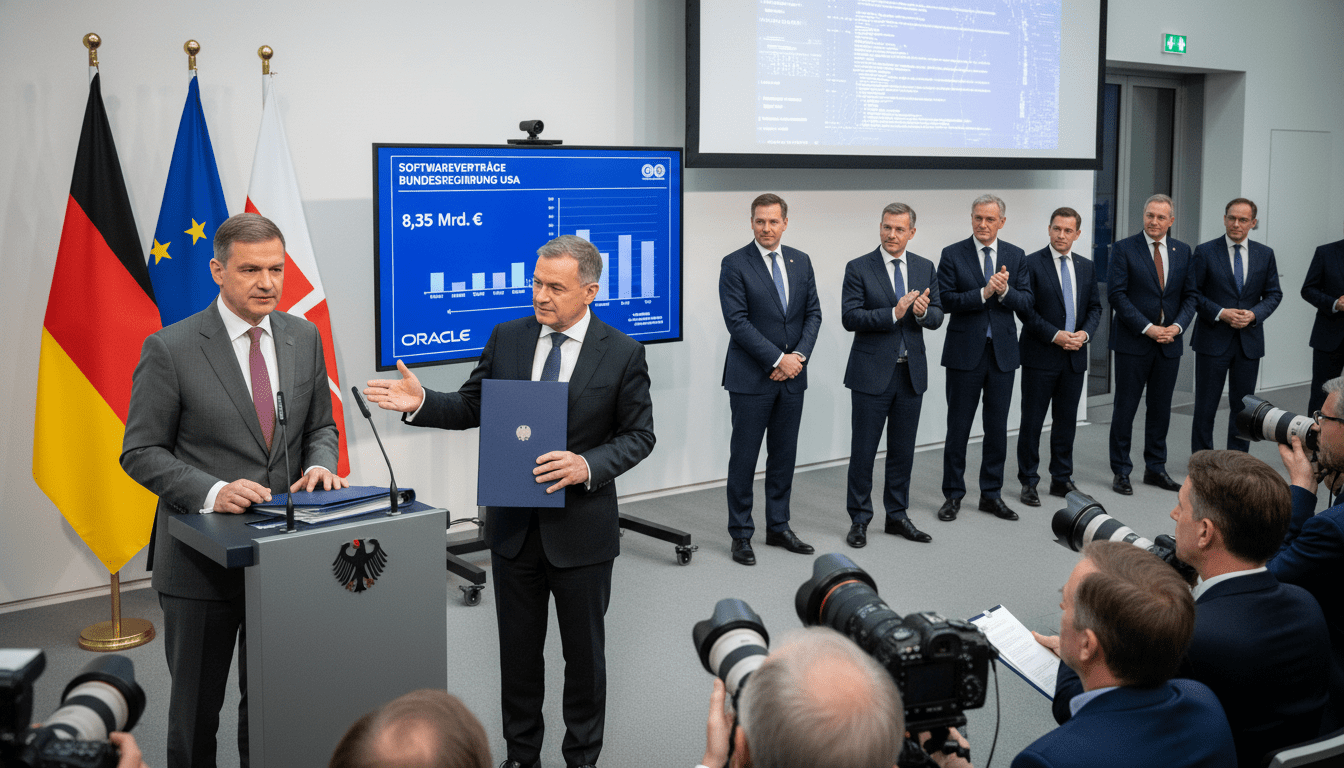
German government holds at least €8.35 billion in US software contracts
German government holds at least €8.35 billion in contracts with US software firms, dominated by Oracle and Microsoft, raising digital sovereignty concerns prompting debate.
The German government currently maintains US software contracts with a notional value of at least €8.35 billion, according to a recent federal reply to a parliamentary inquiry. The disclosure, which details more than 230 individual and framework agreements, highlights the concentration of procurement with major US technology companies and frames a renewed debate on digital sovereignty. Government figures show these sums reflect contractual ceilings over the lifetime of deals rather than annual expenditure, underlining the scale of the commitments.
Breakdown of the largest contractual commitments
Oracle is listed as the largest single beneficiary, with a total contractual volume of €4.69 billion, most of it concentrated in a single framework agreement managed by the federal procurement office (ZIB). Other major US suppliers cited include NetApp (€1.13 billion), Cisco (€799.8 million), Adobe (€550.5 million), Hewlett Packard Enterprise (€374.9 million) and Dell (€335 million). Microsoft appears in the direct departmental contracts at €51.5 million, although other reporting suggests far larger indirect expenditures.
Annual spending and gaps in available data
Across all federal departments, the administration spent approximately €629 million on software licenses in the most recent budget year documented by the government. From the contracts specifically traced to US suppliers, around €166.8 million flowed in 2025, a figure the government says is drawn from documented agreements and does not capture the full picture. Intelligence services and the Federal Chancellery declined to provide substantive responses to the inquiry, creating acknowledged blind spots in the aggregated accounting.
Microsoft’s wider footprint and accounting discrepancies
A separate government reply to another parliamentary question indicates that roughly €481.4 million was spent on Microsoft products in the last year by a circle of entitled recipients that extends beyond central departments and subordinate agencies. Lawmakers and analysts note the discrepancy between the relatively small direct-contract figure in departmental lists and the much larger overall Microsoft expenditure, suggesting fragmented procurement channels and inconsistent accounting. Linke MP Sonja Lemke described the divergence as evidence that even basic oversight is incomplete and called for clearer financial tracing.
Dependence at workstation level across ministries
The federal inventory shows 473,244 Windows-equipped workstations in the administration compared with 12,915 seats running exclusively alternative software such as Linux or LibreOffice. An additional 34,263 workstations were recorded as having supplemental alternative software available. Several ministries reported no configuration that would allow full operational continuity without Microsoft tools; the Defence Ministry, for example, lists only 30 machines with so-called alternative systems, though those run Apple MacOS and therefore remain dependent on another US vendor.
Procurement frameworks and market advantage
Framework agreements managed by the ZIB allow agencies to draw services and products directly without fresh competitive tendering, in effect granting suppliers a market advantage while accelerating acquisition processes. The government stressed that the contract totals represent potential maximum disbursements rather than guaranteed or recurring annual outlays. Critics argue that the prevalence of large framework volumes limits the state’s flexibility to diversify suppliers and to favor open-source or European alternatives in future procurements.
State efforts toward alternatives remain limited
Efforts to cultivate non-US or open-source options include the creation of the Centre for Digital Sovereignty (Zendis), which offers the Open Desk software suite as a potential alternative to established office platforms. Zendis and similar initiatives have, however, operated with modest budgets since their inception in late 2022; available figures suggest federal funding to these efforts has been well under €100 million in total. Observers say the limited investment undermines claims that the government is prioritizing digital independence and slows practical migration away from entrenched vendors.
The documented contract volumes and the distribution of software on federal workstations have prompted calls from opposition politicians and digital policy advocates for a coherent procurement and migration strategy. They argue that clearer accounting, stricter oversight of large framework agreements and targeted investment in open-source alternatives would reduce vendor lock-in and enhance operational resilience. Federal ministries and procurement authorities will face increased pressure to reconcile contractual ceilings with actual spending and to present a timetable for reducing strategic dependencies.
