
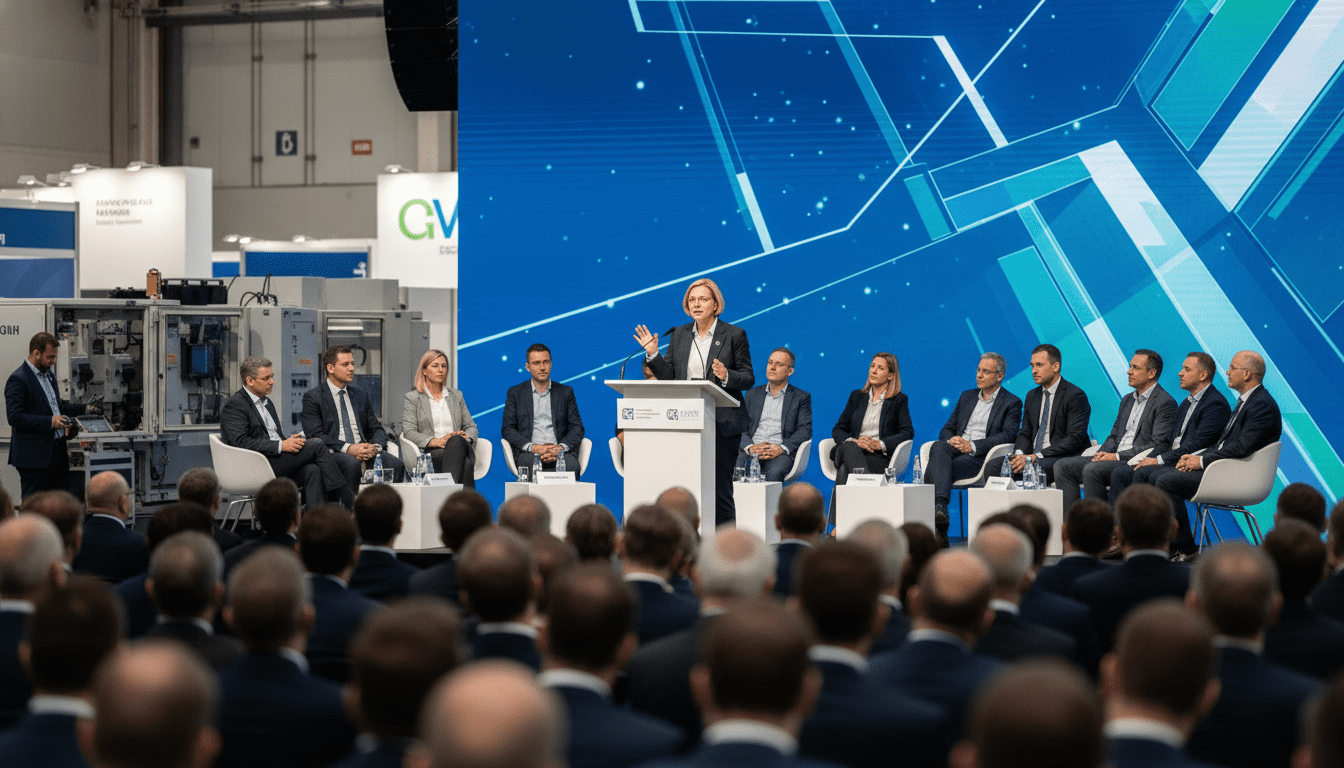
At Hannover Messe, Germany’s Economy Minister Katherina Reiche Urges Greater Private-Sector Role: “The State Cannot Do Everything Alone”
Katherina Reiche delivered a terse but pointed message at the Hannover Messe, telling industry leaders that “the state cannot do everything alone” as she closed a panel discussion. The CDU federal economy minister spoke briefly before a scheduled meeting with the chancellor and leaned toward her Brazilian counterpart after he praised his country’s three percent growth. Her remarks framed a wider debate at the world’s largest industrial fair about the balance between public policy and private investment in Germany’s industrial recovery.
Reiche’s Closing Remarks at Hannover Messe Panel
Reiche made the comment as closing words on a high-profile panel at Hannover Messe, signaling a clear policy emphasis on shared responsibility between government and industry. She spoke with urgency, noting time constraints because she was due to meet the chancellor immediately after the session. The line underscored a recurring theme across conversations at the fair: government facilitation must be matched by corporate initiative.
Exchange with the Brazilian Minister on Growth
The minister’s offhand movement toward her Brazilian counterpart came as he highlighted his country’s recent economic performance, citing three percent growth. Observers said the brief interaction illustrated contrasting national approaches to industrial policy and growth stimulation. Delegates at Hannover Messe interpreted the moment as emblematic of the global dynamics ministers face when reconciling domestic constraints with examples of faster growth elsewhere.
Tight Schedule and Political Significance
Reiche’s hurry to meet the chancellor after the panel added political weight to her remarks, indicating coordination at the highest levels of government. Officials present described a packed agenda, with the Hannover Messe serving as a backdrop for multiple bilateral and multilateral discussions on trade and industry. The timing reinforced that the minister’s message was intended for both the public audience and colleagues in the federal administration.
Calls for Greater Private Investment and Innovation
Industry leaders at Hannover Messe reacted to Reiche’s statement by reiterating calls for clearer incentives to spur private investment and innovation. Executives said they were seeking predictable regulatory frameworks, better access to capital, and faster permitting processes to accelerate projects. Several representatives argued that while public support remains vital, lasting competitiveness depends on firms’ willingness to invest and modernize operations.
Energy Costs and Industrial Competitiveness
Energy prices and supply stability emerged repeatedly in conversations surrounding the minister’s remarks, as companies stressed the need for cost certainty to plan long-term investments. Manufacturers at Hannover Messe emphasized that high energy costs can undermine returns on new plants, digitalization, and green technology adoption. Reiche’s call for a partnership with the private sector was heard alongside urgent industry appeals for targeted policy measures to address energy-related risks.
Sector Responses and Concrete Demands
Trade associations attending Hannover Messe presented a range of concrete demands in response to the minister’s plea for shared responsibility, from tax incentives for capital expenditure to streamlined apprenticeship programs. Some business leaders urged the government to prioritize public–private partnerships in areas such as hydrogen infrastructure and advanced manufacturing. Others cautioned that without decisive action on skills and supply-chain resilience, private investment alone would struggle to deliver the structural changes the industry needs.
Implications for Germany’s Industrial Strategy
Reiche’s succinct message at Hannover Messe feeds into an ongoing policy debate over how Germany will sustain industrial strength amid global competition and structural change. Policymakers face the task of designing measures that both leverage state support and mobilize private capital toward net-zero transitions and digital transformation. The minister’s emphasis on shared responsibility signals a push for collaborative approaches that combine regulation, targeted public funding, and clearer market incentives.
The exchange, brief as it was, crystallized a central tension at Hannover Messe between expectations placed on government and demands from industry for greater autonomy and clearer frameworks. As discussions continue over energy policy, investment incentives, and workforce development, the minister’s words are likely to reappear in negotiations between Berlin and the private sector. The fair’s gatherings underline that forging a sustainable industrial future will require coordinated action, with both state institutions and businesses expected to play active and complementary roles.
