
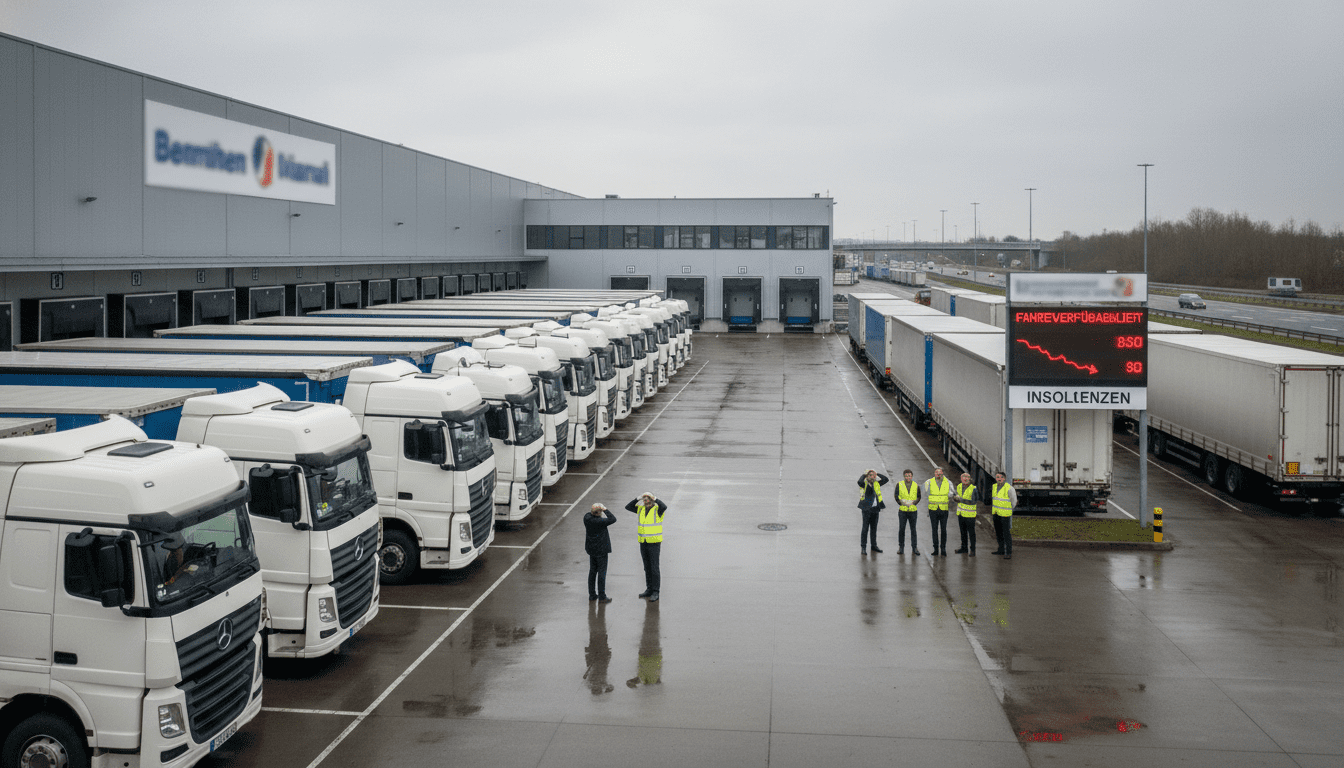
German transport insolvencies set to rise as fuel costs and driver shortage squeeze mid-sized firms
German transport insolvencies are expected to rise as fuel costs, a 120,000-driver shortage and weak demand squeeze mid-sized firms, industry groups say.
The head of the Federal Association for Road Freight, Logistics and Disposal (BGL) warned that insolvencies in the German transport sector will climb under current conditions. Rising pump prices since the outbreak of the Iran conflict have added fresh pressure to companies already stressed by an acute lack of drivers and shrinking margins. Smaller and medium-sized firms, which carry a large share of road-haul capacity, are the most exposed and may increasingly be forced into business closure.
BGL head calls situation “catastrophic” for small carriers
Dirk Engelhardt, president of the BGL, described the prevailing environment as severe and said the industry faces a deepening insolvency wave. He identified the driver shortage as the sector’s most acute problem, estimating a shortfall of roughly 120,000 lorry drivers nationwide. Engelhardt said fuel-price shocks since the Iran war have markedly worsened the position of smaller carriers already operating on thin margins. He cautioned that insolvency filings are likely to accelerate if prices and geopolitical uncertainty persist.
Weak economic demand is eroding logistics revenues
Representatives of the forwarding and logistics association underscored that demand-side weakness in the broader economy is filtering through to logistics volumes and profitability. Frank Huster, chief executive of the Federal Association of Freight Forwarders and Logistics (DSLV), said lower revenues and compressed returns are now the norm for many companies. While the DSLV noted that forwarding firms do not feel insolvencies at the same scale as direct road-transport operators, it still expects an uptick in business failures across the freight sector. The combination of falling margins and higher operating costs is reducing resilience across the supply chain.
Capacity reductions mask latent risk to national logistics resilience
Industry leaders report that many mid-sized carriers have cut capacity in response to the cost squeeze, a move that does not register in insolvency statistics but raises strategic concerns. Reduced fleet availability means Germany’s freight system could lack surge capacity if demand recovers quickly or in the event of a crisis that requires rapid transport mobilization. Trade associations warned that declining spare capacity increases the vulnerability of critical supply chains and could hamper economic recovery. Observers say the trend of voluntary downsizing may accelerate as smaller operators seek to preserve cash and avoid insolvency filings.
Data from Datev points to a return toward pre-crisis insolvency levels
A recent analysis cited by the accounting and data services firm Datev shows a steady loss of mid-sized players and a rise in monthly insolvency figures after the pandemic-induced trough. Datev’s findings indicate the logistics sector is moving back toward the insolvency levels seen before the pandemic, with smaller enterprises particularly affected. The report highlighted that rising wage bills and sustained cost pressures are contributing factors in the uptick of insolvency notifications. Analysts say the trajectory suggests a prolonged period of consolidation unless costs are mitigated or demand improves.
Trade associations urge rapid government intervention and targeted relief
Several transport industry associations addressed Chancellor Friedrich Merz in an open letter dated April 11, 2026, calling for immediate measures to ease the cost burden on carriers. The letter demanded lower energy and electricity taxes, elimination of the CO₂ double charge in road freight, and short-term relief such as targeted price caps or compensation payments. Associations argued such steps are necessary to prevent a wave of insolvencies among firms that underpin national logistics capacity. They also stressed that targeted, temporary relief would buy time for structural reforms and longer-term decarbonization measures.
Betz International, a long-standing regional carrier from Swabia, has been cited as a recent high-profile insolvency, illustrating how even established firms can quickly fall into distress under sustained cost pressure. Trade bodies say that while headline cases attract attention, a larger, quieter trend of mid-sized operators scaling back or exiting the market is under way.
The industry’s call for policy relief comes against a backdrop of volatile energy markets and continued geopolitical uncertainty that could prolong the current cost shock. Associations and data providers alike warn that without swift economic support or a marked improvement in demand, more transport companies may be forced to cease operations, with knock-on effects for manufacturers, retailers and emergency logistics.
As the sector navigates higher fuel bills, escalating wage costs and a persistent driver shortfall, stakeholders say the balance between short-term relief and long-term structural adaptation will be decisive. Industry groups urge policymakers to act quickly to stabilize capacity and preserve the middle-market firms that sustain Germany’s freight network.
If policymakers do not deliver targeted measures, the coming months could see a steady rise in insolvency filings among road hauliers and a continued erosion of the country’s transport capacity, with consequences for supply chains and economic recovery.
