
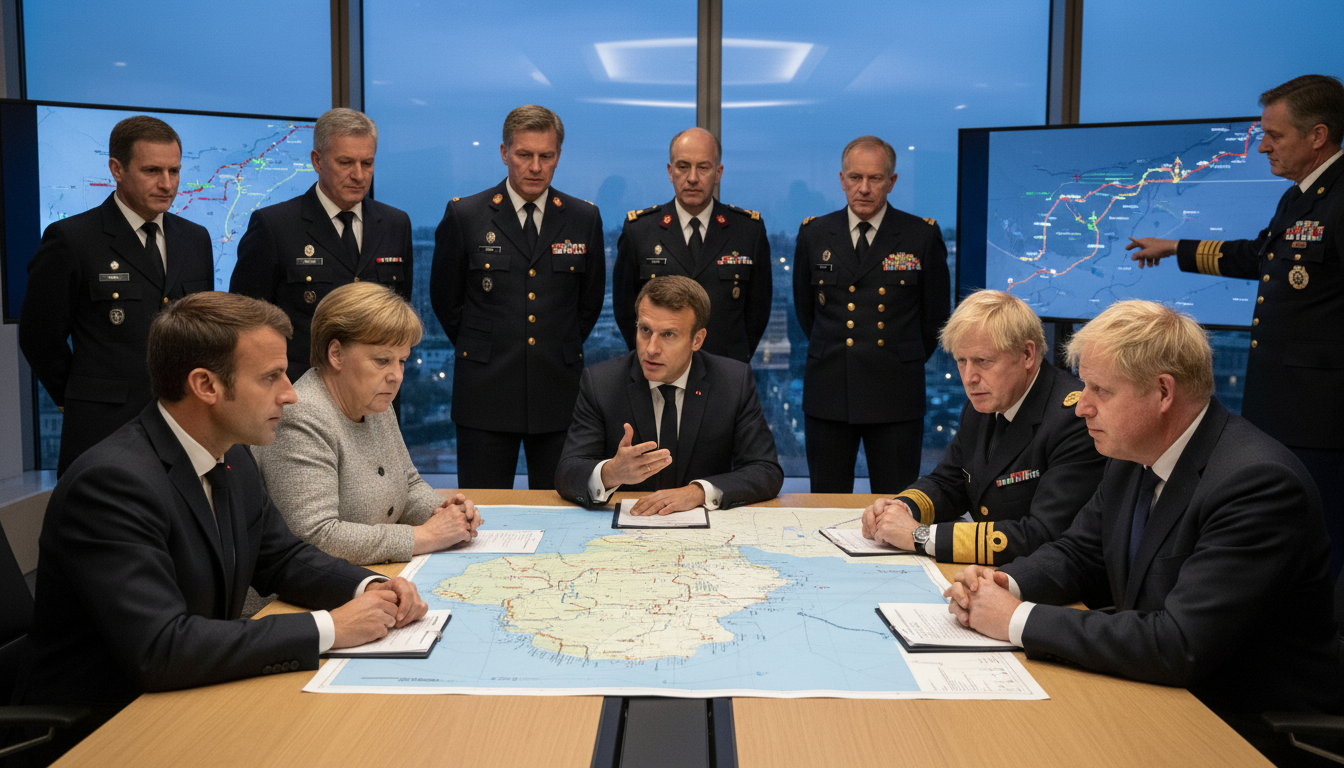
Europe debates a Hormuz mission without the US as Merz heads to Paris
Europe considers a Hormuz mission without the US as Merz travels to Paris; Israel reacts, Lebanon-Israel talks continue, and the EU advances child protection.
Chancellor Merz will travel to Paris on Friday for talks that may shape a European response in the Gulf, as leaders weigh a possible Hormuz mission without direct US involvement. French officials are reported to favor an operation that excludes the main warring parties in the region, a proposal that delegates caution given the diplomatic and military sensitivities. The plan has generated debate in capitals across Europe while diplomatic channels remain active ahead of the Paris meeting.
France proposes a Gulf operation excluding warring parties
French diplomats have pushed for a narrowly framed operation in the Strait of Hormuz that would avoid direct confrontation with combatant states, according to officials briefed on discussions. The idea aims to safeguard commercial shipping lanes while limiting escalation, but it faces legal and practical hurdles tied to mandates, rules of engagement and regional consent.
European capitals are divided on the scope and command of any mission, with some arguing for NATO or UN formats and others preferring a European-led initiative. Questions remain about the mission’s logistics, intelligence-sharing, and whether participating states would accept the risk of operating without US military assets.
Merz’s Paris trip and intra-European coordination
Chancellor Merz’s visit to Paris is designed to coordinate with President Macron and other partners on a common position for the Gulf, particularly ahead of wider consultations. German officials say the talks will focus on political alignment and interoperability rather than immediate troop commitments.
European diplomats stress timing and unity, noting that a credible diplomatic front will be needed before any operational decisions are made. The discussions are as much about signaling as about concrete plans, with leaders conscious that policy coherence will affect regional perceptions.
Israeli backlash after German criticism of settlements
Berlin’s cautious criticism of Israeli settlement expansion and calls for an end to fighting in Lebanon provoked a sharp response from some Israeli politicians, highlighting the strain between allied capitals. A senior Israeli minister accused the German government in inflammatory terms, a move that German officials described as disproportionate and damaging to bilateral trust.
German diplomats have responded privately, urging restraint and insisting that criticism was aimed at policy, not the Israeli state or its people. The exchange underscores the diplomatic tightrope European leaders face when balancing support for Israel’s security with concerns over civilian displacement and regional stability.
Lebanon-Israel talks reveal deep differences on Hezbollah
Recent talks between Lebanon and Israel have produced a narrow set of agreements but exposed a wide gulf over the role and disarmament of Hezbollah. Both sides say they want the group disarmed, but they disagree sharply on process and sequencing; Israel seeks long-term security guarantees, while Lebanese interlocutors have proposed only a temporary 15-day ceasefire as a first step.
Analysts caution that disarming an entrenched militia with significant political and military infrastructure will require international guarantees, a credible enforcement mechanism, and buy-in from regional stakeholders. Without clear mechanisms and timelines, negotiators acknowledge that the goal of removing Hezbollah’s armaments remains highly uncertain.
EU advances anonymous age-verification app to protect children online
The European Commission unveiled plans for a continent-wide age-verification app intended to help protect minors online while preserving user anonymity. The proposed system would allow people to prove age without sharing personal identifying data, addressing both safety concerns and privacy protections.
Privacy advocates and tech firms will likely scrutinize the app’s architecture to ensure anonymity and resistance to tracking, while lawmakers will weigh enforcement and interoperability across member states. The proposal signals the EU’s growing focus on digital safety as a cross-border regulatory priority.
Spain to regularize hundreds of thousands of undocumented residents
Madrid announced a pathway to legal residence and work permits for roughly half a million undocumented migrants, a move that marks a major shift in domestic migration policy. The government says the measure aims to integrate long-term residents into the legal economy, although it faces political opposition and legal challenges.
The Catholic Church and some civil society groups have welcomed the plan as pragmatic, while conservative parties have criticized it as incentivizing irregular migration. Implementation will require administrative capacity to process applications and safeguards to prevent exploitation.
Regional political fallout after Hungary’s shift affects Russian ties
The recent political shift in Hungary, where an opposition victory ended years of Orbán-era governance, has reverberated in Moscow given Budapest’s prior alignment with Russian interests. Russian officials reportedly view the change as the loss of a significant EU ally, although Hungary’s energy and trade dependencies on Russia are not expected to unwind immediately.
Practical consequences may include a review of long-term contracts and an adjustment in bilateral engagement, but analysts note that economic interdependence will slow any abrupt policy reversals. The development highlights how domestic elections in Europe can have outsized effects on wider geopolitical relationships.
Jan van Aken announced he will relinquish his role as party co-chair for health reasons but plans to remain in office through June to ensure an orderly transition. The party said in a statement that his decision was prompted by medical advice and that internal processes are under way to select a successor.
As European leaders prepare for the Paris meeting, they face a complex mix of operational, legal and political questions surrounding any Hormuz mission, plus a raft of related regional issues. The coming days will test how far European capitals are willing to coordinate independently of Washington and how they will balance diplomatic pressure, military risk and broader regional stability.
