
Péter Magyar’s victory topples Viktor Orbán’s power apparatus in Hungary
Peter Magyar’s election victory upended Viktor Orban’s power as state television changed tone, Budapest celebrated and a rapid government transition began.
Péter Magyar’s decisive win in Hungary’s recent parliamentary vote has set in motion a swift dismantling of key pillars of Viktor Orbán’s decade-long governance, including a sudden reorientation of state media and signs of institutional paralysis. The election result and immediate reactions on state television and in the streets of Budapest signal a rapid political shift that the new prime minister-designate has moved quickly to capitalize on. Magyar’s emergence as the victor has focused attention on the mechanics of a fast transition and the challenges of rebuilding independent institutions.
State media pivots during the night
State television, long a central instrument of Orbán’s communication strategy, adopted an unexpectedly neutral tone within hours of the result, broadcasting sober coverage of Magyar’s victory. Journalists and viewers noted the change as striking, given the channel’s prior role as a consistent mouthpiece for the government. Reports from inside ministries suggest administrative upheaval, with officials hurriedly securing or disposing of documents amid uncertainty about the incoming administration.
Presidential response and courtroom unease
President Tamás Sulyok publicly signalled support for a rapid government formation and indicated he would propose Magyar for prime minister, a move that removes a key procedural obstacle to transition. Sources close to the Constitutional Court reported shock and a freeze in normal operations as legal officials awaited further developments. For now, constitutional formalities appear to be proceeding without overt institutional resistance, though senior officials are said to be closely monitoring the process.
Public reaction on Budapest’s streets
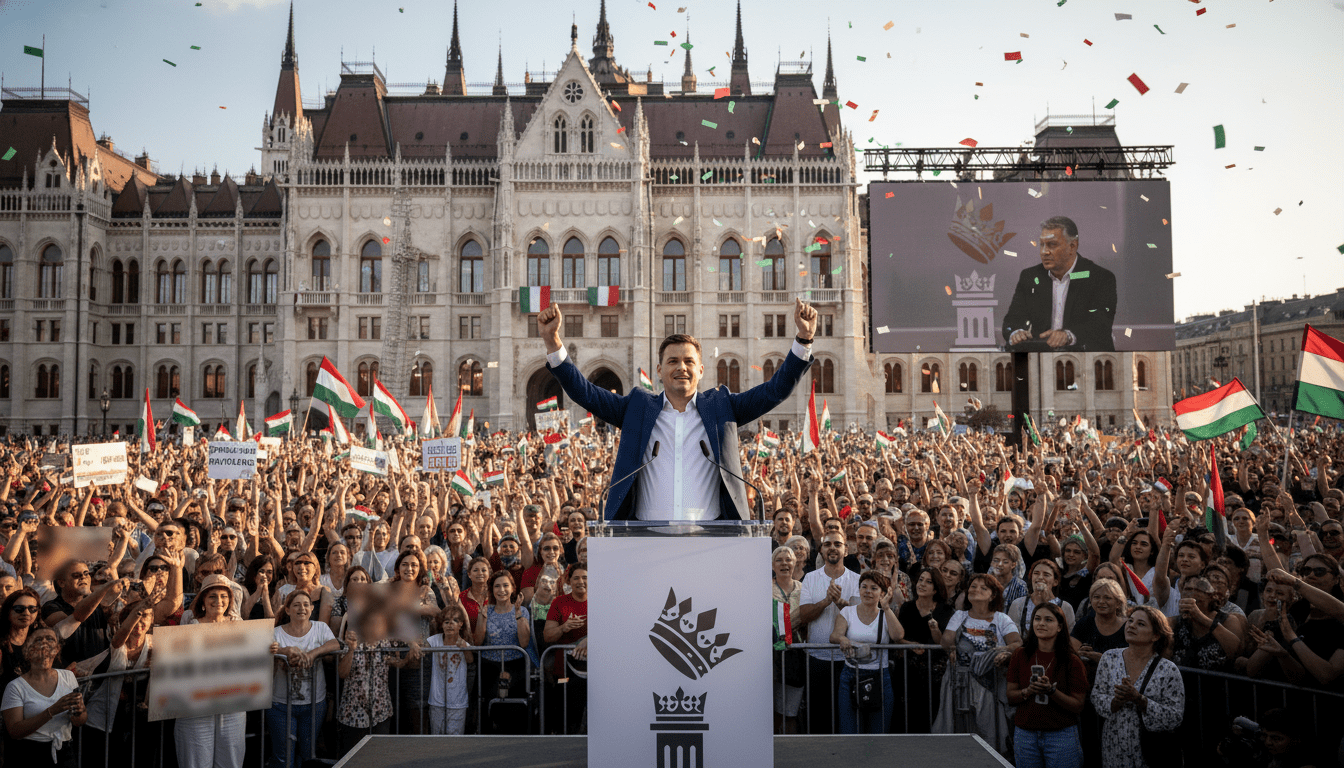
Scenes along the Danube and across central Budapest were marked by spontaneous and exuberant celebration as citizens reacted to Orbán’s concession and Magyar’s victory. Crowds of all ages embraced, sang late into the night and treated the outcome as a historic inflection point, drawing frequent comparisons to the popular movements of 1989. Conversations in cafes, on trams and in public squares have become dominated by questions about the future direction of policy and civic life.
Magyar’s early statements and tactical moves
In his first broadcast interviews, Magyar struck a combative tone toward the state news apparatus, calling it compromised and proposing to suspend the news division pending reform. Hours later he met with President Sulyok and, while maintaining civility in public, pressed for swift institutional changes and suggested the presidency had been rendered unsuitable by recent conduct. At the same time, Magyar has sent conciliatory messages to civil servants, acknowledging their role in maintaining public services and requesting cooperation to ensure an orderly handover.
Legacy of the ‘illiberal state’ and its limits
Analysts say the election marks a repudiation of the “illiberal democracy” model Orbán articulated in 2014, which prioritized national interest and centralized authority over liberal pluralism and competitive markets. Over successive terms, the state concentrated power in the executive, reshaped the judiciary and used public resources to build a sympathetic media and economic clientele. Those structural advantages produced electoral strength, but mounting economic strains, visible inequality and declining public services eroded broader popular support and made the governing model vulnerable.
Propaganda fatigue and the resilience of independent media
Observers note that, despite substantial state investment in pro-government outlets, dissenting and independent media outlets persisted and expanded their reach over time. The regime’s control of narrative weakened as citizens increasingly accessed alternative reporting and discussed politics in public and online forums. Even with a significant minority—estimated at roughly 38 percent—continuing to back Fidesz, the erosion of monopoly-control over information helped create the conditions for Magyar’s victory.
Tasks facing the incoming administration
Magyar inherits a short list of immediate priorities: stabilizing the civil service, restoring checks and balances, addressing economic weaknesses tied to cronyism, and reestablishing international confidence. He has signalled a willingness to recruit career experts within ministries and to rely on technocratic competence during the transition, but delivering tangible improvements quickly will be essential to sustain public trust. Political analysts caution that the durability of this change will depend on the new government’s ability to demonstrate better governance, reduced corruption and economic policies that improve ordinary living standards.
The election outcome in Hungary represents both a dramatic political reversal and the start of a delicate period of institutional reconstruction. As state institutions, courts and the presidency adjust to a new balance of power, the pace and tone of reforms—alongside economic performance—will determine whether the shift becomes a sustained democratic reset or a pause in a longer political contest. The next weeks will test Magyar’s capacity to convert electoral momentum into effective government.
