
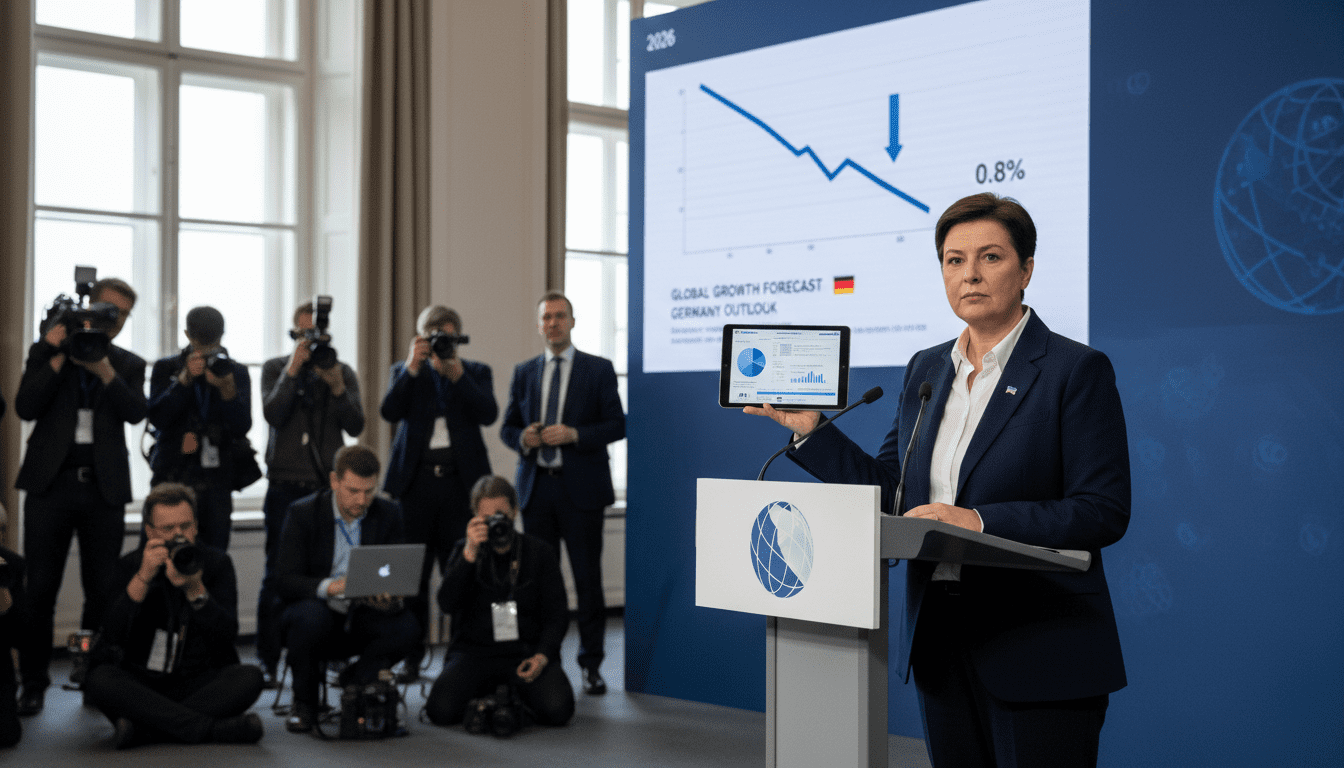
IMF growth forecast trims global outlook; Germany 2026 growth cut to 0.8% amid Iran conflict
IMF growth forecast lowers global expansion to 3.1% and cuts Germany’s 2026 GDP outlook to 0.8% as the Iran conflict and Hormuz blockade push energy costs higher now.
The International Monetary Fund released a revised IMF growth forecast that downgrades both global and German expansion for 2026, citing disruptions from the Iran conflict and a de facto blockade of the Strait of Hormuz. Germany’s 2026 growth projection was cut to 0.8 percent from a previous 1.1 percent, while the IMF trimmed its world growth forecast to 3.1 percent from 3.3 percent. The move comes as energy prices spike and supply routes remain uncertain, shaping a weaker near-term outlook for several economies.
IMF revises world and German GDP projections
The IMF’s spring update reduced its 2026 world growth forecast to 3.1 percent, reflecting disruptions tied directly to the Iran conflict and higher energy costs. Germany’s outlook was revised down to 0.8 percent for 2026, placing it below the IMF’s projected eurozone average of 1.1 percent.
IMF Chief Economist Pierre-Olivier Gourinchas told press agencies that without the conflict the fund would have lifted the global forecast to 3.4 percent, underlining that the downward adjustment “largely reflects disruptions caused by the conflict.” The IMF said its projections assume the conflict’s duration and intensity remain limited and that related economic disruptions subside by mid-2026.
Strait of Hormuz blockade fuels energy price surge
The IMF explicitly cited the de facto closure of the Strait of Hormuz as a principal driver of the revisions, noting the chokepoint handles roughly one-fifth of global oil and liquefied natural gas transit. Since late February 2026, attacks on tankers and regional oil infrastructure have pushed oil and gas prices sharply higher and raised shipping risk premiums.
Washington and other capitals have stepped up naval deployments and sanctions talk has intensified. U.S. President Donald Trump announced a blockade of Iranian ports in the Strait of Hormuz that the administration put into effect on April 13, 2026, a move aimed at curbing Tehran’s maritime operations but one that analysts say further complicates supply and insurance costs for global energy markets.
Domestic impact: Germany’s forecasts and fiscal implications
The downward revision complicates Berlin’s domestic planning, as the federal government had previously expected 1.0 percent growth for 2026 and relies on spring projections for tax revenue estimates. Leading German research institutes had already trimmed their GDP forecast to 0.6 percent, citing an “energy price shock” that risks rolling through industry and household budgets.
Lower growth translates into tighter public finances and could alter the spring budget calculus ahead of next year’s fiscal planning. A weaker tax base would reduce automatic revenue gains, prompting policymakers to weigh revenue adjustments, targeted support for affected sectors, or revisions to spending plans tied to headline growth assumptions.
Sectoral channels and business responses
Higher energy and shipping costs have immediate effects on manufacturing competitiveness, freight-intensive sectors and inflation readings across Europe. Germany’s export-oriented industries face rising input costs at a time when global demand is already rebalancing, squeezing margins and delaying investment decisions for some firms.
Businesses are responding with a mix of hedging, price pass-through and short-term cuts to discretionary spending. Energy-intensive companies and logistics firms are among the most exposed, and analysts warn that prolonged volatility could prompt supply-chain re-routing and longer-term shifts in sourcing strategies.
IMF caveats and conditional scenarios
The IMF emphasized that its forecasts depend on a relatively constrained conflict scenario: limited geographical spread, capped intensity and disruption that fades by mid-2026. If hostilities escalate or the blockade persists, the fund said downside risks would grow substantially and could lead to deeper and more widespread economic losses.
Policymakers face narrow choices: build buffers against a protracted energy shock or act quickly to stabilize financial and commodity markets. The IMF’s baseline reflects a best-effort accounting of current conditions, but it also flags the need for contingency planning if the situation deteriorates.
Regional outlook: who bears the brunt and who is insulated
According to the IMF outlook, advanced economies with diversified energy sources and substantial fiscal room—chiefly the United States—are expected to weather the shock better. The U.S. forecast was nudged down to 2.3 percent growth for 2026, a 0.1 percentage-point downgrade, reflecting relatively smaller exposure to oil route disruptions compared with some European economies.
Eurozone members with closer trade and energy links to the Gulf, and economies with limited fiscal flexibility, face more pronounced risks. Germany’s position below the euro-area average reflects both its industrial structure and the timing of the energy shock as domestic recovery was still consolidating.
Policymakers in Berlin and Brussels will need to balance short-term relief measures against medium-term fiscal sustainability and the inflation outlook.
The IMF’s revised projections underscore the fragility of the current recovery and the outsized role geopolitical shocks can play in economic forecasts, leaving governments and firms to brace for continued volatility as the situation in the Gulf evolves.
