
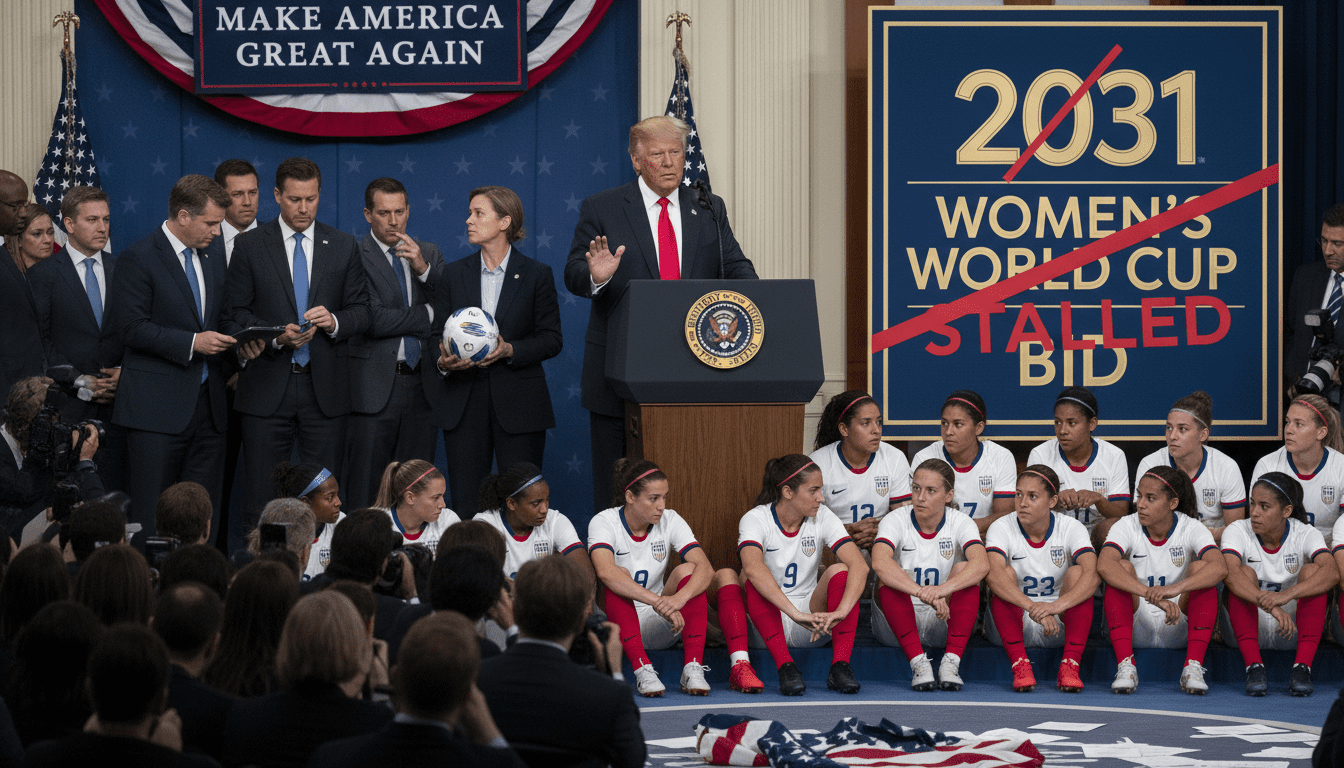
U.S. intervention in women’s sports stalls 2031 World Cup bid amid transgender athlete debate
White House directive on transgender athletes complicates FIFA guarantees for the U.S.-led bid to host the 2031 Women’s World Cup, heightening international tensions.
White House directive and the launch of an intervention campaign
A White House executive action issued days after President Trump’s inauguration has inaugurated what officials describe as a campaign of intervention in sports, explicitly urging that “men” be kept out of women’s competitions. The move frames the measure as necessary to protect safety, fairness and the integrity of women’s sport, language that has driven a contentious national debate. That intervention, centered on the treatment of transgender athletes, is now spilling into international sport governance and the hosting process for the 2031 Women’s World Cup.
Collegiate figures challenge the scale of the claimed issue
Supporters of the directive point to concerns about competitive balance, but available evidence cited by senior sports officials suggests the actual number of affected athletes is extremely small. At a Senate hearing, NCAA president Charlie Baker testified that he was aware of “fewer than ten” transgender athletes among roughly 500,000 collegiate competitors, a figure that undercuts arguments for sweeping federal mandates. Critics argue that broad policy responses risk stigmatizing a tiny population while failing to address the practical realities inside leagues and schools.
2031 Women’s World Cup bid caught in diplomatic crossfire
The U.S. Soccer Federation’s joint bid with Mexico, Costa Rica and Jamaica to host the expanded 48-team 2031 Women’s World Cup is facing an unexpected obstacle: FIFA requires host nations to provide state guarantees covering visa access for participants and fans and tax treatment of tournament revenue. FIFA has historically sought such assurances to protect operational and financial arrangements, but the White House has so far withheld the specific guarantees FIFA is seeking. The impasse prompted FIFA to postpone a planned award of hosting rights that had been expected at a congress in Vancouver last April, and the decision now awaits an extraordinary congress later this year.
Administration messaging and internal task force posture
Reporting by the New York Times indicates that officials involved in World Cup planning have been told the White House wants a firm stance aligned with its newly articulated standard for women’s sport. Andrew Giuliani, who has been described as directing a presidential task force on the men’s tournament, communicated that the administration endorses a policy rejecting the participation of men in women’s competitions "in general," citing fairness, safety and dignity. Those statements have been interpreted by FIFA and other stakeholders as a signal that Washington may condition or delay guarantees on the adoption of similar rules by international federations.
Responses from players, leagues and unions
The proposal has drawn sharp and divergent responses across the sport. High-profile voices such as former U.S. captain Megan Rapinoe have publicly attacked exclusionary measures, calling them unfounded and harmful to women’s sport. By contrast, some players and commentators, including voices in domestic leagues, have argued for stricter eligibility criteria; proposals have ranged from limiting participation to those assigned female at birth to implementing genetic or hormone testing protocols. Professional leagues like the NWSL currently lack league-wide rules on the issue and would face legal and collective-bargaining hurdles if they sought to impose new restrictions without players’ unions’ agreement.
Medical controversies and the Band a case study
The debate intersects with medical testing controversies highlighted by individual cases. Barbra Banda of Zambia, who identifies and competes as female, was excluded from the Africa Cup of Nations in 2022 after tests reportedly showed testosterone levels above a prescribed limit. FIFA later permitted Banda to play at the 2023 Women’s World Cup and at the Paris Olympics, illustrating inconsistent approaches among confederations and global governing bodies. The Banda case underscores the practical and ethical complexity of applying medical criteria to eligibility and the potential for divergent outcomes between regional bodies and FIFA.
Potential international fallout and calendar implications
Because FIFA requires host-government guarantees as part of any award, continued reluctance from the White House could delay or complicate the 2031 bid’s prospects and trigger broader diplomatic friction with co-host nations. Football stakeholders warn that politicizing eligibility rules risks fragmenting international consensus and could force FIFA into difficult choices about regulatory changes versus hosting logistics. The deferred decision and the prospect of an extraordinary congress leave member associations and commercial partners waiting for clarity that will affect planning timelines and investment decisions.
The dispute places global sport governance at the center of a domestic political debate, forcing federations, players and governments to weigh legal, scientific and ethical considerations while under public scrutiny. The outcome of the U.S. posture on transgender athletes and the related guarantee negotiations will likely shape not only the 2031 Women’s World Cup bid but also broader policies on athlete eligibility and international sporting cooperation.
