
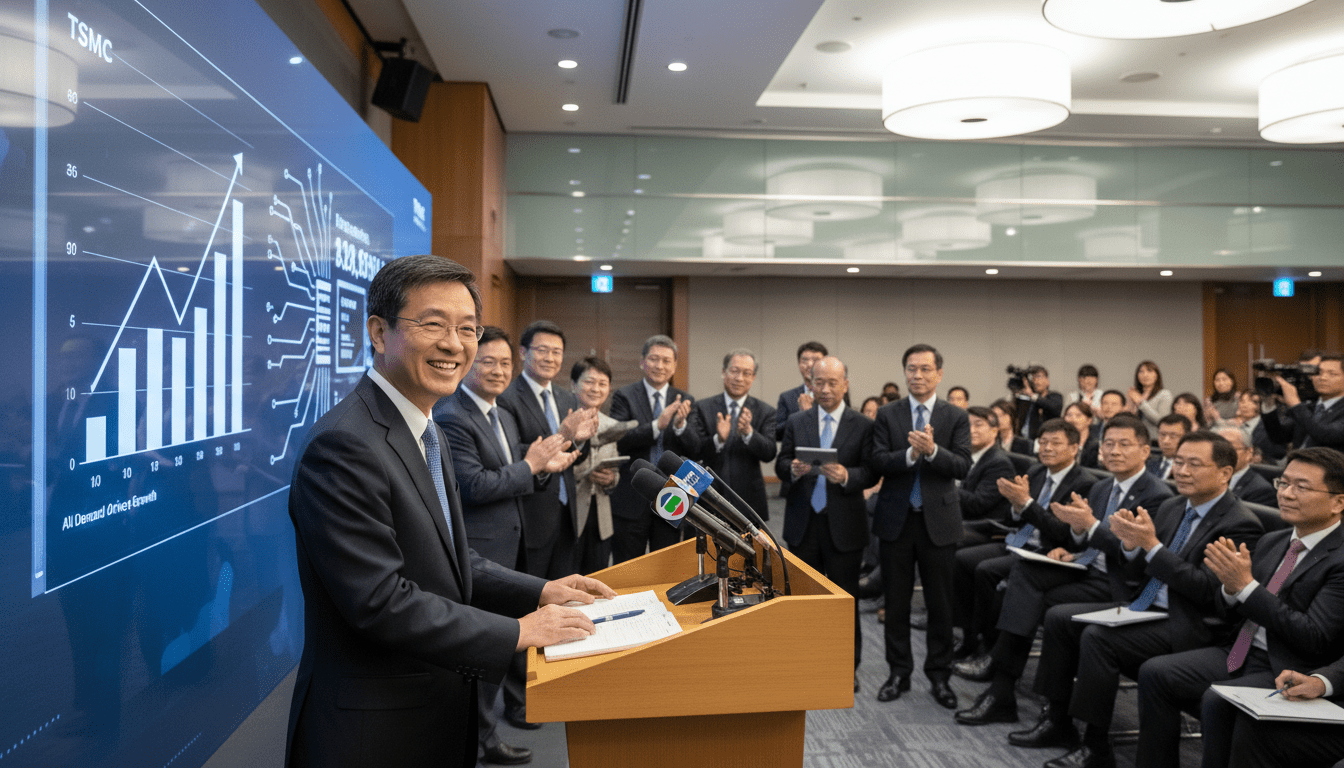
TSMC revenue jumps 35% in Q1 as AI demand drives record sales
TSMC revenue surged 35% in the first quarter to €30.5 billion, boosted by strong demand for AI processors and robust orders from global chip customers.
The world’s largest contract chipmaker, Taiwan Semiconductor Manufacturing Company (TSMC), reported a sharp rise in TSMC revenue for the first quarter, with sales climbing 35 percent to about €30.5 billion. Company officials attributed the growth to rising demand for high-performance processors used in artificial intelligence systems, marking a notable acceleration from the pace at the end of 2025.
Q1 Revenue Surge and Currency Note
TSMC recorded a 35 percent year-on-year increase in quarterly sales, a leap that translated into roughly €30.5 billion in revenue.
The company said the gain represented an acceleration of more than half compared with growth at the close of 2025, underscoring a faster momentum entering the new fiscal period.
This spike in TSMC revenue reflects stronger-than-expected demand for advanced foundry services, particularly for chips designed for AI workloads and data-center acceleration.
AI Chip Demand as Primary Driver
TSMC pointed to sustained demand for high-performance processors used in artificial intelligence as the principal factor behind the revenue uptick.
Customers building AI servers and accelerators have been ordering processors manufactured on TSMC’s most advanced process nodes, increasing utilization of the company’s cutting-edge fabs.
That shift toward AI-related workloads has lifted average selling prices and factory throughput for the contract manufacturer, contributing directly to TSMC revenue growth.
Implications for Global Chip Supply
The jump in TSMC revenue highlights the tight link between AI adoption and global semiconductor supply chains.
Foundry capacity for advanced nodes has become a bottleneck as cloud providers, hyperscalers, and AI hardware vendors expand their fleets of AI accelerators.
TSMC’s stronger sales suggest near-term pressure on lead times for the most advanced chips, which could affect technology road maps and procurement plans across the industry.
Financial Position and Operating Trends
Alongside sales growth, TSMC’s operating metrics indicate improving utilization across its production network.
Higher demand has lowered per-unit fixed costs and supported margin expansion on leading-edge products, according to company statements.
Investors and market watchers will closely monitor whether this revenue surge translates into sustained profit gains as TSMC balances capacity investment and pricing dynamics.
Capacity Investment and Production Plans
To meet rising orders, TSMC has signaled continued emphasis on expanding capacity at premium process nodes over the medium term.
Planned investments in new tooling and wafer starts aim to raise output of the advanced logic chips that power AI accelerators and high-end servers.
The pace and location of that investment will play a central role in how quickly the market eases on availability and what pricing dynamics look like for AI-optimized processors.
Customer Mix and Market Position
As the world’s largest contract chipmaker, TSMC’s customer base spans major cloud providers, fabless designers, and global systems vendors.
The company’s dominant position in advanced process technologies gives it leverage in attracting large-volume orders for AI chips, helping to drive the recent rise in TSMC revenue.
How demand evolves among key customers and whether competitors expand capacity at scale will shape TSMC’s market share and pricing power over the coming quarters.
The surge in TSMC revenue in the first quarter underscores how the rapid rollout of artificial intelligence across industries is reshaping semiconductor demand and capital allocation. The coming months will reveal whether current orders convert into sustained higher utilization and margins, and how quickly the industry can scale advanced production to match the needs of AI compute growth.
