
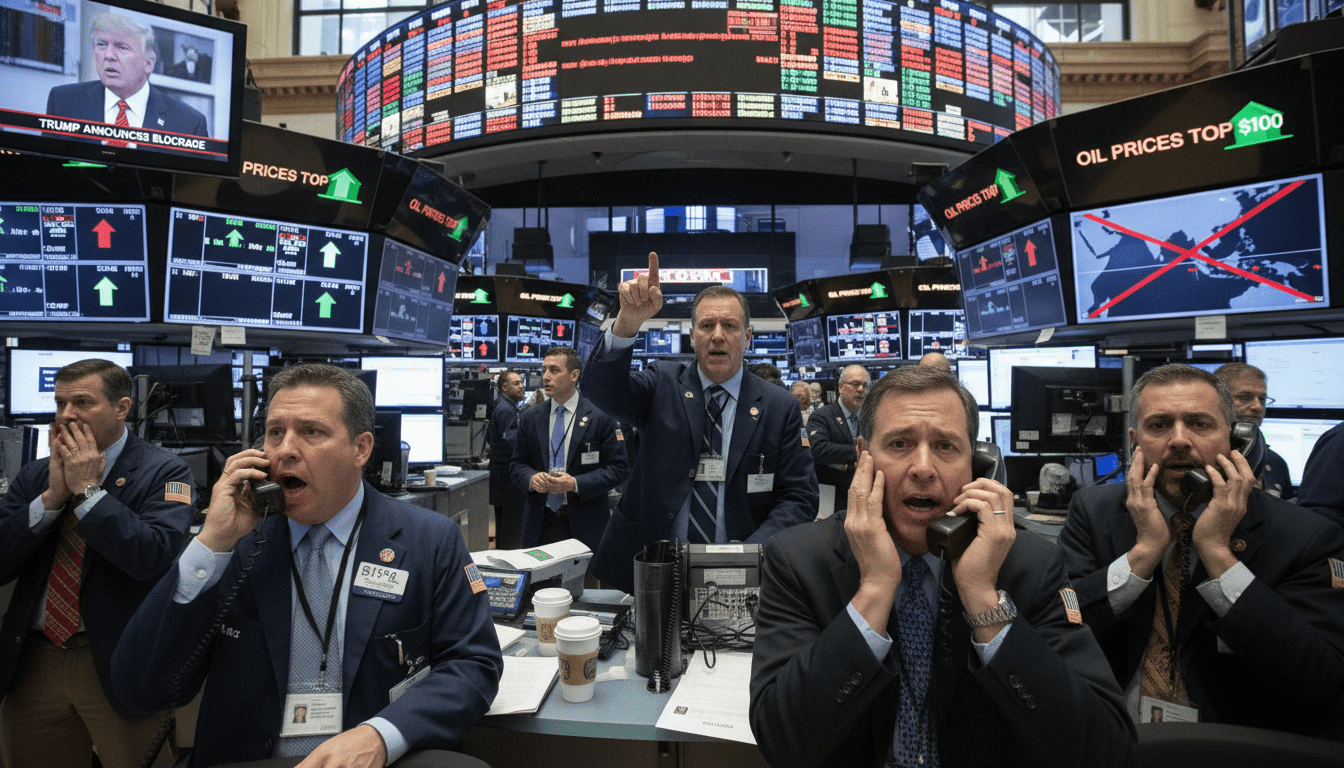
Strait of Hormuz oil prices surge past $100 after US announces blockade
Strait of Hormuz oil prices spike above $100 as US orders blockade starting April 13, 2026, at 16:00 MESZ, prompting tanker diversions, market volatility and political risk.
The price of oil jumped sharply after failed talks between the United States and Iran and a U.S. announcement to block maritime traffic to and from Iranian ports, pushing Brent crude above $100 a barrel. Market participants cited immediate shipping disruptions through the Strait of Hormuz and renewed supply concerns as the main drivers of the move. Traders also flagged the risk that sustained higher oil prices will feed into inflation and broader economic anxiety ahead of the U.S. congressional elections.
US orders blockade of Iranian ports to begin April 13, 2026
The U.S. Central Command said the stoppage of ship movements to and from Iranian ports would begin on April 13, 2026, at 16:00 Central European Summer Time (MESZ). The measure followed the collapse of late-night negotiations aimed at halting the conflict between the United States and Iran. President Donald Trump told U.S. media the move was intended to isolate Iranian maritime activity, a decision he acknowledged could keep fuel prices elevated through November’s congressional elections.
The announcement represented a significant escalation in maritime policy for the region and was framed by U.S. officials as a security and enforcement action. Details released by the command described a targeted halt to traffic tied directly to Iranian ports, rather than a blanket interdiction of commercial shipping across the entire Gulf region.
Immediate spike as Brent tops $100, WTI follows
Oil benchmarks reacted within hours, with Brent crude rising about eight percent to roughly $102.80 per barrel and U.S. West Texas Intermediate also gaining ground for May delivery. Before the talks collapsed, Brent had been trading near $95.20 per barrel, underscoring how rapidly geopolitical events have reverberated through physical and paper markets.
Analysts said the price surge reflects the market’s fear of lost supply and higher transportation costs rather than an instantaneous physical shortfall. Still, commodity strategists warned that if shipping through the Strait of Hormuz becomes restricted for any sustained period, the impact on global inventories and refine-throughput could be material.
Tanker traffic avoids the strait as ship data shows diversions
Real-time shipping data from industry trackers indicated an immediate behavioral shift by tanker operators. A Maltese-flagged supertanker reportedly turned back before transiting the Strait of Hormuz and anchored in the Gulf of Oman; the vessel had been scheduled to load Iraqi crude for delivery to Vietnam. Those movements were tracked by market data providers tracking vessel positions and trade flows.
At the same time, a small number of vessels continued into the Gulf, with two tankers under Pakistani registry and one flying a Liberian flag entering as scheduled. Shipping insurers and charterers are already revising routing and coverage, and some operators are opting to reroute via longer, more expensive passages to avoid heightened risk near Iran’s coastal waters.
Tehran rejects blockade and warns of countermeasures
Iranian military officials dismissed the U.S. move as "ridiculous and absurd" and vowed to monitor and control any hostile activity in the area. The head of the Iranian navy, Shahram Irani, said Iran would track the deployments of U.S. forces and asserted that the Islamic Revolutionary Guard Corps would treat any military ship approaching the Strait of Hormuz as a violation of the ceasefire, pledging to respond.
The Revolutionary Guard’s earlier statements that ships nearing the strait would be regarded as breaching a truce add to the volatility, according to regional security experts. That rhetoric increases the likelihood that even noncombatant merchant vessels could be caught between opposing directives from state actors and naval forces operating in close proximity.
Analysts warn of lost Iranian exports and tighter supply
Energy market analysts estimated that preventing Iranian exports through the strait could remove up to two million barrels per day from seaborne flows, a level that would tighten an already fragile market. Saul Kavonic of the analysis firm MST Marquee and banking analysts cited by market observers warned that such a reduction would amplify existing supply constraints and pressure refining margins.
Financial institutions including major regional banks noted the risk to global oil balances and the potential for sustained price volatility. Market commentary also highlighted the knock-on effects for consumer fuel prices and transportation costs in import-dependent economies, with political fallout likely to intensify in affected jurisdictions.
European shipowners and insurers remain cautious
The German Shipowners’ Association (Verband Deutscher Reeder) said there was limited reason to assume a near-term easing of the situation and pointed to additional operational risks such as the possible presence of mines in the strait. Removing maritime mines, if present, would be a technically challenging step toward restoring normal traffic, the association added in remarks reported by news agencies.
Insurers and classification societies have already signaled heightened premiums for voyages near the Gulf and are reviewing guidance to vessel operators. That reassessment is expected to increase shipping costs and could reshape freight flows for crude and refined products until regional waters are deemed secure.
Global oil markets will remain sensitive to further developments in the coming days as traders reassess inventories, shipping routes and geopolitical risk premia. The announced U.S. blockade and Iran’s responses introduce new uncertainty into a supply chain that had already been strained by earlier disruptions.
Geopolitical frictions around the Strait of Hormuz will likely keep oil prices and transport costs under close watch, with policymakers and market participants monitoring both naval movements and diplomatic channels for signs of de-escalation or further confrontation.
