
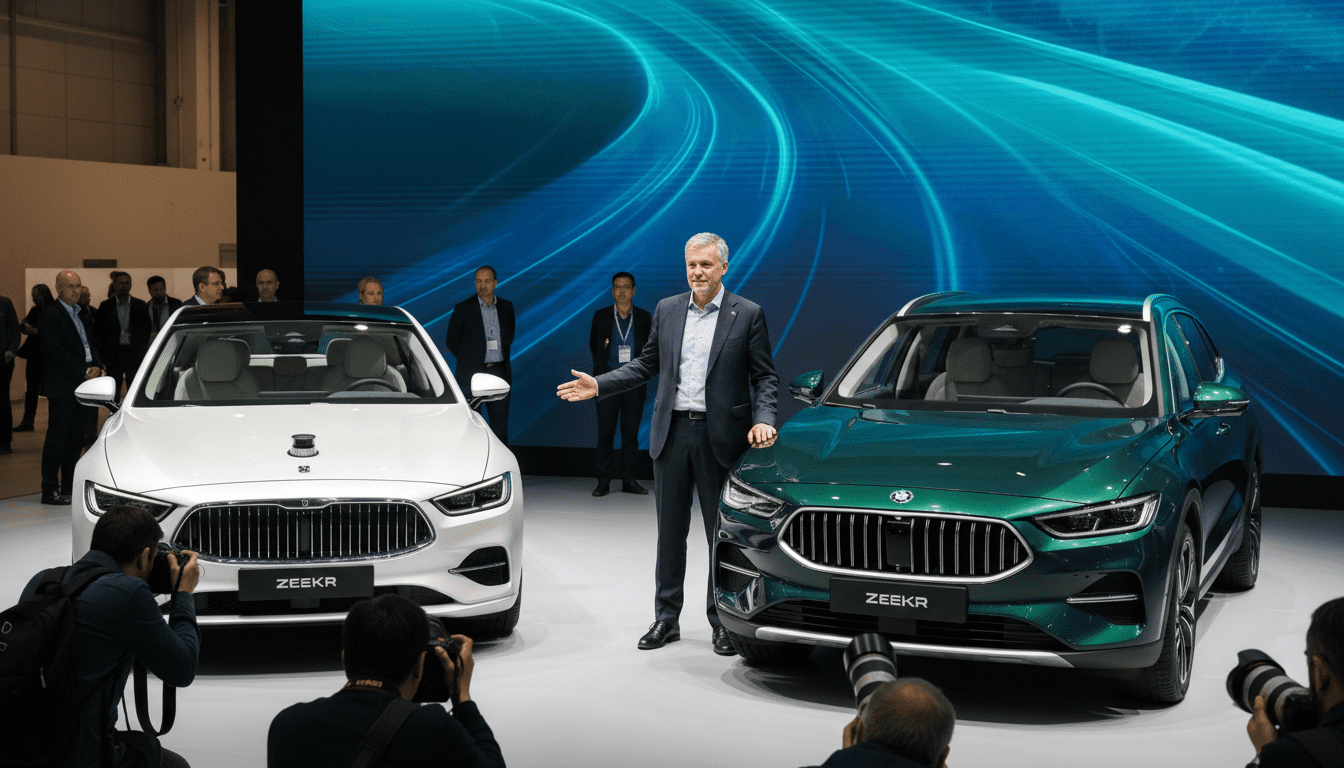
Stefan Sielaff on Chinese Car Design: Zeekr, Lynk & Co. Seek Stronger Brand Identity
Stefan Sielaff explains how Chinese car design at Geely—from Zeekr to Lynk & Co.—is shifting toward clearer brand identity, luxury models and hybrid strategies.
Stefan Sielaff, the former Audi and Bentley designer now leading design for Geely brands, says Chinese car design is entering a phase of clearer brand definition after an initial period of visual experimentation. He describes how early electric models shared similar, grille-free faces and how newer products are being refined with distinct identity markers. His comments illuminate why Zeekr and Lynk & Co. are changing stylistic approaches as they prepare for European markets and premium segments.
Expert view on current recognition challenges
Sielaff acknowledges that even experts can struggle to distinguish Chinese marques at a glance, particularly in dense urban settings such as Shanghai. He attributes this partly to the rapid pace of model introductions and a transitional period in which many manufacturers emphasized simplified EV faces. The designer frames this as a temporary stage that will give way to stronger and more consistent brand cues.
Origins of visual similarity among EVs
According to Sielaff, the initial wave of Chinese electric vehicles adopted smooth, grille-less fronts as a visible shorthand for “electric,” which produced a degree of uniformity across brands. That choice created easy recognition for powertrain type but blurred brand lines, he says. As product ranges mature, manufacturers are reintroducing elements that convey individual identity rather than only technical differences.
The grille’s comeback and aesthetic trade-offs
Sielaff notes a broader industry reversal where even brands that technically no longer require traditional radiators are reinstating grille-like elements for visual reasons. He argues that consumers rarely needed to differentiate engines by appearance historically, and the same logic applies to EVs. In practice, some of Geely’s newer vehicles already incorporate grille treatments because their drivetrains include plug-in or hybrid configurations rather than being pure battery-electric models.
Finding the middle ground between individuality and family likeness
Drawing on his European background, Sielaff explains his design philosophy: neither a catalog of unrelated model personalities nor a strict “Matryoshka” family face is ideal. He favors a balanced approach that allows a recognizable brand identity to coexist with distinct model characters. This strategy, he believes, will help Chinese brands develop a coherent image while preserving product-level differentiation.
How Zeekr and Lynk & Co. will diverge
Sielaff outlined concrete positioning moves within the Geely group: Zeekr will push further into the luxury territory, including models that target premium buyers and fleet clients in Central Europe. Lynk & Co. is being steered toward younger buyers and urban customers, while Geely-branded vehicles will occupy mainstream segments. He also mentioned an eventual top-tier luxury offering comparable to a Maybach within the broader group architecture.
Design signatures and market realities
The designer says Zeekr’s future cars will feature a signature grille and a clearer logo as part of the “Imagine Beyond” identity being rolled out in China. He warned that such visual elements take time to build consumer recognition, especially compared with century-old European emblems. Sielaff also stressed practical constraints: color palettes for early European-market models are conservative because of fleet and leasing considerations, which limit designers’ freedom to introduce bold hues.
Studio expansion and cross-cultural collaboration
Sielaff described the logistical and cultural challenge of building design capacity from scratch, noting new studios in Shanghai and Göteborg as key to the effort. He said this dual presence facilitates cultural exchange and speeds product development, enabling eleven new models to reach the market during his five-year tenure. The Göteborg studio, he added, was created to match top global design facilities and to anchor European influence in the process.
Geely’s design trajectory, as explained by Sielaff, reflects a broader industry shift: rapid product cycles demanding early clarity of brand identity, pragmatic choices tied to market realities, and an increasingly globalized design process. The company’s next steps—stronger logos, grille motifs, and differentiated brand strategies—aim to make Chinese car design instantly recognizable in crowded markets while still allowing distinctive model personalities to emerge.
