
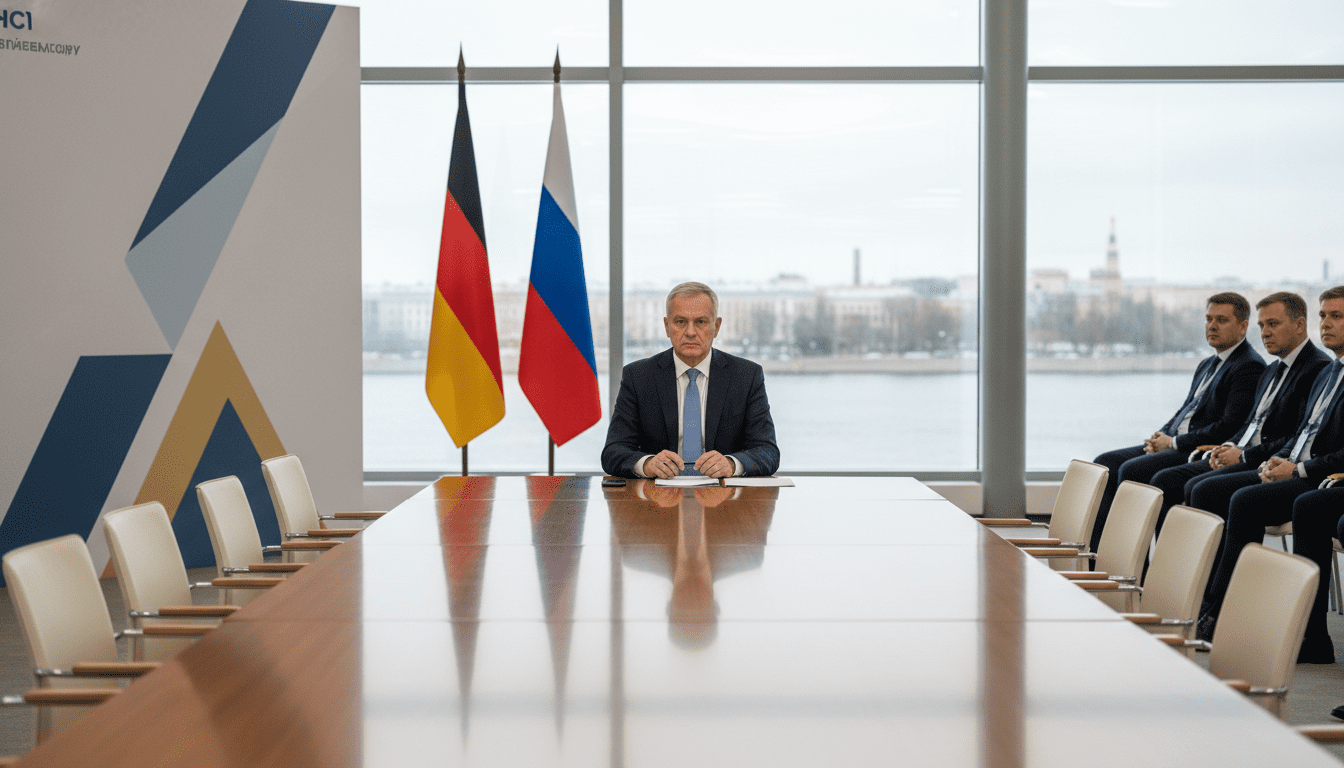
German business in Russia reduced to a single visible presence at St. Petersburg forum
Only a handful of German executives attended the St. Petersburg Economic Forum, with Thomas Bruch the lone major business representative amid political criticism.
Germany’s expected delegation to President Vladimir Putin’s International Economic Forum in St. Petersburg largely failed to materialize, leaving the event’s German footprint confined to a single “Business-Dialog” session. The reduced turnout sharpened scrutiny at home about the optics and risks of continued economic engagement, as one prominent retailer and a few long-established Russia-based entrepreneurs dominated the discussion. The episode raised fresh questions about how firms balance commercial interests with political and reputational concerns while under Western sanctions and public pressure.
Sparse German presence at the forum
Organizers and Russian officials had promoted what they described as a substantial German participation, but the reality on the ground was different. Instead of a large official trade mission, the program showed one German-led business discussion that drew only a handful of participants with direct ties to the Russian market. The contrast between the announced expectations and the small delegation underscored how divided corporate Germany remains over doing business in Russia.
Thomas Bruch as the principal business face
Thomas Bruch, the former long-time head of the Globus group, emerged as the most visible German business figure at the event. Now in his mid-70s and having ceded control of the wider holding to his son, Bruch continues to run the company’s Russian operations independently, overseeing roughly 20 hypermarkets and about 10,000 employees in the Moscow region. On the panel he framed the retailers as essential providers of everyday goods and said their operations aligned with decisions taken by the German government, stressing continuity and local supply responsibilities.
Podium composition and the absence of war criticism
The “Business-Dialog” was moderated by the head of the Moscow-based German-Russian Chamber of Commerce and featured a mix of German advisers and Russian industry figures. Among the other speakers were an adviser to the state-linked Gazprom, a Severstal representative from the steel sector, and executives who acquired former Western company assets when those firms exited the market. The session notably lacked public criticism of Russia’s military actions in Ukraine, a silence that critics said strengthened the impression of normalization.
Political backlash in Berlin
Reaction from German politicians was immediate and sharply critical, with lawmakers warning that participation could be interpreted as normalizing Russia’s conduct. Members of the governing coalition said the business appearances risked undermining unified Western pressure and could send the wrong signal amid ongoing sanctions. One Bundestag deputy argued that such engagement, particularly by high-profile representatives, blurred the line between commercial activity and political endorsement.
Sanctions, subsidies and local advantage
Speakers with deep roots in Russia described how shifts in policy and trade since 2014 reshaped opportunities on the ground, particularly in food production and retail. Agriculture entrepreneur Stefan Dürr, who runs one of Russia’s largest dairy businesses, outlined rapid growth in domestic production and said the company now supplies millions of tonnes of milk annually. Dürr also acknowledged that measures introduced after 2014 — Russia’s import restrictions on some Western foodstuffs — accelerated demand for domestic producers, a dynamic that critics say was reinforced by generous local support and market protection.
Commercial calculus and reputational risk
Several participants framed continued operations as a matter of providing essential goods and preserving jobs, while downplaying political implications. Company representatives told employees and stakeholders that withdrawal could bring severe consequences, including the risk of nationalization or punitive measures in a market where foreign firms already face state pressure. At the same time, critics inside and outside Germany highlighted the potential reputational costs and legal complexities for firms that maintain deep commercial ties to Russia amid sanctions and public scrutiny.
The St. Petersburg event laid bare the split between public expectations and private decisions among German businesses tied to Russia. For some executives, the calculus remains driven by existing investments, market share and employee responsibilities; for others, political and ethical considerations have prompted retrenchment or exit. The uneven representation at the forum is likely to prolong debates in Berlin and boardrooms about when and how German businesses should disengage from a market where commercial opportunity collides with geopolitical consequence.
