
West Bank violence surges after deadly Nablus clash; settlers attack villages and Israeli army launches raids
Violence erupts across the West Bank after a deadly confrontation near Nablus, with settler assaults, widespread arson and Israeli military operations leaving multiple dead, dozens detained and communities under lockdown.
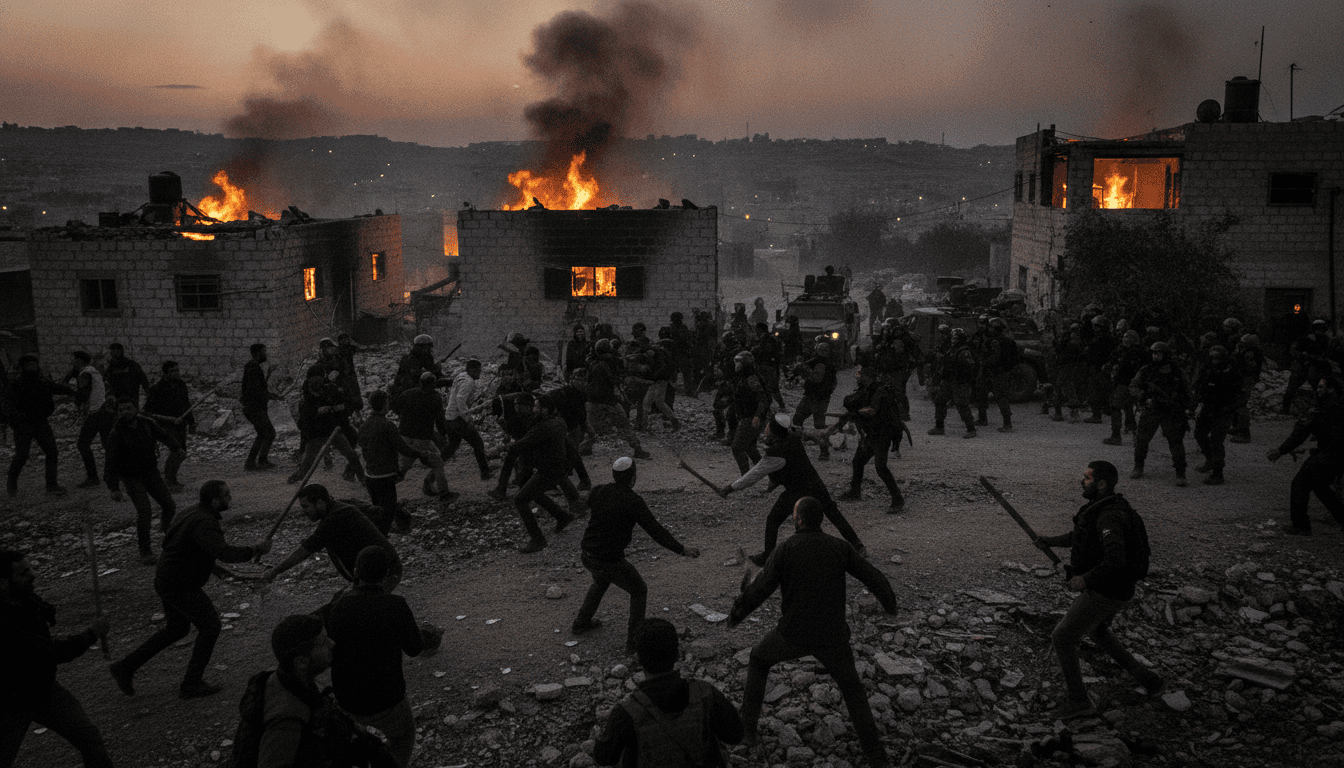
A wave of West Bank violence unfolded over the weekend after a lethal clash near the city of Nablus that left two Israelis and four Palestinians dead, according to local and Israeli authorities. Images and video from the occupied territory showed thick smoke, burned-out vehicles, scorched fields and damaged homes as settlers and security forces moved through Palestinian villages. The escalation has combined retaliatory attacks by settlers with sweeping Israeli army raids, increasing fear and movement restrictions for civilians across the region.
Settler Attacks Spread Across Northern West Bank
Settler groups carried out a series of attacks on Palestinian villages following the Friday confrontation, according to Palestinian reports and local witnesses. Houses were set alight, fields and vehicles were burned, and roadblocks were erected that hampered access for residents and emergency services.
Two mosques were targeted in apparent arson attacks, and a wall near one site was sprayed with the words “Rache Benayahu” alongside a Star of David. Palestinian residents said that one village was assaulted twice within hours, and that settlers fired at passing cars near Bethlehem.
Deadly Confrontation Near Nablus Sparked Wave of Violence
The initial violence erupted near the village of Tell southwest of Nablus, where a confrontation between villagers and a group of roughly 30 Israelis — including some youths — escalated into gunfire. Witnesses described a struggle during which, they said, Palestinians seized a weapon from an Israeli; shots were then exchanged among villagers, settlers and soldiers.
Palestinian officials characterized the episode as an attack by “settler militias,” while the Israeli army described it as a terrorist incident targeting Israeli hikers, a framing echoed by national political leadership and many domestic media outlets. Details remain contested and under investigation by authorities on both sides.
Israeli Military Conducts Large-Scale Raids and Arrests
Israel’s military Chief of Staff ordered an extensive “counterterror” operation immediately after the killings, saying security forces would pursue those responsible. The army reported that more than 70 people had been detained by Saturday amid raids across the area, and said troops entered medical facilities in Nablus to arrest individuals who had been treated for gunshot wounds.
Parts of the West Bank were sealed off as soldiers established checkpoints and blocked routes into Nablus, measures that local rights groups said impeded ambulances and civilian movement. An Israeli human-rights organization reported that two heavily pregnant women gave birth in ambulances after access to hospitals was restricted.
Plans for Home Demolitions and Movement Restrictions
Military units produced diagrams of several family homes belonging to Palestinians whom the army identified as participants in the attack, and officials said those houses could be demolished as a deterrent. Home demolitions have become an increasingly frequent punitive tool, a practice critics call collective punishment while supporters describe it as a security response.
Movement controls and road closures around flash-point communities remained in place through the weekend, leaving many Palestinians unable to reach workplaces, markets or medical care. Residents described a heightened sense of vulnerability as checkpoints and patrols multiplied.
Political Directives: Netanjahu and Katz Order Action
Prime Minister Benjamin Netanyahu and Defense Minister Israel Katz announced a series of measures intended to punish perpetrators and prevent further attacks, signaling a tougher security posture. Officials said they would step up operations in villages viewed as hubs of militant activity and accelerate procedures to legalize existing outposts and establish new ones.
Netanyahu invoked the language of dismantling “terrorist nests,” and the government’s stated policy of reinforcing settlements was followed by immediate action from settler groups on the ground. Critics warn that responding to violence with expedited settlement measures risks deepening tensions rather than reducing them.
Settlement Expansion and New Outposts Erected Overnight
Within hours of the confrontation, settlers erected tents at four locations in the northern West Bank and staged what activists describe as “hikes” or “wandering” tours intended to assert presence and provoke. One such group attempted to pass through Tell en route to another outpost, a move that residents and experts say is deliberately confrontational.
Settlement researchers and Israeli analysts contend that extremist settler factions increasingly seek escalation. Dror Etkes, a leading expert on settlements, described these hikes as “provocative tours” designed to signal that settlers will operate freely, and singled out certain outposts as hubs of militant behavior.
Local Voices and Humanitarian Consequences
Civilians on both sides bore the brunt of the violence: dozens were injured in clashes and raids, many were detained, and several families reported losing homes or crops to fire. The seizure of medical facilities for operations and the interruption of emergency services heightened alarm among humanitarian organizations operating in the West Bank.
The unrest also produced isolated incidents elsewhere in the territory, including a separate case in the south where a Palestinian man disarmed an Israeli during a scuffle; that episode did not lead to fatalities. Observers warn that the erosion of the “barrier of fear” — the deterrent that had previously kept many civilians from using lethal force to defend property — could make further violent confrontations more likely.
The immediate aftermath of the Nablus confrontation left communities across the West Bank on edge as security operations, settler mobilization and political moves by Jerusalem combined to deepen a volatile cycle of retaliation and repression. Observers and local leaders warned that without rapid de-escalation measures the violence could spread further, complicating prospects for calm in the occupied territory.
