
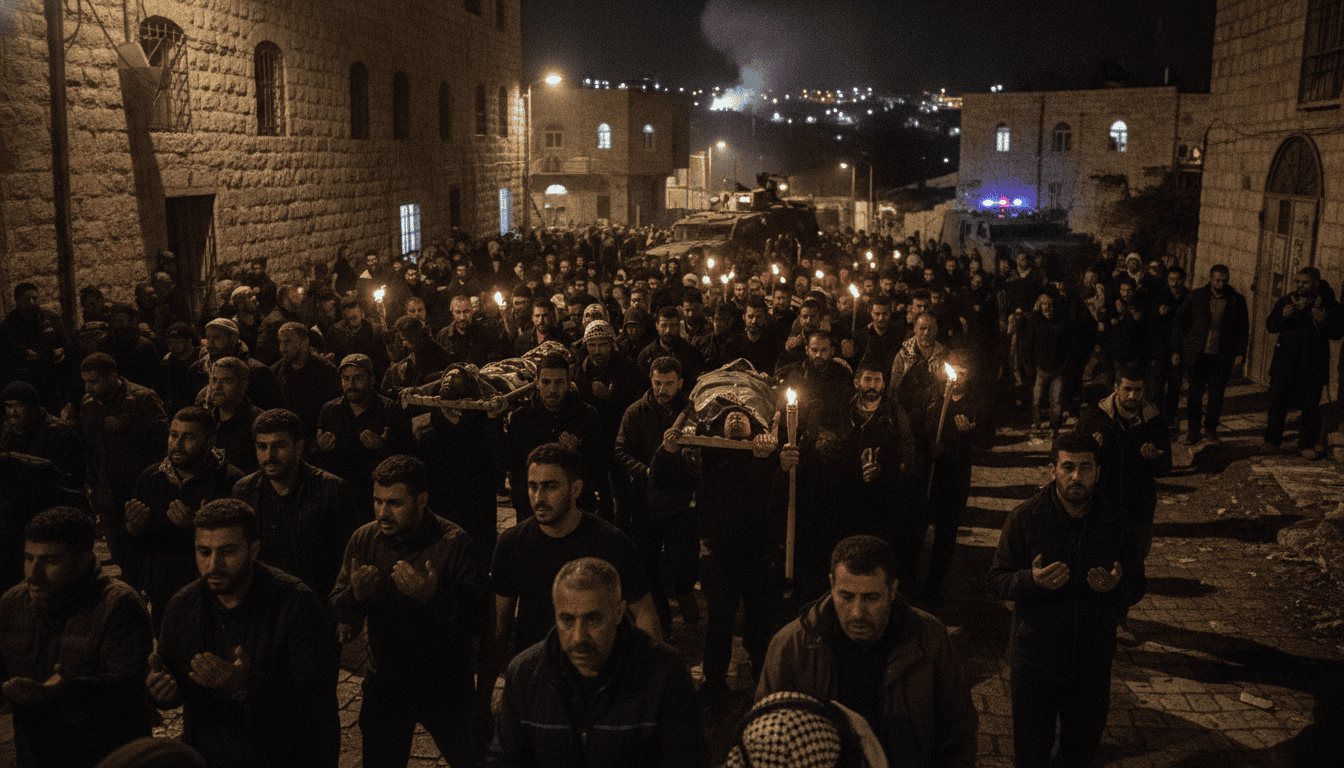
West Bank violence near Nablus: Funerals held after deadly clash leaves four Palestinians dead
Funerals held overnight for four Palestinians killed near Nablus after a confrontation between settlers, soldiers and villagers on July 24–25, 2026, deepened fears of renewed West Bank violence.
Deadly clash in Tal and the Nablus area
On July 24, 2026, violence erupted in and around the Palestinian town of Tal, southwest of the city of Nablus, leaving four Palestinians dead and at least one Israeli killed during the confrontation, local and international reports said. The incident followed an encounter between a group of Israeli settlers and residents of Tal that escalated into shooting and wider clashes across nearby villages. (investing.com)
The sequence of events remained contested, with different accounts from Palestinian health officials and the Israeli military about the deadly exchange. Hospitals in Nablus received multiple casualties and images from local media showed distraught relatives gathering over bodies brought in from the scene. The unrest prompted a swift and extensive security response across the northern West Bank. (apnews.com)
Conflicting official accounts of what triggered the violence
Palestinian officials and local leaders in Tal said the confrontation began when a large group of armed Israeli settlers entered the area, attempted to break into homes and opened fire, prompting residents to rush out to defend their properties. Local Fatah figures and village sources described the settlers’ actions as an aggressive raid. (1-e8259.azureedge.net)
By contrast, the Israeli military and emergency services said troops were deployed after reports that Israeli civilians hiking near the Havat Gilad settlement had been attacked and that a Palestinian had snatched a weapon and opened fire at the group. Israeli statements said soldiers responded to protect civilians and later pursued suspects in the area. These divergent narratives underpin the immediate dispute over responsibility for the deaths. (investing.com)
Funerals and local mourning overnight into July 25, 2026
Funerals for the four Palestinians were held overnight into July 25, 2026, as families and community members gathered in Nablus to bury the dead amid heavy military presence and tight security measures. Video and photographic coverage showed crowds mourning outside hospitals and bodies being transferred under escort, according to local reporters. The burials came as residents described a climate of fear after recent weeks of heightened settler activity in the area. (apnews.com)
Palestinian health authorities said several others were wounded in the clashes, including some in critical condition, and appealed for medical access while checkpoints and roadblocks limited movement to and from Tal. Ambulance and hospital staff reported difficulty reaching some injured people as security cordons tightened in the immediate aftermath. (1-e8259.azureedge.net)
Israeli military operations and movement restrictions
Following the July 24 incident, Israeli forces imposed a security cordon around Nablus and Tal, set up roadblocks and announced manhunts for those suspected of involvement, the military said. Troops increased their presence across the northern West Bank as authorities described plans for broader counterterror operations in the area. (investing.com)
Officials in Jerusalem said they would convene emergency meetings to determine next steps and urged a firm response to the killing of Israelis in the incident. In some statements, senior Israeli politicians called for punitive measures that included home demolitions and revocation of work permits for suspected perpetrators. Those calls intensified alarm among Palestinians who said such responses would amount to collective punishment. (apnews.com)
Human rights groups and international concern
Human Rights Watch and other rights organisations warned the killings risked spiralling into wider abuses unless authorities acted to stop settler violence and protect civilians. HRW highlighted a broader pattern of increasing settler attacks in the northern West Bank this year and urged the Israeli government to halt reprisals that could lead to mass atrocities. International agencies and humanitarian observers have repeatedly flagged the Nablus area as a flashpoint. (hrw.org)
UN and aid officials have recorded a rising toll of West Bank fatalities in 2026 and expressed concern that punitive measures and unrestrained settler actions would worsen the humanitarian situation. The combination of settler raids, military raids and restricted access to medical care has compounded tensions and drawn repeated international calls for restraint. (apnews.com)
Risk of wider escalation and local fears
Residents in Tal and neighbouring villages warned that Friday’s events could spark further retaliation and cycles of violence across the northern West Bank, especially given recent months’ spike in settler incursions. Community leaders and local officials described the area as effectively under siege during and after the confrontations, voicing fears of more raids and punitive operations. (1-e8259.azureedge.net)
Israeli calls for decisive action following the death of Israelis will test whether security forces pursue de-escalation or measures likely to inflame tensions, analysts said. For now, the heavy presence of soldiers and settlers around Palestinian towns, and the continuing closure of routes in and out of Nablus, have left civilians bracing for contact that could produce more casualties. (apnews.com)
The immediate aftermath of the July 24–25 clashes has left families grieving and communities on edge while conflicting accounts of the confrontation continue to drive a volatile security and political situation in the West Bank.
