
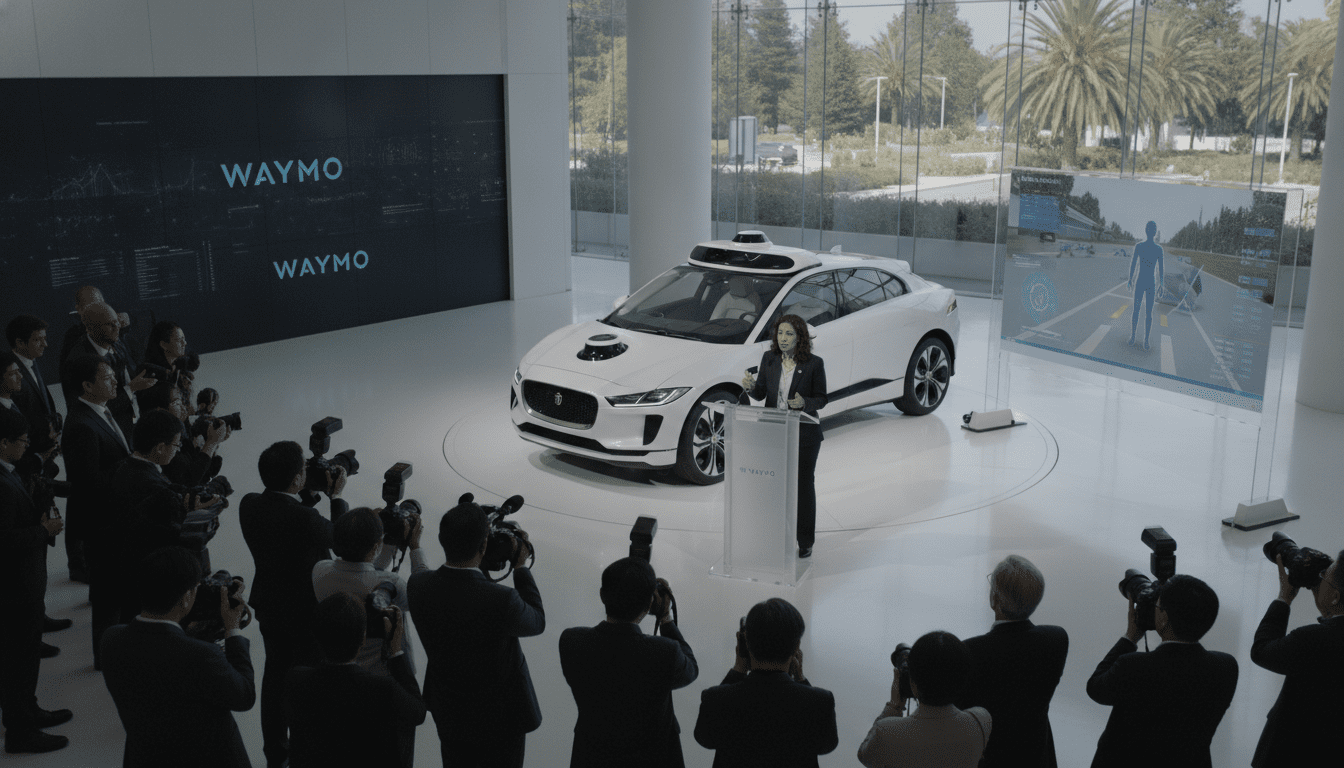
Waymo Reference Driver: new human driver model aims to benchmark autonomous safety
Waymo’s Reference Driver model benchmarks autonomous vehicles against human drivers using active inference, improving crash analysis and sharing code for research.
Waymo unveiled a new computer model it says more accurately measures how its autonomous driving software compares with human drivers. The model, named the Reference Driver, was developed in collaboration with researchers at TU Delft and published in Nature Communications. Waymo describes the system as a behavioral benchmark that can simulate how a careful, competent human would anticipate and respond to traffic conflicts.
Research publication and collaborators
Waymo and TU Delft published the Reference Driver research in a peer-reviewed journal, presenting the model as an advance over prior industry approaches. The paper lays out a modeling framework that seeks to reproduce human decision-making across the moments leading up to a crash. The company said the research was peer reviewed and is now part of the technical literature on automated driving safety.
Waymo emphasized that the Reference Driver fills a gap left by earlier models, which concentrated on last-second, reactive maneuvers rather than the anticipatory behavior that often determines crash outcomes. The company framed the work as analogous to moving from physical crash dummies to a behavioral equivalent that can be used in virtual testing environments.
Active inference underpins the model
The Reference Driver uses a theoretical framework known as active inference to represent human drivers’ internal planning and expectations. Active inference treats behavior as the process of imagining possible futures and selecting actions that minimize surprise and risk. Waymo said this approach allows the model to simulate the internal “surprise” a human driver might feel during a traffic conflict.
Researchers involved with the project, including TU Delft assistant professor Arkady Zgonnikov, said the model’s capacity to capture anticipatory responses provides a more human-like baseline for evaluating autonomous systems. Waymo argued that capturing that internal state is essential to assessing whether an autonomous vehicle is meeting reasonable expectations for human-like driving.
Application to crash analysis and a recent Santa Monica incident
Waymo positioned the Reference Driver as a tool to better understand the role of human behavior in collisions its robotaxis encounter. The company noted that accurate human-driver models are necessary to grade robotaxi performance in crash scenarios and to identify where autonomous systems can improve. Waymo specifically referenced a January incident in Santa Monica, California, in which one of its robotaxis struck a child near an elementary school and later used its prior human-driver model in public statements about expected impact speeds.
In that case, Waymo reported its vehicle impacted the child at about 6 miles per hour after decelerating from roughly 17 miles per hour, and said its prior model suggested an attentive human driver would have made impact at around 14 miles per hour. The collision remains under investigation by the National Highway Traffic Safety Administration and the National Transportation Safety Board, and Waymo said the new Reference Driver will help evaluate such events with greater fidelity.
Scalability and testing at scale
Waymo says the Reference Driver is designed to operate across large test sets and thousands of scenarios, not just isolated incidents. The company argued the model can quickly represent and evaluate numerous complex, real-world crashes in a virtual environment, accelerating identification of performance gaps. That scalability is important as Waymo expands operations to additional cities and faces intensified scrutiny from regulators and the public.
The firm framed the Reference Driver as a tool to speed iterative improvements, allowing engineers to pinpoint where autonomous perception, prediction, or planning diverged from reasonable human expectations. Waymo also suggested the model can be adapted beyond collision avoidance to represent a wider range of road-user behaviors.
Open research release and collaboration invitation
Waymo said it is releasing the Reference Driver research code under an academic, non-commercial license to encourage outside analysis and collaboration. The license, the company stated, permits use for research, teaching, personal experimentation, and scientific publication. By opening the code, Waymo signaled a willingness to have external researchers validate, extend, and stress-test the model.
The company invited academic partners and industry stakeholders to build on the Reference Driver, arguing that collaborative refinement will improve benchmarks used across the autonomous vehicle sector. Waymo framed the release as part of an effort to make safety evaluation more transparent and reproducible in virtual testing settings.
Waymo’s Reference Driver marks a shift in how autonomous systems might be compared to human behavior, offering an anticipatory, theory-driven benchmark that the company says is better suited to analyze the full sequence of actions leading to crashes. The model’s publication and open-code release make it available for independent study and could influence how regulators and researchers assess the safety of robotaxi fleets going forward.
