
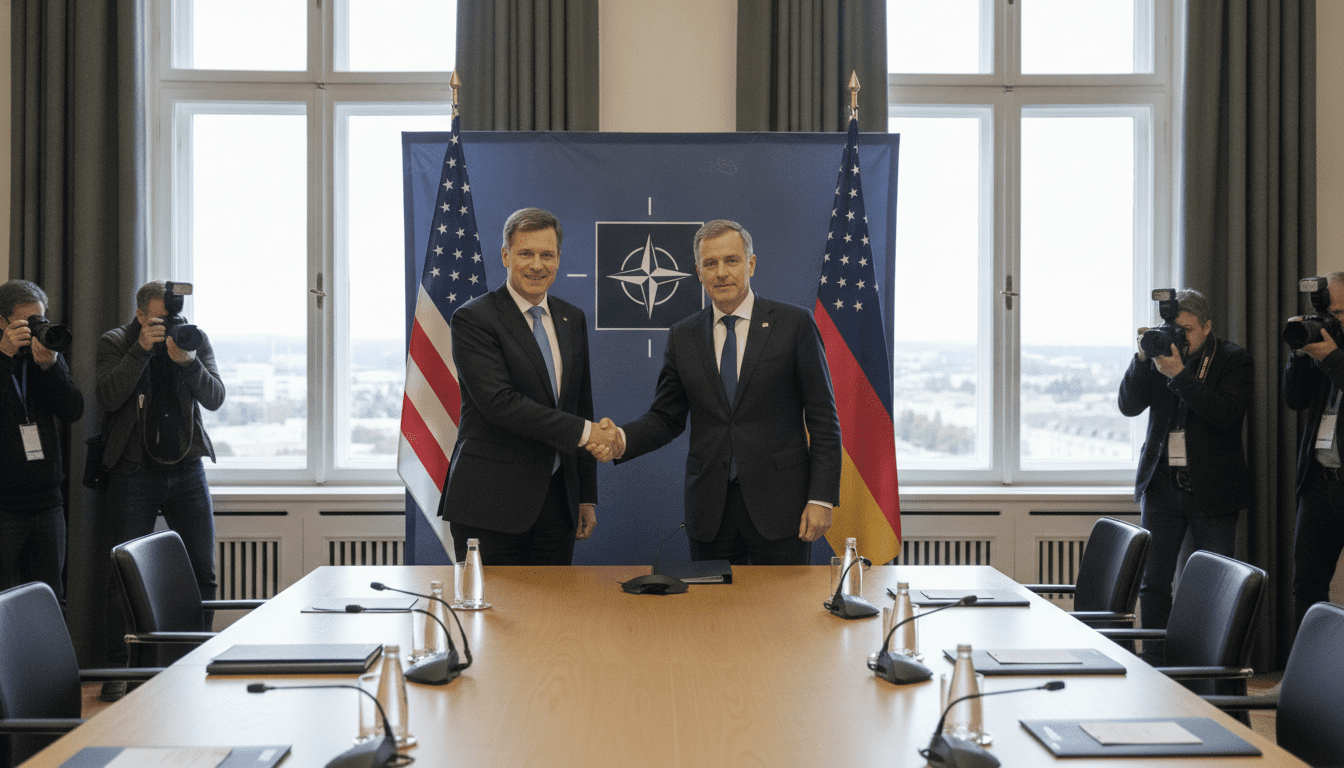
German minister Wadephul urges renewed focus on transatlantic partnership after Washington talks
German Foreign Minister Johann Wadephul told Marco Rubio that the transatlantic partnership with the US is vital amid global crises and NATO tensions.
Germany’s foreign minister said the transatlantic partnership remains essential as he met his US counterpart in Washington to shore up cooperation ahead of a critical NATO summit. Johann Wadephul warned that a range of global crises threaten economic stability and risk driving wedges between close partners, and he urged determined work to keep the alliance intact. He framed the meeting with Marco Rubio as part of a broader effort to align responses to security and economic disruptions.
Wadephul stresses alliance resilience in Washington
Wadephul described the partnership with the United States as indispensable during “deep-seated upheavals,” saying allies must work together to prevent fractures in global stability. He emphasized practical cooperation on security and economic policy rather than ceremony, signaling a willingness to address difficult disagreements openly. The minister framed his posture as both defensive and proactive, vowing to defend the partnership against pressures that might erode trust between Berlin and Washington.
Wadephul’s remarks sought to balance reassurance with realism, acknowledging strains without minimizing the relationship’s strategic importance. He pushed back against narratives that suggest alliance ties are self-evident, arguing that active diplomacy and shared problem-solving are required. The emphasis was on concrete deliverables and sustained engagement rather than symbolic reaffirmations.
Differences flagged ahead of NATO summit in Ankara
With NATO leaders due to meet in Ankara next week, Wadephul acknowledged there are divergent views among allies on policy and priorities. He said those differences make coordinated answers more important, not less, and urged summit participants to forge common positions on pressing security questions. The German minister suggested that the summit should produce tangible mechanisms for consultation and burden-sharing to prevent disputes from becoming sources of strategic weakness.
Officials in Berlin and allied capitals are watching whether the summit can close gaps on issues ranging from deterrence posture to Middle East policy. Wadephul’s public call for unity reflects a broader apprehension among NATO members that political rhetoric could outpace substantive alliance commitments. He framed the upcoming meeting as a test of whether allies can translate shared interests into operational cooperation.
U.S. mediation on Russia-Ukraine shows limited momentum
Wadephul also commented on efforts by the United States to mediate between Russia and Ukraine, describing progress as stalled and underscoring the limitations of current diplomacy. He noted that continued instability on Europe’s eastern flank compounds economic and security pressures across the transatlantic space. The German minister said allied coordination on de-escalation and deterrence remains an urgent priority even as formal mediation efforts struggle to advance.
Observers say a lack of visible progress in mediation raises questions about diplomatic leverage and the willingness of principal actors to engage in sustained talks. Wadephul indicated that Germany expects allies to keep exploring diplomatic tracks while maintaining defensive capabilities, reflecting a dual-track approach common to current Western strategy. The message was that patience and persistence are required, but so are credible deterrent measures.
Trump’s public critique adds strain to alliance cohesion
The meeting occurred against a backdrop of public criticism from U.S. President Donald Trump, who has recently accused key allies of insufficient support and suggested the United States could decline future requests for help. Those remarks have fueled debate in allied capitals about the durability of U.S. security commitments and the need for clearer burden-sharing arrangements. Wadephul’s consultations aimed in part to allay such concerns by reaffirming Germany’s interest in a robust partnership with Washington.
European ministers and NATO officials face the delicate task of responding to public pressure while avoiding escalatory rhetoric that could deepen mistrust. Wadephul’s appeal for continued U.S. engagement reflected an assessment that, despite sharp language, core security ties remain intact. He expressed confidence that Washington will continue its security commitment to Europe, a view he said rests on shared strategic interests rather than rhetorical fluctuations.
Trade agenda next on Wadephul’s itinerary at Mercosur summit
After Washington, Wadephul plans to travel to Paraguay to attend the Mercosur summit, where trade discussions are expected to feature prominently. He said the EU’s prospective free trade pact with Brazil, Argentina, Uruguay and Paraguay aims to lower trade barriers and boost the exchange of goods and services. Berlin sees such an agreement as complementary to security cooperation, arguing that stronger economic ties can reinforce political alignment across regions.
Negotiators on both sides have long sought a balance between market access and regulatory protections, and the Mercosur forum will be closely watched for progress on outstanding technical and political issues. Wadephul indicated that Germany will press for a deal that secures reciprocal benefits while safeguarding environmental and labor standards. His participation underscores a dual-track diplomacy linking economic and security priorities.
The coming days will test whether Wadephul’s diplomatic push can translate into practical commitments at NATO’s Ankara summit and meaningful progress at the Mercosur talks in Paraguay. Allies will watch closely to see if public criticisms and stalled mediations can be set aside in favor of coordinated action that strengthens both security and trade links across the Atlantic.
