
Pius Brotherhood excommunication confirmed by Vatican after illicit Swiss ordination
Vatican confirmed the Pius Brotherhood excommunication after an illicit Swiss episcopal ordination, warning clergy and faithful who join the SSPX face schism.
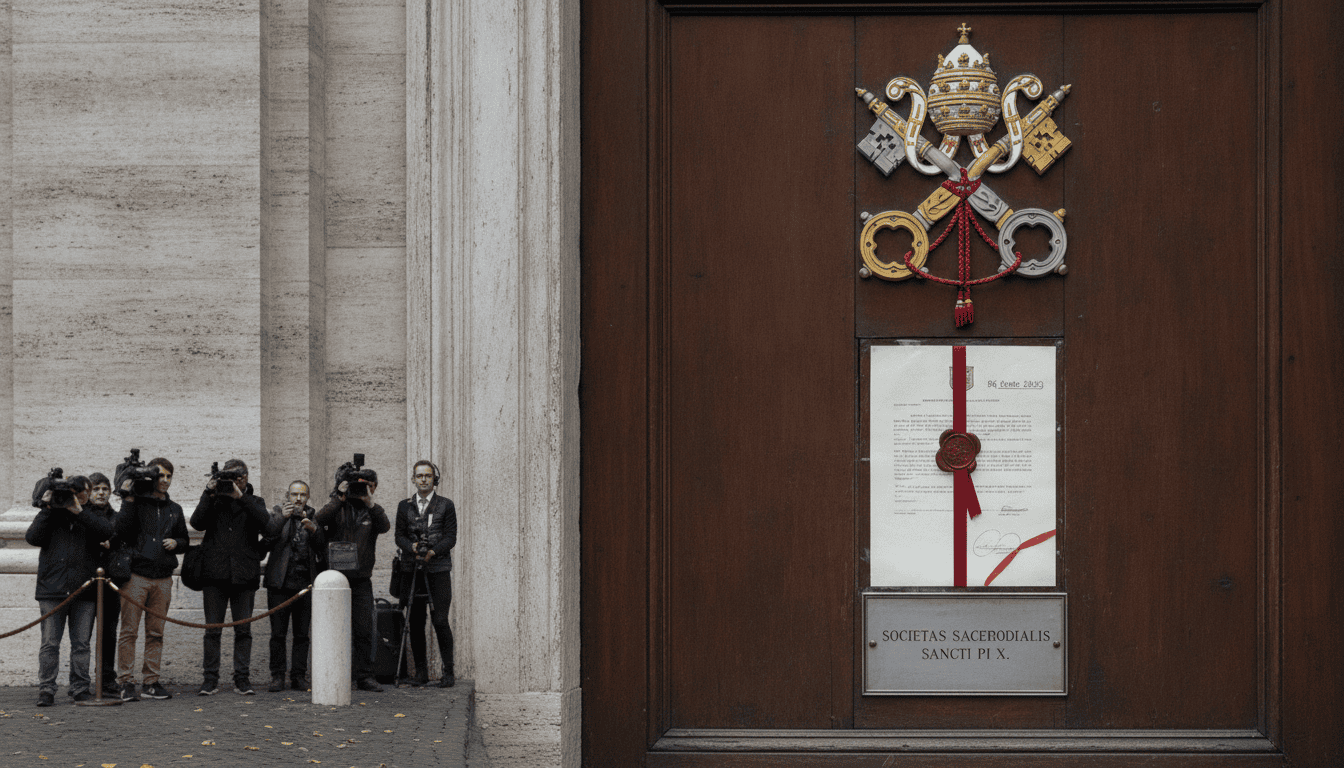
The Vatican this week formally confirmed the Pius Brotherhood excommunication following an unauthorized episcopal ordination in Switzerland that took place on Wednesday and drew participants from the traditionalist Society of Saint Pius X (SSPX). The Holy See said the ceremony constituted a schismatic act under canon law and that the sanction of excommunication applied automatically to those directly involved. Cardinal Víctor Fernández issued an explanatory note expanding that assessment to include priests and non-priests who formally align with the group.
Vatican statement and immediate sanctions
The Holy See announced that six men who took part in the forbidden episcopal ordination have been declared excommunicated under church law. Vatican officials described the rite as illicit and schismatic, triggering the automatic penalty prescribed by the code of canon law for acts judged to split the Church.
The announcement also clarified that the declaration was not limited solely to the six ordained but intended to delineate the canonical consequences for those who formally attach themselves to the fraternity’s structures. The Vatican framed the move as a defensive response to safeguard ecclesial unity and the integrity of sacramental ministry.
Cardinal Víctor Fernández’s explanatory note
Cardinal Víctor Fernández, the prefect charged with safeguarding doctrine, issued a written explanatory note accompanying the Vatican’s declaration. His note warned that clergy and lay members who formally join the SSPX would be understood to participate in schismatic activity and therefore risk similar canonical penalties.
The explanatory note reiterated that the extension of excommunication was intended to cover not only the immediate ordination participants but also those who, by formal adhesion, accept the community’s separation from decisions of the Second Vatican Council. Vatican officials described the paper as both a legal clarification and a pastoral caution to the faithful.
1996 precedent and canon law reasoning
The Vatican’s move echoes an earlier determination made in 1996 by the Pontifical Council for the Interpretation of Legislative Texts, when the Church assessed the canonical status of the SSPX after unauthorized ordinations in 1988. That earlier ruling had concluded the excommunication extended beyond the bishops involved to priests and formal adherents of the fraternity.
Church lawyers say the recent note restates the same canon-law logic: an act judged schismatic under the canons carries automatic penalties, and formal affiliation with a group that rejects key magisterial decisions can place adherents in the same juridical category. The Vatican presented the clarification as a formalization of juridical consequences long discussed within the Roman Curia.
Reversal of past concessions by Benedict and Francis
The Vatican statement also reversed several practical concessions that had blurred the SSPX’s canonical status in recent years. The note explicitly rescinded earlier measures that had allowed certain sacramental functions performed by SSPX priests to be recognized as valid or licit under specific circumstances.
Those earlier concessions followed Pope Benedict XVI’s 2009 lifting of the excommunications on the SSPX bishops and Pope Francis’s 2016 pastoral allowances for confessions and marriages celebrated with SSPX priests. The new Vatican position signals a renewed legal boundary and removes the limited tolerances that had temporarily eased pastoral interactions.
SSPX teachings and points of contention with Rome
The Society of Saint Pius X remains committed to a rejection of several reforms of the Second Vatican Council, including the Church’s modern teachings on religious freedom and formal engagement in ecumenical dialogue. The fraternity also insists on the restoration of older liturgical forms and a strict interpretation of tradition that it says Vatican II undermined.
Those doctrinal stances have long been the source of tension with Rome, which views adherence to the council’s teachings as essential to contemporary Catholic identity. Vatican officials have framed the recent measures as a response to the fraternity’s sustained resistance to key doctrinal and pastoral developments.
Practical consequences for clergy and the faithful
Under the Vatican’s clarification, priests who formally join the SSPX risk being treated as schismatics, with implications for sacramental faculties, canonical assignments, and public ministry. Lay people who take formal membership could also face canonical censure and restrictions on participation in official parish ministries.
For ordinary Catholics who attend SSPX chapels or receive sacraments from their clergy, the new position may create legal and pastoral uncertainty. Diocesan bishops will now need to assess cases individually and communicate clearly with local communities about the status of ministers and the validity or liceity of rites celebrated under SSPX auspices.
Reactions and prospects for further dialogue
The Vatican framed the explanatory note as both a juridical clarification and an invitation to reconciliation, but it left open the practical steps required for any renewed rapprochement. Officials signaled that a return to full communion would require explicit acceptance of the council’s teachings and a clear renunciation of schismatic acts.
Observers say the move could harden stances on both sides in the short term, while also compelling more formal negotiations if the SSPX seeks canonical regularization. The longer-term trajectory will depend on whether the fraternity responds to the Vatican’s conditions or continues to assert its doctrinal positions outside the Church’s agreed parameters.
The Vatican’s formal confirmation of the Pius Brotherhood excommunication and the accompanying explanatory note mark a decisive reassertion of canonical limits regarding schism, and they raise immediate pastoral and legal questions for priests, faithful and bishops across dioceses where the SSPX has influence.
