
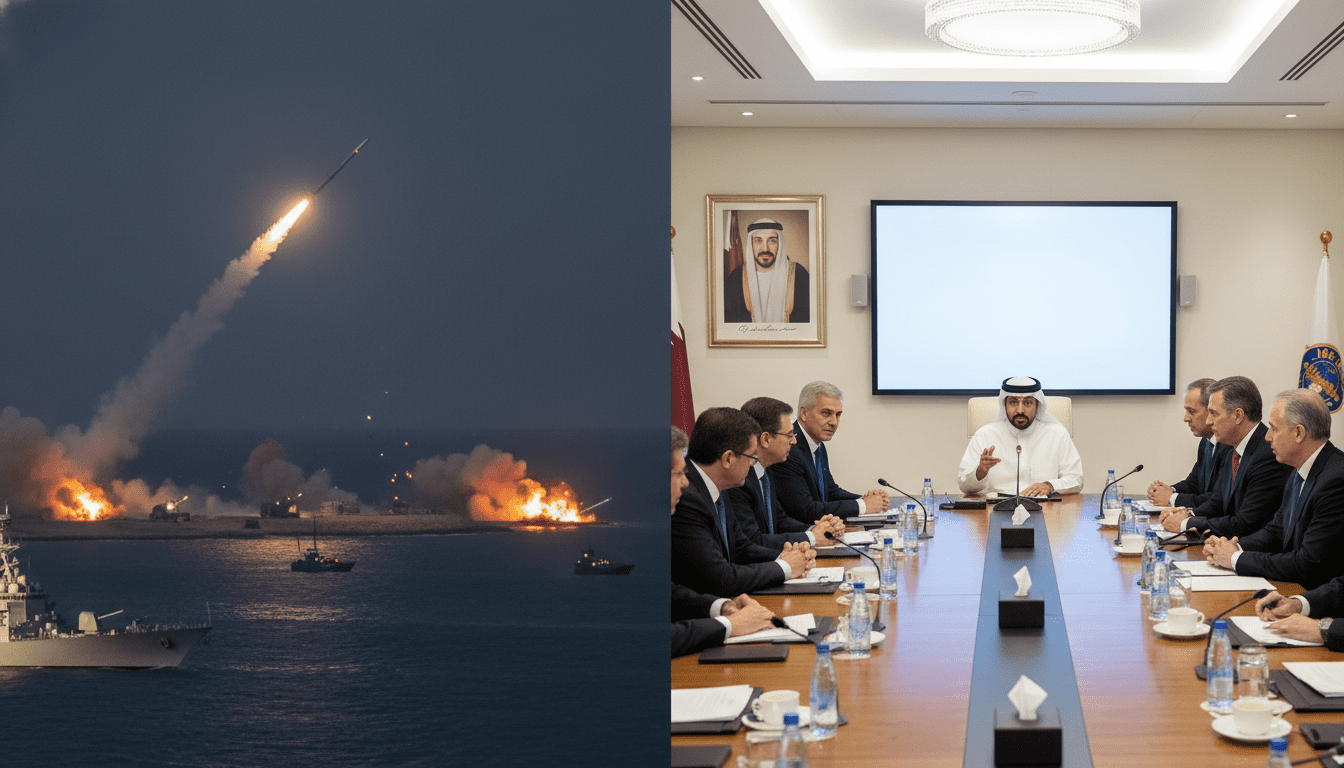
US strikes Iranian missile sites and boats while Qatar talks seek ceasefire extension
US forces say they struck Iranian missile sites and boats in southern Iran as negotiators meet in Qatar to try to extend a fragile ceasefire; diplomats say talks could take days.
The United States said on Tuesday that its forces conducted self-defence strikes against missile launchers and vessels attempting to emplace mines in southern Iran, while an Iranian delegation met in Doha for negotiations on extending a ceasefire agreed in April. Secretary of State Marco Rubio told reporters the text of a potential deal was still being worked on and that finalising terms could take a few days. Iranian state media reported explosions near Bandar Abbas and Tehran offered no immediate official confirmation of the strikes.
US military statement on strikes
The US Central Command said its forces launched strikes in southern Iran to protect personnel and assets from threats posed by Iranian forces, identifying targets as missile sites and boats laying mines. The CENTCOM statement, issued on Monday, framed the action as defensive and provided limited operational detail about the location or ordnance used. Officials declined to disclose force posture specifics but emphasised the strikes were intended to forestall imminent risks to U.S. and coalition forces operating in the region.
CENTCOM spokespeople described the operations as narrowly tailored and tied to immediate threats in the maritime approaches to the Strait of Hormuz. Military officials said the strikes were not intended to escalate the wider conflict but to restore freedom of navigation and safety for commercial shipping. The limited public detail underscores both the sensitivity of the strikes and the administration’s stated preference for keeping diplomatic options open.
Iranian reactions and local reports
Iran’s state broadcaster IRIB reported loud explosions near Bandar Abbas around midnight local time, but Iranian officials did not immediately confirm or deny the US account. Reporting from Tehran noted that while authorities have not publicly contested the U.S. assertions, they also refrained from offering operational details or attributing responsibility. That absence of official comment has left a gap filled by state media descriptions and eyewitness accounts from the Gulf port region.
Independent reporters in Iran described heightened activity and disrupted maritime operations near the southern coastline, with local authorities tightening security around strategic installations. Analysts caution that incomplete public statements by Tehran can be part of deliberate ambiguity, allowing officials to calibrate their diplomatic response while avoiding overt steps that might derail ongoing negotiations.
Diplomatic talks in Qatar
The strikes occurred as senior Iranian negotiators were in Doha for a fresh round of talks aimed at extending the ceasefire that has largely held since early April. Officials familiar with the visit said negotiators discussed the Strait of Hormuz and Iran’s stockpile of highly enriched uranium, while Iran’s central bank governor reportedly attended to discuss the possible release of frozen Iranian funds as part of a final settlement. Iranian foreign ministry spokespeople have said that nuclear matters would be addressed only after a framework accord is agreed.
Secretary of State Rubio, speaking in Jaipur during a visit to India, said the negotiating parties were still “talking back and forth” over specific language in an initial document and that reaching a definitive pact could take a few days. He added that the United States was determined to see the straits kept open, calling the current disruptions “unlawful” and unsustainable for global trade. Diplomatic sources emphasized that despite the strikes, Washington and Tehran appear to be maintaining direct channels to salvage a broader agreement.
Analysts on the military-diplomatic balance
Former U.S. diplomat Adam Clements, now a senior analyst, told reporters he was not surprised by the public acknowledgement of strikes and that tactical military actions can coexist with strategic diplomacy. He cautioned, however, that repeated kinetic incidents risk undermining trust and increasing the chance of miscalculation. Clements said he believed the core diplomatic track still has momentum but warned that further military engagements could complicate negotiators’ work.
Security experts say targeted strikes aimed at immediate threats can be calculated to avoid broader escalation, but they also note the political risks. Each side faces domestic constituencies that may press for stronger responses, and commanders in the field can have incentives to act decisively when their forces are threatened. Planners on both sides must weigh short-term operational gains against the longer-term objective of achieving a durable ceasefire.
Implications for the Strait of Hormuz and markets
Since early April, disruptions in the Strait of Hormuz have pushed up energy prices and heightened concerns among shipping firms about transit safety. Tehran’s attempts to interdict shipping and to deploy mines have already forced re-routing and increased insurance costs for vessels. The recent U.S. strikes are likely to be closely watched by shipowners and traders for signs of whether the sea lane will be secured or face renewed attacks.
Markets reacted to the reports with heightened volatility as traders assessed the risk of broader disruption to oil and gas supplies. Energy analysts said that even limited escalation can translate quickly into price swings because the Strait remains a critical artery for global hydrocarbon flows. Officials in consumer and producer states have urged restraint while underlining the urgency of restoring unimpeded passage.
Negotiators in Doha are racing to convert framework agreement language into a concrete, enforceable deal that addresses navigation, nuclear safeguards, and financial measures. The presence of central bank officials on the sidelines suggests economic levers, including frozen assets, may be part of the final package.
The United States and Iran now face a narrow window in which diplomacy must outpace kinetics if the ceasefire is to be extended and deepened. Observers say both sides will be judged on their capacity to translate agreements into verifiable, lasting changes on the water and in Tehran’s nuclear declarations.
For now, the situation remains fluid: military encounters at sea and diplomatic shuttle talks in Doha continue in tandem, with negotiators warning that a final accord will require careful drafting and time to secure. The coming days are likely to determine whether negotiators can convert a fragile pause into a broader, enforceable settlement that keeps the Strait of Hormuz open and eases pressure on global energy markets.
