
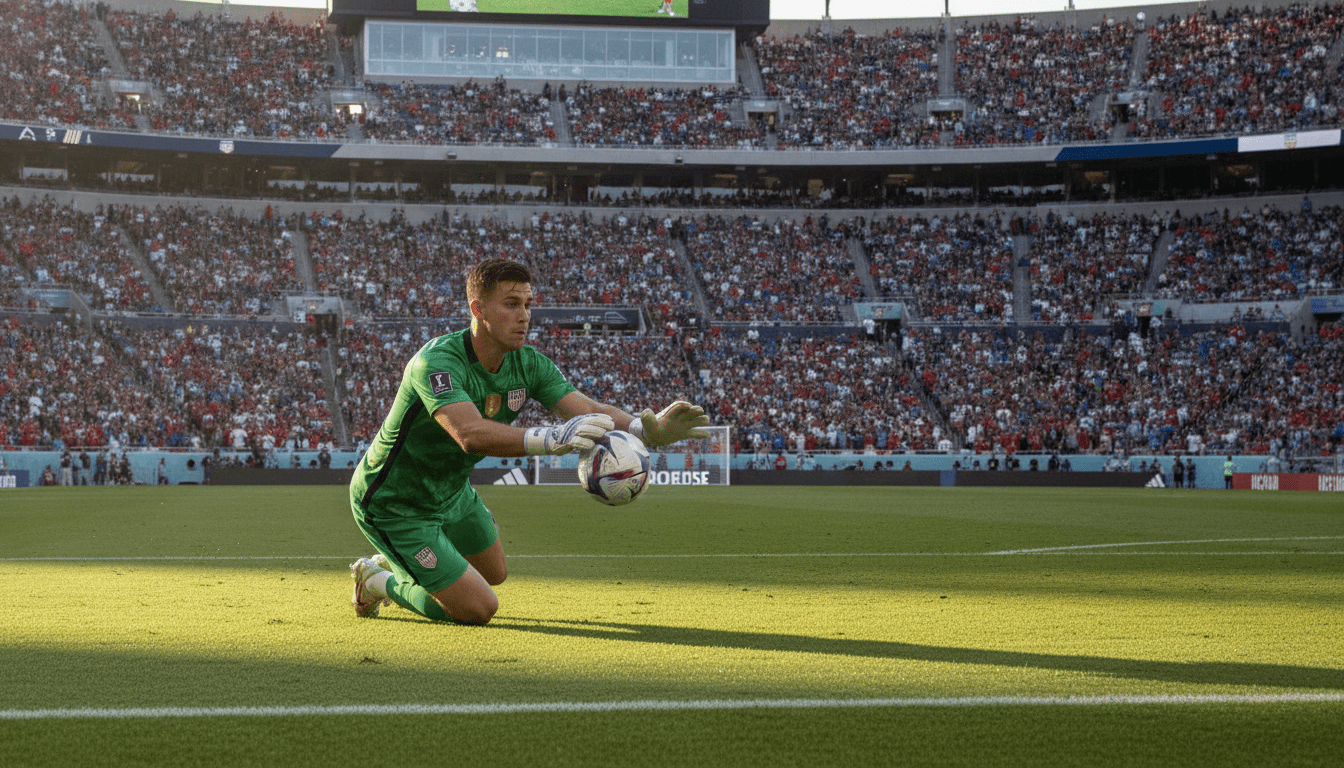
US goalkeepers face scrutiny as U.S. reaches World Cup knockout stage
US goalkeepers face scrutiny as the U.S. enters the 2026 World Cup knockout stage; Matt Freese’s MLS experience, analytics and composure are now in focus.
The United States’ goalkeeping situation has become a focal point as the host nation prepares for the World Cup knockout rounds, putting US goalkeepers and their readiness under renewed scrutiny. Matt Freese, the 27-year-old starter who rose through American ranks and plays for New York City FC, stands at the center of a debate about experience, modern tactics and goalkeeper development. Concerns stem less from recent group opposition than from a broader trend: many of the country’s top keepers ply their trade domestically rather than as starters in Europe’s top leagues. The coming round-of-16 match in San Francisco will be seen as a barometer for how those trends translate under tournament pressure.
Matt Freese’s Journey from Harvard to MLS Starter
Matt Freese’s route to the national team is unconventional for a World Cup goalkeeper: after youth opportunities in England, he chose to study at Harvard before establishing himself in Major League Soccer. At Harvard he combined economics and computer science studies with athletics, producing analytic work on penalty probabilities and goalkeeper positioning as part of his coursework. Those projects are cited as sources of confidence inside the squad, providing Freese with a unique toolkit for reading opponents and making split-second choices between taking risks and staying conservative.
Freese’s club career has been built entirely in the United States, a path that reflects a broader shift in American soccer development where domestic opportunities now retain elite prospects. That trajectory contrasts with earlier eras when promising U.S. keepers moved to Europe to polish their craft in more competitive, high-expectation environments.
Tim Howard and Tony Meola Shape Public Expectations
Public perception of American goalkeeping remains heavily influenced by iconic performances from the past, most notably Tim Howard’s record-seventeen saves in the 2014 World Cup match against Belgium and Tony Meola’s role in 1994. Those moments elevated goalkeepers into national heroes and set benchmarks for durability, shot-stopping and presence. They also helped shape a narrative that American keepers needed to be imposing, physically dominant figures between the posts.
That legacy is double-edged: it raises expectations while sometimes obscuring how the position has evolved globally toward greater technical and tactical involvement with the team’s play. Veteran voices in U.S. soccer echo both admiration for the past and a recognition that modern demands have changed the criteria for elite performance.
Lack of European Club Starters in American Goalkeeping Pool
A striking trend at this World Cup is the paucity of American goalkeepers who are regular starters for major European clubs, a contrast with many outfield players now featuring across top leagues. Several MLS clubs have turned to experienced international imports rather than exporting domestic goalkeeping talent overseas, leaving few U.S. keepers exposed to the week-in, week-out demands of Europe’s top-five competitions. That lack of continental club experience fuels questions about readiness when facing world-class forwards in knockout conditions.
Coaches and analysts warn that club pedigree is only one measure of readiness, but they concede it often correlates with exposure to varied tactical systems, higher-pressure matches and different types of attacking threats. The U.S. staff appears to be balancing these concerns with confidence in players’ specific skill sets and the cohesion built during tournament preparation.
Modern Tactics Push Goalkeepers into Playmaking Roles
The tactical evolution of soccer has recast the goalkeeper as an active contributor to build-up play and defensive organization, increasing the value of foot skills and decision-making under pressure. Teams now select keepers not just for reflexes and aerial command but for their comfort with possession, passing accuracy and ability to act as an additional outfield option. That shift is part of why critics argue the U.S. must accelerate training that develops both hands and feet in tandem.
For Freese and his peers, the dual demand—to be reliable shot-stoppers and credible playmakers—frames match preparation and scouting. Opponents study how American keepers influence tempo, when they choose to distribute quickly and how they defend set-piece chaos. These subtler elements of goalkeeping are likely to influence the outcome of tight knockout fixtures.
Data and Decision-Making Become Freese’s Edge
Freese’s academic work on penalty modeling and positional datasets has been highlighted as a practical asset rather than an academic curiosity. The goalkeeper carried out granular tracking of where keepers position themselves in different scenarios and how those choices affect conceding chances. Team analysts say that such data-driven insights can sharpen anticipation, reduce cognitive overload during critical moments and provide a tactical edge in shootout scenarios or when managing risk late in matches.
Former internationals have suggested that calmness and preparation can offset deficits in high-level club experience, and Freese’s temperament is repeatedly cited as a stabilizing factor. Coaches emphasize that a goalkeeper who can remain composed, communicate clearly and apply analytical principles under stress can alter striker calculations and influence opponent behavior.
Round-of-16 in San Francisco Tests U.S. Goalkeeping Depth
The knockout match in San Francisco will be the first significant pressure test of the U.S. goalkeeping setup on the World Cup stage, and it offers a clear measure of both individual and systemic readiness. Observers will watch Freese for command of his area, distribution choices and responses to sustained pressure from experienced attackers. Backup options on the roster, some with international club backgrounds, provide contingency but also raise questions about consistency and chemistry.
If the U.S. advances, deeper tests could come against teams featuring world-class forwards, forcing a sustained assessment of how domestic development, analytics and coaching combine to produce top-level goalkeeping. The outcome in San Francisco will shape conversations about talent pathways and whether the U.S. should prioritize exporting keepers to Europe or doubling down on domestic programs that marry traditional shot-stopping with modern playmaking.
As the tournament moves on, the performance of US goalkeepers will not only influence immediate results but could accelerate adjustments in coaching, scouting and player pathways across the American game. The next matches will reveal whether the current crop can translate preparation into decisive actions under the highest international pressure.
