
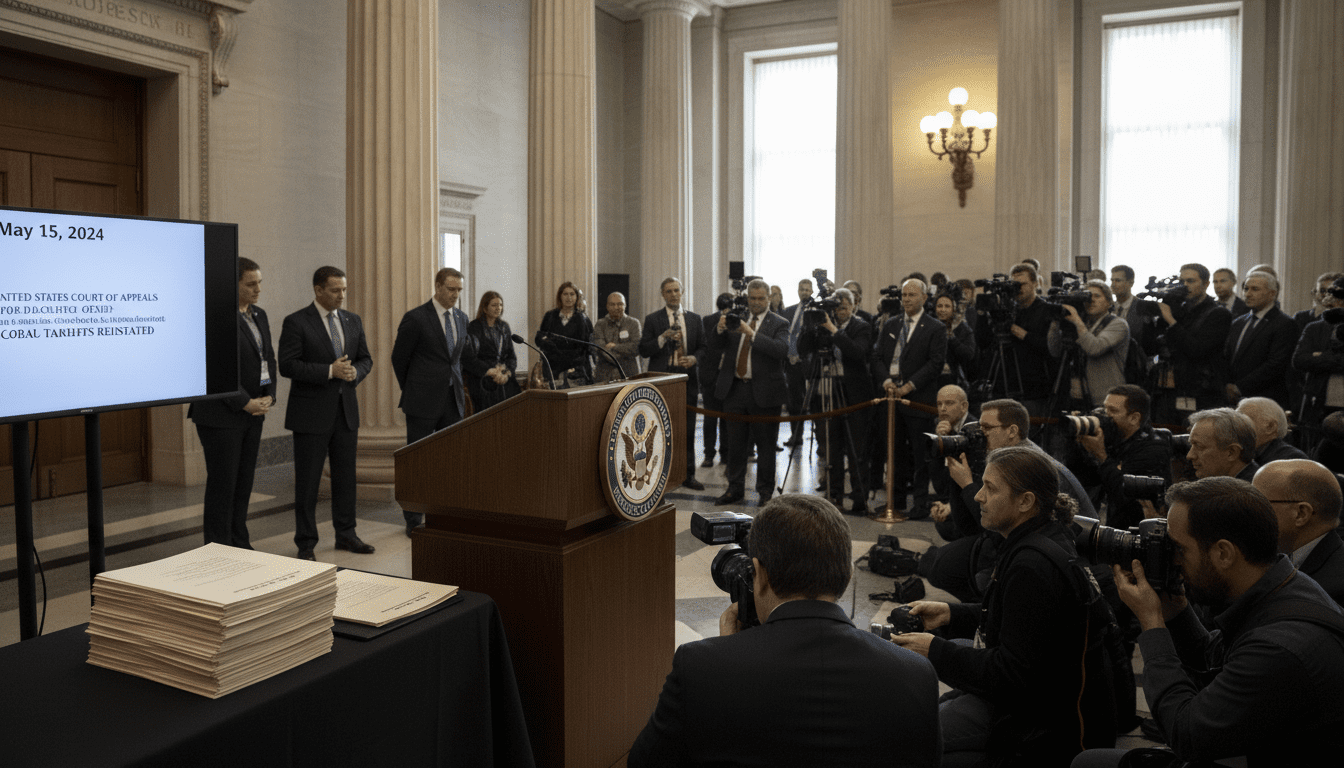
US Appeals Court Reinstates Trump’s 10% Global Tariffs Pending Review
Appeals court accepts government appeal, temporarily reinstating President Trump’s 10% global tariffs for plaintiffs while refunds and legal battles continue.
The U.S. Court of Appeals has accepted a government appeal that temporarily restores President Donald Trump’s 10% global tariffs for the plaintiffs in a landmark trade suit, reversing a recent New York trade court ruling. The 10% global tariffs keyword reflects the measure at the center of the dispute, which is now back in force for two companies and the state of Washington while the appeals process proceeds. Plaintiffs have seven days to respond to the appeal, and the lower court’s order requiring refunds has been stayed pending the appellate court’s decision.
Appeals court pauses New York trade court decision
The appellate panel’s decision to accept the government’s appeal suspends last week’s ruling from the U.S. Court for International Trade in New York, which had found the tariff action unlawful. That lower court had concluded the administration exceeded its authority under the trade statute cited when it imposed a blanket 10% duty on goods from around the world in February. With the appeal accepted, collection of the duties from the specific plaintiffs has resumed for now, though the underlying legal fight will continue.
The government must now make its case before the appeals court, and the plaintiffs have a short window to file their opposition. Until the appellate judges issue a final ruling, the trade court’s order that required refunds is not operational for those named in the suit.
Who is involved and what is at stake
The litigation was brought by two unnamed companies and the state of Washington, challenging the administration’s authority to impose a universal 10% tariff on imports. The plaintiffs argued that the White House misapplied a provision of a 1974 trade statute to justify broad, economy-wide duties. The government counters that blocking the tariffs would undermine the administration’s trade agenda and efforts to narrow longstanding trade deficits.
While the current appeal affects the payments and refunds of the two companies and Washington state, the case carries broader symbolic weight for U.S. trade policy. A ruling against the administration could limit the executive branch’s ability to unilaterally impose sweeping tariffs on imports without congressional action.
Legal history and recent court actions
The 10% tariffs were announced in February and immediately triggered a cascade of legal challenges. In February, the U.S. Supreme Court struck down a large portion of the tariff package, ordering the administration to refund many duties and raising questions about the administration’s statutory authority. The New York trade court then declared the global 10% levy unlawful and directed refunds to affected importers, prompting the government to appeal.
The appeals court’s acceptance marks the latest procedural turn in a fast-moving docket that has already seen emergency filings and high-profile judicial scrutiny. Plaintiffs and their legal teams now face a compressed timetable to respond and press their claims at the appellate level.
Refunds, financial exposure and business reaction
The dispute has significant financial implications. The administration faces potential reimbursement obligations that legal filings and judicial orders have estimated could reach as high as $166 billion for duties already collected. Some importers have already begun to receive partial refunds as courts have ordered government agencies to return certain payments, according to reporting from international news services.
Businesses and trade groups are watching closely; the temporary reinstatement increases immediate uncertainty for companies that import goods and priced supply chains on the expectation of tariff relief. Several firms may face interim cash flow strains depending on whether collections resume or refunds are reinstated.
Sector-specific duties remain unchanged
The appeals court action did not alter a separate set of sector-specific tariffs that target categories such as steel, aluminum and automobiles. Those targeted levies, imposed under different trade authorities and subject to separate litigation and policy review, remain in effect independent of the global 10% duty dispute. Policymakers and industry representatives have emphasized that the two tracks—broad global duties and sectoral tariffs—follow distinct legal and political paths.
Observers note that leaving sectoral measures intact while litigating the global duty creates a layered tariff environment that complicates importers’ pricing and sourcing decisions. Congressional action could still change the picture if lawmakers act before the global levies expire.
Timeline ahead and political implications
The global 10% tariffs are scheduled to expire in July unless Congress votes to extend them, placing a hard deadline on both policy and litigation. The appeals court’s calendar and any subsequent Supreme Court review will shape whether that statutory sunset matters in practice. If courts ultimately rule the duties unlawful, the government may be required to return large sums collected from importers.
Beyond the immediate financial consequences, the dispute highlights tensions over executive authority in trade policy and raises political stakes as lawmakers, companies and states weigh the economic and diplomatic effects of unilateral tariffs. The administration has framed the duties as central to its trade strategy; opponents call them an overreach that disrupts global commerce.
The appeals court’s acceptance of the government’s filing has injected new uncertainty into a case that will test the limits of presidential power in trade and determine whether the 10% global tariffs remain a lasting component of U.S. economic policy.
