
Russian report raises question of a Ukrainian ballistic missile strike
Russian report of a downed ‘operational-tactical’ rocket raises question of a first Ukrainian ballistic missile strike and strains Moscow’s air defences.
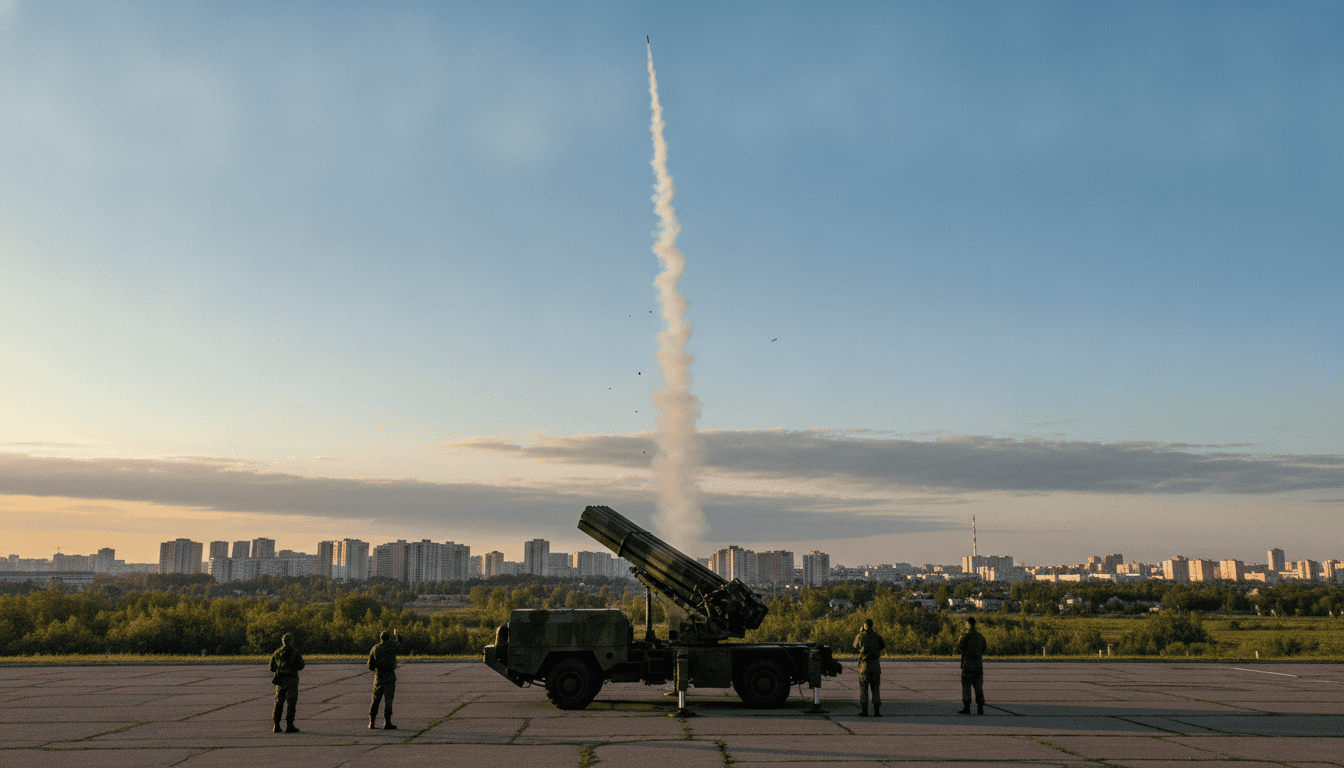
A terse statement distributed by Russian state media on Wednesday said air-defence units had knocked down “an operational-tactical long-range rocket” alongside guided bombs and hundreds of unmanned aerial vehicles, a formulation that has prompted analysts to ask whether a Ukrainian ballistic missile was used. The phraseology differs from how Moscow describes Western-delivered cruise missiles, driving attention toward domestic Ukrainian developments and the Fire Point firm’s FP-series rockets.
Moscow’s wording and the implied weapon type
The Russian announcement did not name a specific model but used terminology—operativ-taktischer Raketenkomplex—that in Russian military parlance commonly denotes ground-launched ballistic systems. That choice of words is noteworthy because Moscow typically labels Western cruise missiles and other long-range strike systems differently, which has led observers to treat the statement as a possible implicit confirmation of a ballistic intercept.
Russian outlets reported the tally of intercepts as including seven guided bombs and more than 600 aircraft-like drones, which underscores the scale of the episode even before questions about the single rocket are settled. The sparse official language has thus become the most significant evidence available so far, setting off debate among military bloggers and analysts.
Debris, geolocation and contested identification
Photos and short videos that circulated online the day before the announcement suggested a high-altitude launch and subsequent warning alerts in the Moscow region. Independent geolocation by open-source analysts placed a video of suspected debris on the southwestern fringe of Moscow, roughly 50 kilometres from the city centre, but investigators said the fragments shown were not conclusive for a definitive identification.
That ambiguity has not prevented speculation. Some Russian military bloggers have proposed the FP-9 as a candidate, while Ukrainian developers and a number of analysts caution that visual evidence remains insufficient to determine the launcher or warhead type with confidence.
Fire Point’s FP series and public claims
Fire Point, a Ukrainian company known for its FP-1 and FP-2 attack drones and the FP-5 Flamingo cruise missile, announced late last year that it had entered ballistic missile development with two larger projects, FP-7 and FP-9. Company statements and exhibition mock-ups indicate the smaller FP-7 is intended for shorter ranges and that the FP-9 would extend reach much further, with the firm at times citing ambitious range, speed and payload targets.
Company leadership has been publicly guarded about details. The head developer responded tersely to online questions about whether the FP-9 had been used in the incident, denying claims in a single-word reply. He had earlier suggested live tests of both FP-7 and FP-9 would take place over the summer, comments that have fed both anticipation and scepticism in military-technical circles.
Production capacity and lingering doubts
Despite high-profile announcements, Fire Point’s production claims have provoked questions. Promises that many hundreds of Flamingo cruise missiles would be produced monthly have not materialised, and scaling up sophisticated rocket production remains a major industrial challenge in wartime. Ownership structures and links to business figures implicated in corruption investigations have also attracted scrutiny, even as the company denies improper affiliations.
Analysts note that producing drones at scale is not the same as building and sustaining a ballistic-missile programme, which requires reliable propellant supplies, hardened manufacturing capability and extensive testing regimes to ensure guidance and survivability.
Western cooperation and air-defence projects
Some aspects of the Ukrainian missile effort are supported by foreign partners. Since late 2025 Denmark has supplied solid propellant for cruise missile motors, while German firms have been reported to discuss production lines for the Flamingo and radar components. In particular, a partnership announced this year envisions radar suppliers contributing to a nascent Freyja missile-defence architecture designed to compensate for shortages in interceptor stocks.
These cooperative arrangements reflect a deliberate strategy: bolster Ukraine’s ability to defend its airspace while enabling indigenous strike capabilities. Officials involved in export and procurement have stressed transparency in air-defence projects even as offensive missile programmes remain more opaque.
Air-defence vulnerabilities and strategic consequences
Ballistic rockets, if proved in use, pose different challenges to Russia’s air-defence networks than drones or subsonic cruise missiles, because of their higher speeds and different flight profiles. The reliability of S-300 and S-400 batteries, and even of Western Patriot systems, to consistently intercept such threats has been debated by military planners, and past engagements have shown limits in any layered defence.
Strategically, the emergence of Ukrainian ballistic capability could expand Kyiv’s options against deep inland targets that are currently shielded from smaller drone strikes. That potential range raises concerns in Moscow about critical infrastructure vulnerability and complicates calculations over deterrence, escalation and the timing of negotiations.
The incident arrives amid wider military and political pressures: recent think-tank estimates have highlighted heavy losses on both sides of the front, and Russian leaders have reiterated expansionist aims in public forums. For Kyiv, a demonstrable long-range strike tool could serve both operational and deterrent purposes; for Moscow, it would force reassessment of air-defence postures and potentially harden responses.
Indicators remain circumstantial and competing claims unresolved, but the language used in Russian reports and the surrounding open-source material mark a notable moment in the conflict’s weapons development trajectory. Whether this episode will be confirmed as the first use of a Ukrainian ballistic missile or remain an inconclusive event, it has already sharpened debate over production capacity, air-defence effectiveness and the strategic dynamics on which both capitals now focus.
