
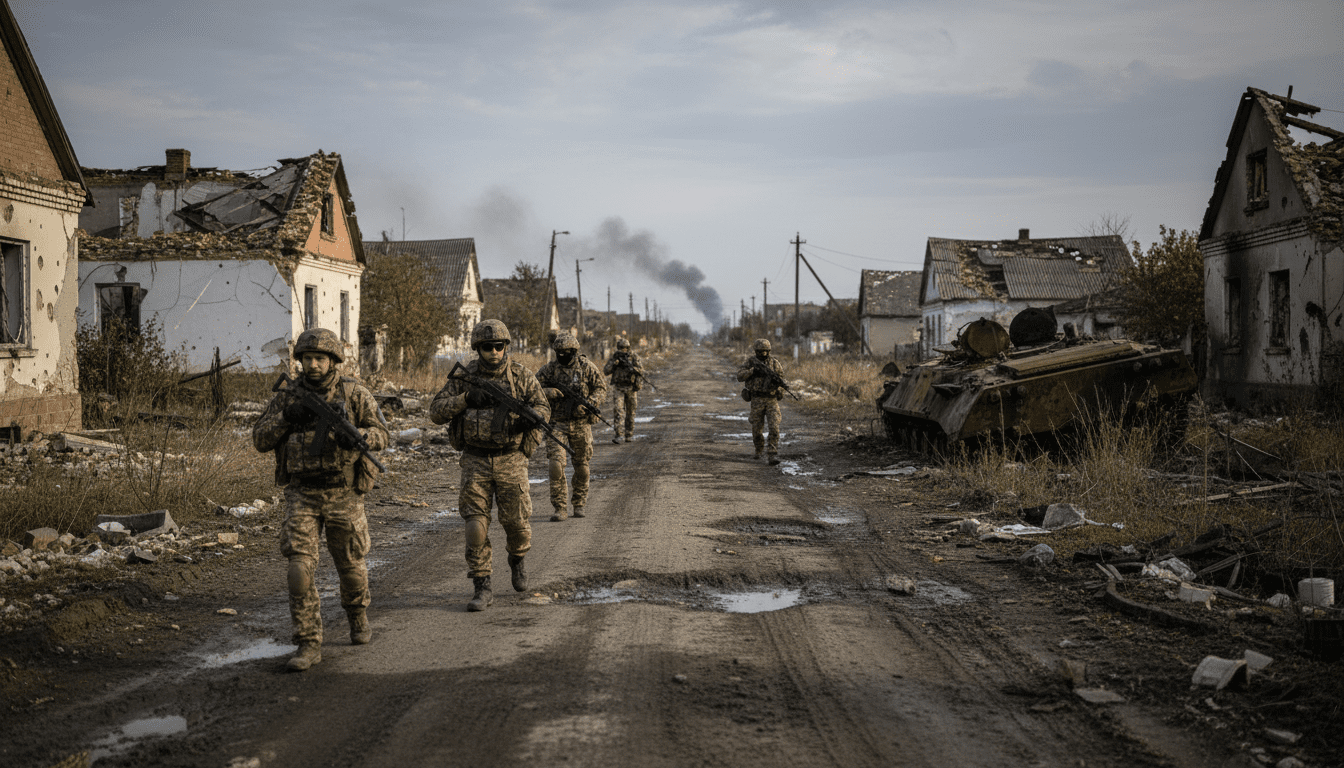
Ukrainian advance near Sloviansk: ISW says troops pushed into Sakitne center
Ukrainian advance near Sloviansk is confirmed by the Institute for the Study of War, which reports geolocated footage of Ukrainian positions in Sakitne and renewed fighting nearby.
The Institute for the Study of War (ISW) reported on Thursday that Ukrainian forces have advanced into the centre of the village of Sakitne, northeast of Sloviansk, marking a notable tactical gain on the eastern front. Geolocated imagery and drone footage cited by the ISW show Russian drones striking positions in the village, leading analysts to conclude Ukrainian troops now hold ground in Sakitne’s centre. The Ukrainian advance near Sloviansk comes amid intense localized clashes across the Donetsk and Kharkiv regions.
ISW geolocated evidence and drone strikes
The ISW based its assessment on geolocated photos and video that analysts matched to points in Sakitne, indicating on-the-ground Ukrainian positions.
Those images also show Russian unmanned aerial vehicle strikes targeting the same coordinates, suggesting active attempts to dislodge Ukrainian units.
The institute’s methodology relies on open-source verification techniques and cross-referencing imagery with known coordinates, a process the ISW says supports its conclusion that Ukrainian forces reached the village centre.
Fighting and limited gains around Kostyantynivka
Near Kostyantynivka, ISW analysts report Ukrainian forces have pushed Russian units back at two locations, recapturing positions to the east of the city.
South of Kostyantynivka in the village of Berestok, Ukrainian troops advanced but the ISW cautioned that Russian units appear to have infiltrated the areas surrounding those gains.
That pattern—tactical advances followed by Russian probing and infiltration—reflects a contested local battlefield where control can be fluid and verification remains difficult.
Russian ministry claim in Kharkiv lacks independent proof
Russia’s defence ministry has publicly claimed the capture of Vovchansk Shchutory in Kharkiv region, but the ISW says it has not found corroborating evidence.
Open-source analysts routinely seek independent visual confirmation, and in this case such verification was absent from the material the ISW reviewed.
Analysts note that wartime claims by either side can be premature or intended for domestic messaging, underscoring the need for geolocation and imagery before formal confirmation.
Strategic significance of Sloviansk defensive ring
Kostyantynivka and Sloviansk form part of a defensive belt Kyiv has emphasised as critical to preventing further Russian advances into the Donetsk axis.
Russian statements earlier in the year framed the capture of this ring as a priority, but Ukrainian countermeasures and local resistance have repeatedly blunted Moscow’s push.
Control of towns such as Sakitne holds tactical importance for movement of forces and artillery positioning, making even limited gains the subject of intense combat and high strategic value.
Analyst assessments and on-the-ground perspectives
Ukrainian military observer Kostyantyn Mashovets, cited by analysts, said the Russian aim of securing the Sloviansk defensive zone is unlikely to be achieved given Ukrainian resistance.
Independent open-source analysts at the ISW echoed the need for caution in interpreting battlefield claims, relying on imagery and multiple data points before declaring territorial changes.
Both perspectives highlight the interplay between battlefield realities, information operations and the difficulties of independently verifying events amid ongoing hostilities.
The ISW-provided maps used by the reporting outlet display territories assessed as Russian-controlled in red and areas recaptured by Ukrainian forces in blue, with daily changes highlighted; these visual tools help analysts track incremental shifts but do not replace direct, ground-level confirmation.
Open-source verification remains the primary method for international analysts to assess claims, and the situation on the ground can change rapidly as both sides continue offensive and defensive operations.
Recent skirmishes around Sakitne and Kostyantynivka illustrate how localized advances can have outsized operational importance while remaining vulnerable to immediate countermeasures.
As Kyiv and Moscow continue to contest control across the Donetsk and Kharkiv regions, observers will look for additional geolocated imagery and corroborating reports to confirm whether the Ukrainian advance near Sloviansk represents a sustained gain or a temporary tactical movement.
Further updates will depend on new open-source material and official statements that can be independently verified; until then, analysts say assessments should remain provisional and grounded in confirmed imagery and multiple corroborating sources.
