
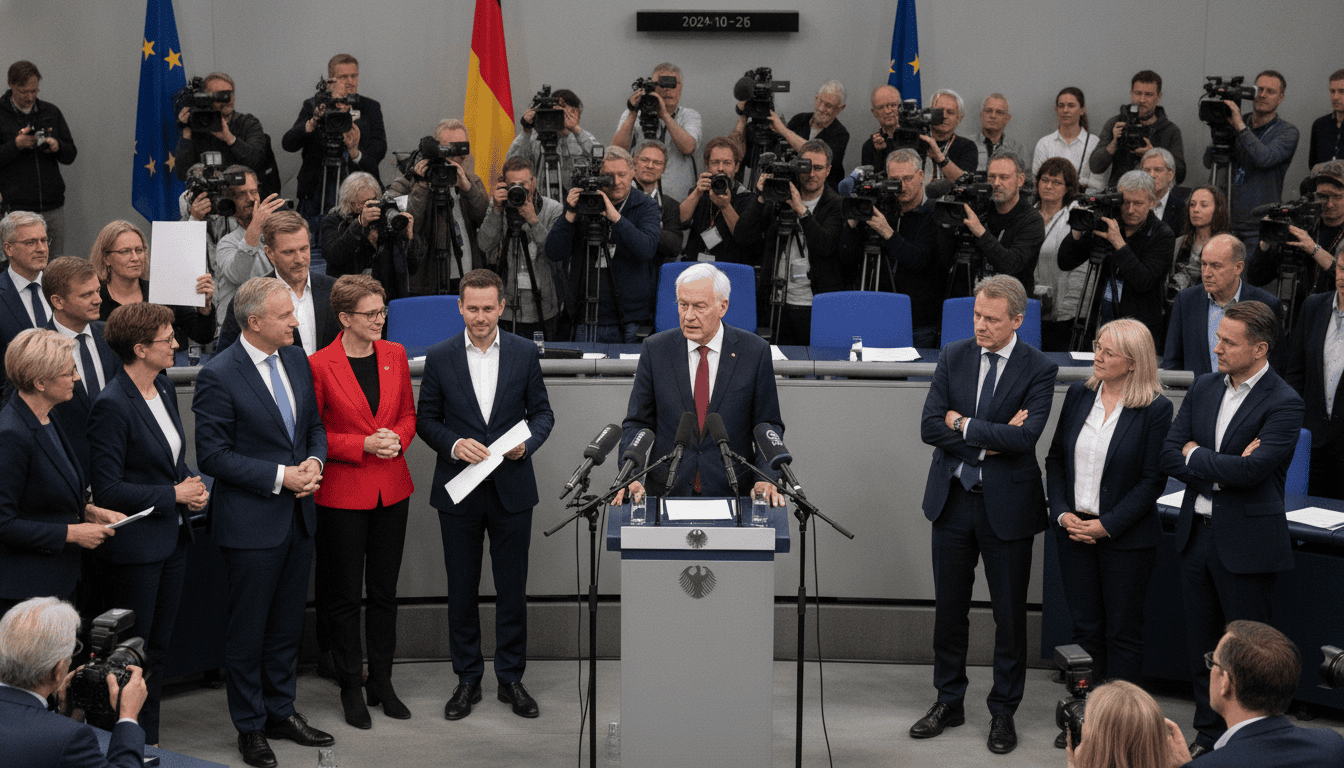
Debate Reignites Over 3% Threshold for Bundestag Seats
Germany faces renewed debate after a proposal to lower the electoral barrier to a 3% threshold for Bundestag seats, a change that would alter representation rules tied to second votes.
The suggestion by former constitutional court president Hans-Jürgen Papier to reduce the current 5% threshold has prompted swift reactions from parties across the spectrum, with Die Linke welcoming the idea and the AfD calling for the rule’s complete abolition. The proposal centers on the share of second votes (Zweitstimmen) required for a party to receive proportional seats in the Bundestag. Supporters argue a lower 3% threshold would improve minority representation, while opponents warn it could increase fragmentation and complicate coalition formation.
Papier’s Proposal and Rationale
Hans-Jürgen Papier, who served as president of Germany’s Federal Constitutional Court, publicly proposed lowering the threshold to 3% as a compromise between proportional representation and governmental stability. He framed the change as a way to reconcile democratic inclusion with the need to avoid excessive party fragmentation. Papier emphasized that a modest reduction could bring smaller political movements into parliament without the disruptive effects of eliminating thresholds entirely.
His proposal referenced concerns about voter disenfranchisement and the democratic legitimacy of excluding parties that command meaningful but sub-5% support. He also framed the idea within Germany’s broader postwar electoral design, which balances constituency-based direct mandates with proportional lists decided by second votes.
Support from Die Linke and the AfD’s Contrasting Demand
Die Linke publicly expressed support for the 3% threshold, arguing it would expand parliamentary diversity and better reflect voter preferences. Party spokespeople said lowering the barrier would give established left-wing and emerging progressive groups fairer access to legislative influence. They presented the proposal as restoring proportionality and addressing the sense of exclusion among smaller electorates.
By contrast, the Alternative for Germany (AfD) has dismissed intermediate reductions and instead called for abolishing any threshold that bars parties with less than 5% of second votes. The AfD frames full abolition as the most democratic outcome, arguing that any legal cut-off arbitrarily distorts voter choice. Critics of the AfD position counter that removing thresholds entirely would risk splintering the Bundestag and undermining governability.
How the Current 5% Rule Works
Under current election law, a party normally must secure at least 5% of second votes (Zweitstimmen) to receive proportional representation in the Bundestag. An important exception remains: a party that wins at least three direct constituency seats via first-past-the-post can obtain proportional seats even if it falls below the 5% mark. This “basic mandate” provision has allowed regionally concentrated parties to gain representation despite low nationwide percentages.
The 5% threshold has long been defended as a safeguard against extreme fragmentation, a lesson drawn from the instability of the Weimar Republic. Legal challenges to the rule in past decades have generally upheld the principle that some threshold is compatible with the Basic Law, provided it pursues legitimate democratic aims and is proportional in effect.
Parliamentary Arithmetic and Coalition Consequences
Lowering the threshold to 3% would have immediate consequences for electoral mathematics and party strategy. A smaller barrier would likely increase the number of parties represented, shifting seat distributions and potentially reducing the share of seats held by major bloc parties. That, in turn, could complicate traditional coalition-building, forcing more multi-party negotiations and novel alliances.
Smaller parties gaining entrance could also change committee compositions and speaking time allocations, affecting legislative agendas. Parties currently benefiting from the 5% rule warn that a lower threshold could make parliamentary majorities less predictable and increase the bargaining power of niche groups.
Legal Pathways and Constitutional Considerations
Implementing a 3% threshold would require changes to federal election law passed by the Bundestag; it would not necessarily require a constitutional amendment. However, any legislative adjustment would likely invite judicial scrutiny and could reach the Federal Constitutional Court if opponents claim it undermines democratic equality or exceeds parliamentary competence. The court historically evaluates thresholds against principles of proportionality and effective governance.
Legal experts also note technical implications for seat allocation mechanisms, including calculations for overhang and compensation seats that aim to preserve proportionality across states. Lawmakers would need to redesign certain formulae to prevent unintended distortions or excessive increases in the overall size of the Bundestag.
Public Debate and Next Steps
The debate is expected to unfold in parliamentary committees and party conferences ahead of any draft legislation. Proponents of change are likely to press for empirical studies on how a 3% threshold would have affected past elections, while opponents will emphasize stability and effective government formation. Public opinion may play a decisive role, particularly if major parties make the proposal a campaign issue.
If the Bundestag opts to take up the idea, the process would include committee hearings, expert testimony, and cross-party negotiations on the precise mechanics of any new threshold. Given the potential for constitutional challenges, parties advancing reform must prepare legal justifications and transitional rules to minimize disruption.
Public trust in electoral rules and the balance between representation and governability will shape the ultimate course of the proposal and determine whether a 3% threshold becomes law or remains a topic of political debate.
