
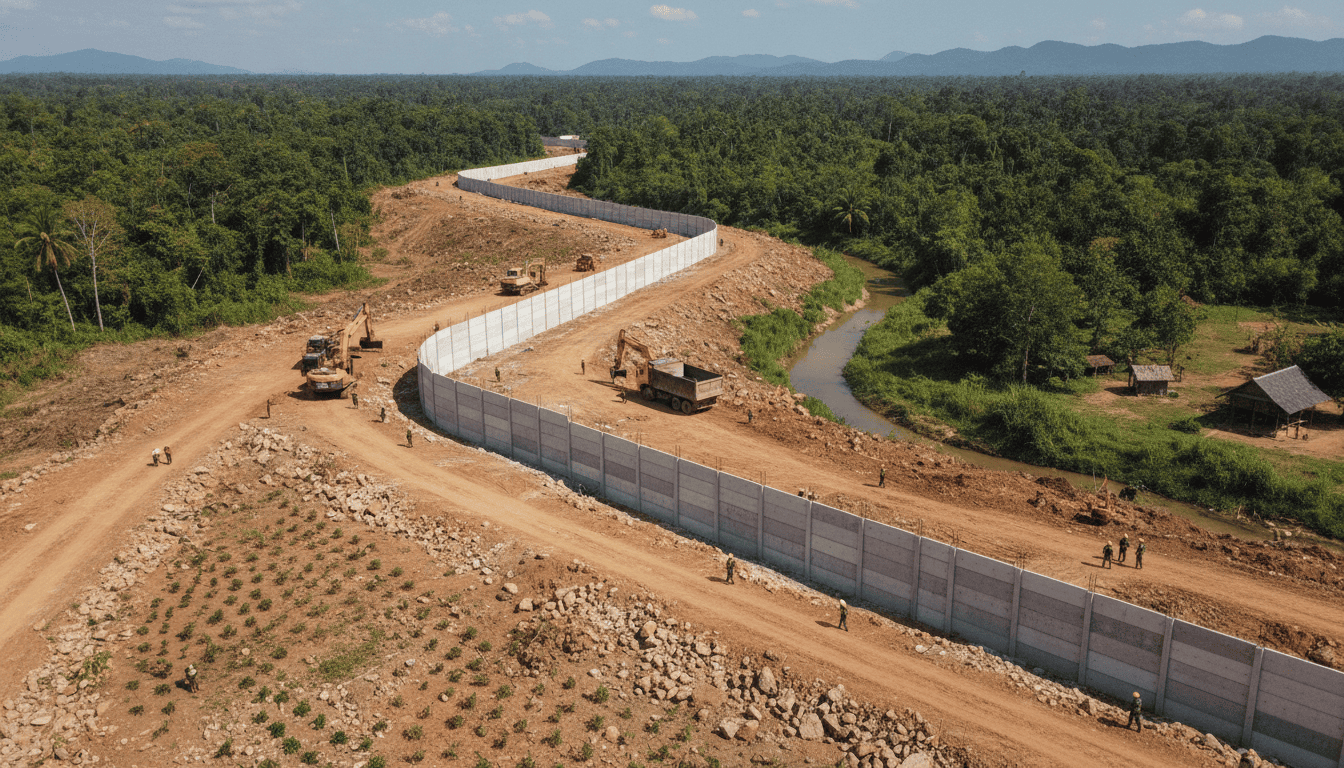
Thailand border fence: Thailand erects 1.3 km pilot barrier in Chanthaburi
Thailand builds a 1.3km pilot border fence in Chanthaburi; military says barriers are targeted, not continuous, amid unresolved Thailand-Cambodia disputes.
Thailand’s military has completed construction of the first permanent segment of a Thailand border fence, a 1.3-kilometre pilot barrier in Chanthaburi province designed with reinforced concrete panels, steel mesh and razor wire. The project is being presented by authorities as a targeted security measure rather than the start of a continuous wall along the more than 800-kilometre frontier. Officials say each site will be assessed before any further fixed barriers are built, while provisional wire entanglements will remain in places where the boundary is disputed.
Pilot Barrier Erected in Chanthaburi
The new barrier stretches roughly 1.3 kilometres and was installed by military engineers using precast steel-reinforced concrete slabs topped with steel fencing and razor wire. Photographs released by local media show a low, continuous concrete base with sections of mesh and concertina wire intended to slow or deny passage.
Military spokespeople emphasized the pilot character of the work, describing it as a discrete security installment to be evaluated for effectiveness before any replication elsewhere. The authorities have framed the structure as an operational experiment rather than a strategic decision to wall off the entire bilateral border.
Military Frames Fence as Targeted Security Measure
Thailand’s armed forces have ruled out plans for a continuous barrier along the entire 800-plus kilometre frontier, saying the government will examine individual stretches to determine whether a fixed barrier is warranted. In sectors where the boundary remains unclear, soldiers will instead deploy temporary razor-wire obstacles pending resolution of territorial questions.
The statement reflects an intent to balance immediate border control needs with political sensitivities, but it leaves open how many locations will ultimately receive permanent works. Defence officials say the pilot will inform cost, logistics and the security benefits of hardened fencing in other areas.
History of the Border and Last Year’s Clashes
The Thailand–Cambodia border has long been the subject of competing claims and local tensions dating back decades, and several stretches remain without a mutually agreed demarcation. Those unresolved boundaries have periodically erupted into clashes between security forces and irregular fighters along both sides of the frontier.
In 2025, weeks of intense fighting between Thai and Cambodian forces killed nearly 150 people and forced hundreds of thousands to flee their homes on both sides of the line. A fragile ceasefire agreed at the end of December 2025 has reduced large-scale combat, but both capitals continue to exchange accusations over incursions and alleged provocations.
Local Communities and Displacement
Local officials in border districts say the memory of 2025’s fighting remains vivid, with many displaced families still living in temporary shelters or having resettled away from the frontier. Humanitarian agencies describe ongoing needs for shelter, food and medical services among communities affected by the previous year’s violence.
The new pilot barrier has elicited mixed reactions among residents: some welcome what they see as a measure to prevent renewed cross-border incidents, while others fear it will harden divisions and complicate the day-to-day lives of farmers and traders who depend on cross-border movement. Market activity and family links that once crossed informal frontier paths could be affected if additional fixed barriers are built.
Regional Signal and Potential Diplomatic Fallout
Analysts say the concrete-and-wire barrier is as much a political message as it is infrastructure, signaling a willingness by Bangkok to take unilateral measures where it perceives security risks. That posture could complicate bilateral negotiations over the boundary if Phnom Penh interprets the works as a change to the status quo.
Diplomatic channels in the region have previously been used to manage skirmishes and limit escalation, and ASEAN interlocutors have urged restraint during past flare-ups. Observers say whether the pilot barrier becomes a one-off or a template for further construction will depend on next steps in bilateral diplomacy and on-the-ground security assessments.
Operational Questions and Next Steps
Military planners acknowledge logistical and legal hurdles to extending permanent fencing across diverse terrain that includes riverine borders, forest and populated villages. Engineers will need to assess whether concrete panels are workable in all locations and whether alternative measures such as surveillance systems or mobile patrols might be more practical.
Officials say the Chanthaburi section will be monitored to evaluate durability, maintenance needs and its effect on cross-border movement and local security incidents. Any decision to replicate the model elsewhere would require additional funding, environmental assessments and, officials stress, case-by-case approval.
The pilot fence in Chanthaburi is likely to shape local security routines and regional diplomacy in the months ahead, as both capitals weigh the trade-offs between visible control measures and the risks of hardening a disputed frontier.
