
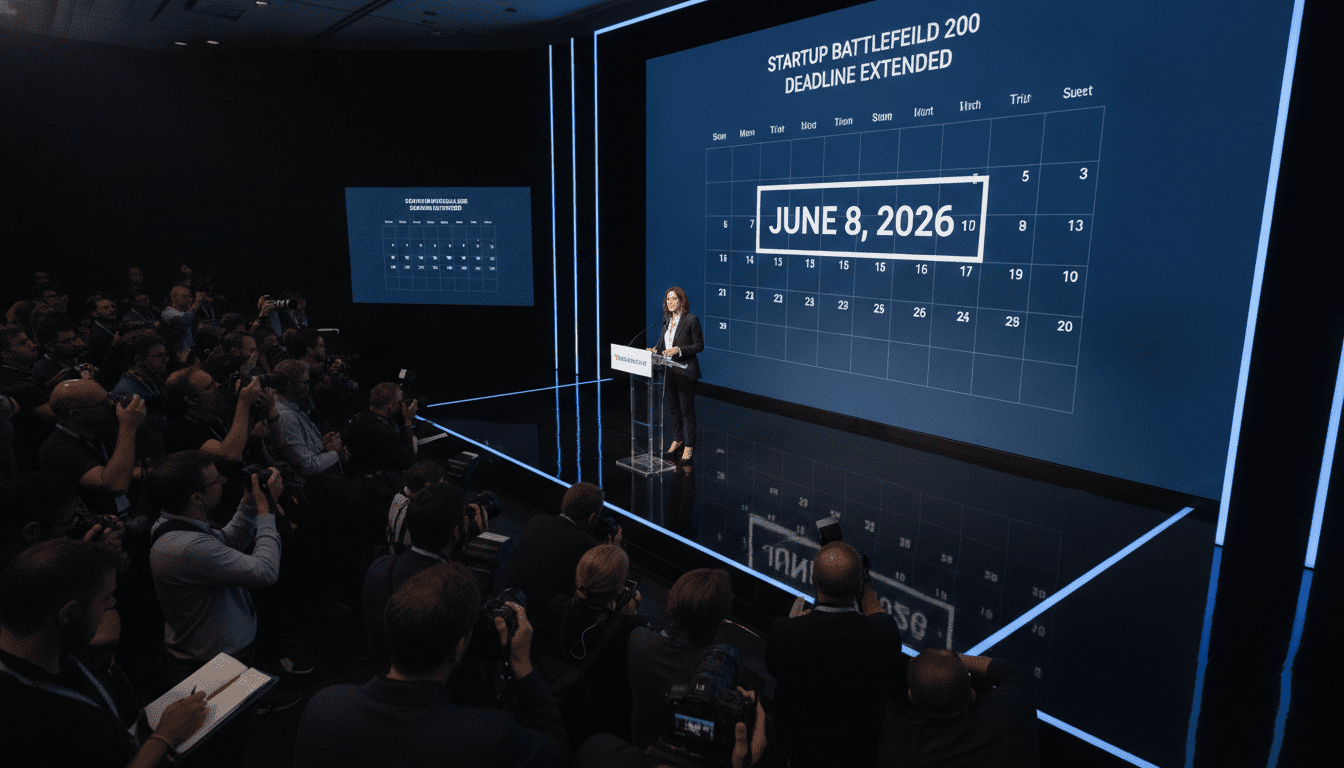
Startup Battlefield 200 Applications Extended — Final Deadline June 8, 2026
TechCrunch extends Startup Battlefield 200 applications to June 8, 2026. Read selection criteria, submission tips, timeline and who should apply. Apply now.
The Startup Battlefield application window has been extended to June 8, 2026, giving early-stage founders one last opportunity to contend for a spot in TechCrunch Disrupt’s flagship pitch program. Startup Battlefield remains focused on discovering companies with ideas that can reshape industries, not simply incremental improvements. This extension is intended to capture overlooked teams and encourage founders who might otherwise assume they’re not ready to submit.
Applications extended to June 8, 2026
Organizers confirmed the new final date for submissions as June 8, 2026, after an initial deadline in late May. The extension reflects continued interest from applicants and allows teams to refine materials before the selection panel begins its final reviews. Selected companies will be notified roughly two months ahead of TechCrunch Disrupt in October.
TechCrunch Disrupt will convene in San Francisco from October 13–15, 2026, and the Startup Battlefield finale will crown the cohort’s champion during the event. Companies chosen for the Battlefield receive stage time, mentorship opportunities, and broad exposure to investors and press. For many past participants, the program has been a springboard to rapid growth and strategic partnerships.
What judges look for: product and disruption
Judges prioritize startups that present genuinely different products or business models capable of redefining a category. The key question evaluators ask is whether the submission describes a change that feels fundamental rather than incremental. Applications that demonstrate a clear pathway to obsolescing existing approaches receive stronger consideration.
Conveying the product’s unique mechanics and the real-world problem it addresses is critical. Applicants should avoid vague claims and instead outline how the technology or process alters user behavior, lowers costs, or opens an entirely new market. Concrete examples of the product in use help reviewers understand the scale of the idea.
Founding team and conviction matter
Selection panels weigh the founding team’s background, domain expertise, and personal conviction heavily in their assessments. Reviewers want to know why the founders are best positioned to solve the problem now and what specific insights drove them to start the company. A crisp origin story that ties personal experience to the product can make an application stand out.
Teams should highlight complementary skills, unique access to data or partnerships, and prior accomplishments that reduce execution risk. Clarity about roles, responsibilities, and the founders’ decision-making framework helps evaluators gauge whether the team can scale the idea into a durable business.
Factors that do not automatically disqualify applicants
Several common concerns do not eliminate a company from consideration. Pre-launch status is acceptable so long as the startup can show a working minimum viable product rather than a conceptual mockup. Reviewers are looking for a demonstrable prototype that illustrates the solution’s core promise.
Prior press coverage, modest traction, or previous unsuccessful applications are not disqualifiers. Similarly, a range of funding stages — from bootstrapped pre-seed to select Series A companies — can be considered, with capital-intensive sectors reviewed on a case-by-case basis. Geographic diversity and industry variety are actively sought by the program.
How to build a compelling application
Demonstrate the product in action: a raw screen recording, an unpolished demo, or a live walkthrough can be more persuasive than a highly produced explainer. The goal is to show functionality and user experience, even if the interface is not yet refined. Authentic demonstrations invite confidence in the team’s technical execution.
Be explicit about competitors and differentiation; “no competition” is rarely credible and can undercut the application. Name rivals, explain their strengths, and then state specifically why your approach wins. Also, tell the founding story succinctly and honestly — reviewers value conviction and transparency over polished marketing copy.
Timeline, logistics and next steps
Applications submitted by the June 8 deadline will be reviewed and finalists announced approximately two months before the Disrupt conference. Companies chosen for the Battlefield will receive guidance on logistics, presentation preparation, and media opportunities in advance of the event. Participation requires readiness to present publicly and engage with investors and journalists on stage.
For teams still refining their submission, the program permits resubmissions up to the final deadline; an already submitted form cannot be edited, but a new entry may replace an earlier attempt. This policy allows founders to iterate and improve their pitch as the product and narrative evolve.
The extension through June 8 provides a final window for ambitious early-stage founders to apply to Startup Battlefield and position their companies for high-profile exposure at TechCrunch Disrupt. If your startup has a working MVP, a clear competitive thesis, and a founding team with conviction, this cycle presents a practical path to reach investors and a global audience.
