
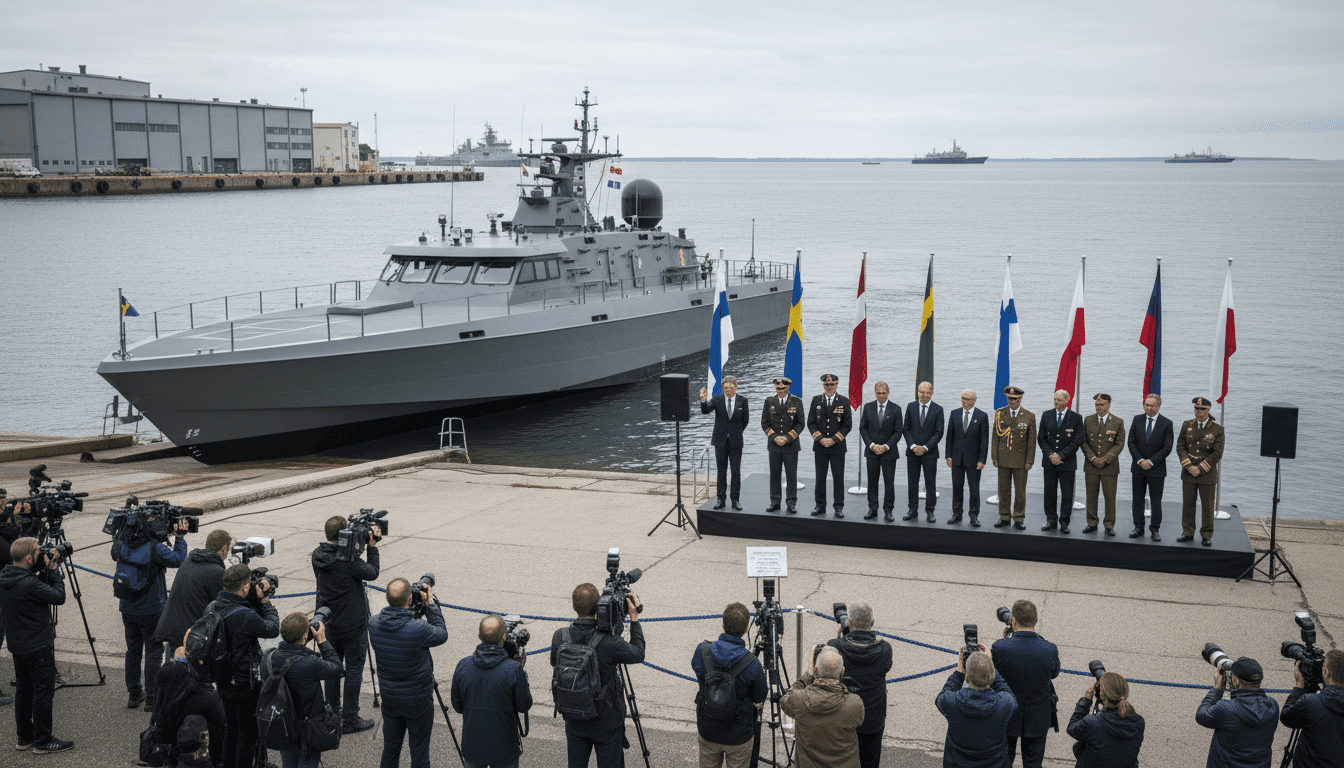
Drone boats surge in Baltic as Stark Defence unveils Vanta 6 amid shadow fleet concerns
Stark Defence unveils Vanta 6 as drone boats gain prominence in the Baltic Sea amid a shadow fleet, cable sabotage and rising maritime security concerns.
Baltic Sea named a growing security hotspot
The Baltic Sea has emerged as a focal point for maritime security, with officials warning of daily threats that range from sabotaged undersea cables to disrupted GPS data. NATO figures and regional leaders describe a shadow fleet of poorly documented vessels that complicates surveillance and challenges national maritime defenses.
These developments have accelerated interest in unmanned systems, particularly drone boats, which governments and law enforcement see as tools for surveillance, deterrence and, potentially, limited kinetic action. The increasing frequency of incidents near vital infrastructure has made the protection of sea lanes and submarine cables a higher policy priority for many littoral states.
Stark Defence introduces Vanta 6 to the market
Munich-based Stark Defence this year revealed Vanta 6, a roughly six-meter uncrewed surface vessel designed to patrol and monitor maritime areas of interest. The firm, founded about two years ago, showcased the craft near the National Maritime Conference, drawing attention from state officials and coastal police delegations.
Vanta 6 follows Stark’s earlier entry into the supply chain for kamikaze drones awarded by the Bundeswehr this spring, indicating the startup’s rapid pivot from aerial to maritime unmanned systems. Company representatives have been signaling potential civilian use cases alongside defense roles to broaden the machine’s market appeal.
Autonomy, endurance and sensor fusion define capabilities
Vanta 6 combines artificial intelligence with satellite and ship-tracking data to build continuous operational pictures and to identify vessels using evasive tactics. The craft is intended to shadow suspicious ships, maintain persistent presence, and create tactical dilemmas for those seeking to evade detection.
Unmanned endurance is a selling point: without a crew on board, the vessel can remain on station longer and rotate with replacements as fuel or maintenance dictates. Designers also say Vanta 6 can deploy aerial drones from its platform, increasing its reach for reconnaissance or, in a combat configuration, offensive options.
Rheinmetall’s K3 Scout provides a benchmark in scale
Established defense contractor Rheinmetall has already advanced production of larger autonomous surface vessels, reporting substantial orders and plans for serial manufacture at Blohm+Voss in Hamburg. Its K3 Scout, developed with the British Kraken Technology Group, is 8.4 meters long, faster and longer-ranged than Stark’s model.
Executives have publicly stated that several hundred of those craft are on order, and the company has disclosed a unit cost estimate that omits major weapon systems. The scale and industrial backing behind Rheinmetall’s program — including recent acquisitions to expand its naval capabilities — present a direct commercial and operational contrast to newer entrants.
Interoperability and open-source software as a competitive edge
Stark Defence emphasizes a systems approach that pairs hardware with an open-source command-and-control layer called Minerva, which the company says can integrate with both national coast guard networks and NATO systems. Interoperability with civilian maritime authorities is framed as crucial where responsibilities overlap and rapid information sharing is needed.
This software-centric argument underlines a broader market split: some buyers prioritize heavy platforms and pre-integrated weapon packages, while others seek flexible, networked tools that can be quickly adapted to varying legal and operational frameworks. Stark positions its offering toward the latter, highlighting modular sensors and software extensibility.
Costs, production questions and political attention
Manufacturers point to sensor arrays, radar suites and night-capable cameras as the main price drivers for drone boats, with early-stage Stark declining to confirm exact figures beyond a six-figure band. Rheinmetall has named a lower baseline price for its platform exclusive of primary armament, suggesting the economics of unmanned surface vessels may be more favorable than traditional naval assets.
German lawmakers are already responding to maritime vulnerabilities with proposals to bolster protection for undersea cables and other critical infrastructure. A parliamentary initiative this week called for a strategic “cable diplomacy” approach, citing the centrality of submarine links to both data traffic and energy systems.
The combination of public concern, commercial bids and defense procurement momentum means maturating demand could reshape regional shipbuilding activity and spur partnerships between startups and established yards. Stark reports ongoing negotiations with German shipyards as it seeks domestic production partners.
The choice facing buyers will hinge on mission profiles: whether to prioritize high speed and range, integrated armament, or networked flexibility and rapid deployability.
Unmanned surface vessels are rapidly moving from experimental projects to ordered fleets, and the Baltic Sea is set to be a proving ground where technical performance, legal norms and diplomatic risk intersect.
