
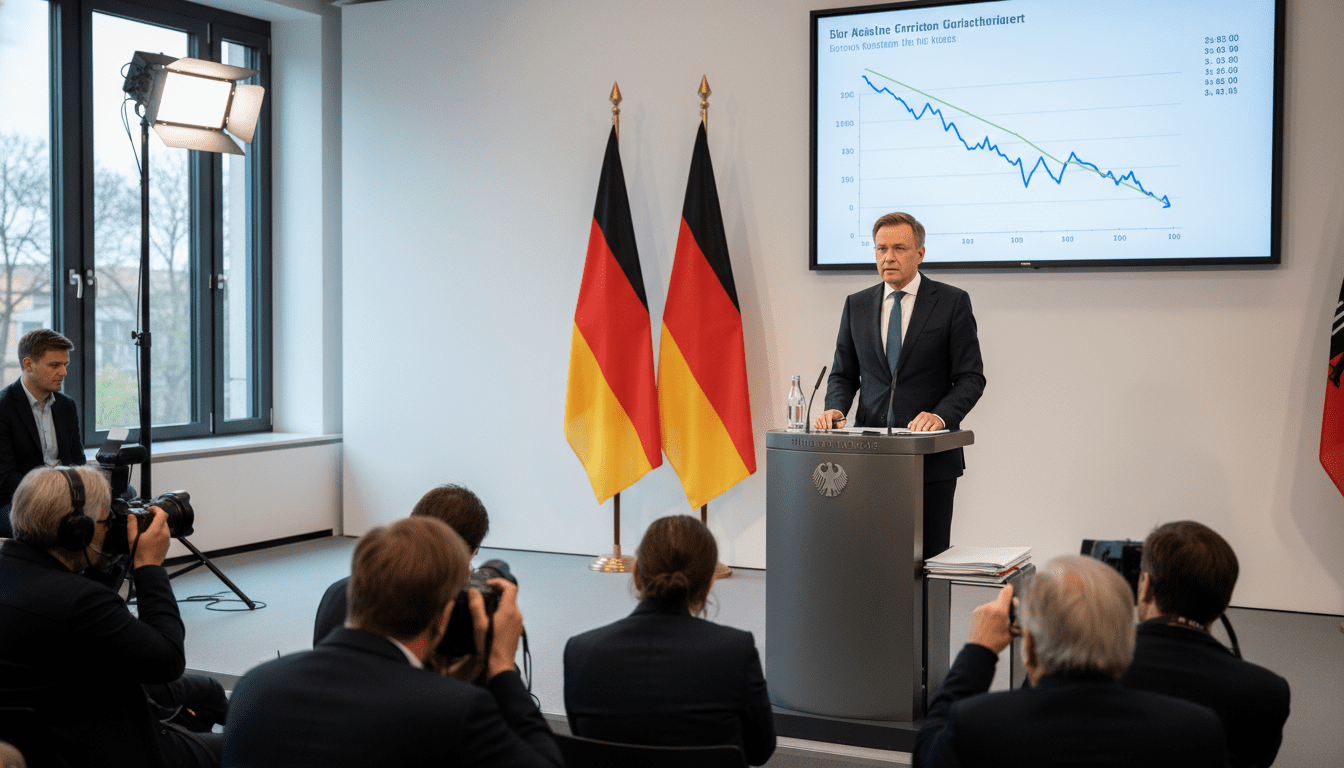
German tax forecast shows €87.5bn revenue shortfall to 2030 as 2026 receipts fall below €1 trillion
German tax forecast: government revenues projected down €87.5bn through 2030; 2027 federal receipts cut by €10.1bn, 2026 total now €998.7bn.
The latest German tax forecast warns of a substantial drop in public revenues, driven by weaker economic prospects linked to the war in Iran and an associated global energy shock. The working group on tax estimates projects a €10.1 billion reduction in federal receipts for 2027 and an aggregate shortfall of €87.5 billion for 2026–2030, and it reports that 2026 tax revenues are now expected to fall to €998.7 billion. The revision comes as the federal government prepares to finalise the 2027 budget in the coming weeks, forcing ministers to reassess spending plans and contingency measures.
Federal budget gap widens for 2027
The tax forecast lowers the federal government’s revenue outlook for 2027 by €10.1 billion compared with previous estimates. That revision tightens fiscal space ahead of the planned budget vote, complicating the ministry’s efforts to balance investment priorities with the need to safeguard employment and public services.
Officials have said the change reflects downgraded growth assumptions and higher energy costs that have curbed economic activity. The adjustment leaves fewer options for one-off measures or discretionary spending unless new revenue or offsetting savings are identified.
Aggregate shortfall of €87.5 billion through 2030
Across federal, state and municipal levels the working group calculates an €87.5 billion reduction in expected tax receipts over the 2026–2030 period. For 2026 alone the forecast reduces federal receipts by €9.9 billion, while state budgets are set back by about €3.0 billion and municipal coffers by €4.3 billion.
The downward revision also affects transfers to the European Union and other intergovernmental payments, contributing to the overall decline. As a result, total tax revenue for 2026 drops below the previously projected €1 trillion threshold to €998.7 billion, marking a meaningful recalibration of short-term fiscal expectations.
Finance minister attributes drop to Iran war and energy shock
Federal Finance Minister Lars Klingbeil linked the weaker outlook directly to the geopolitical turmoil in the Middle East and the resulting energy price shock. He warned that the conflict in Iran and its global economic spillovers have undermined the positive momentum in Germany’s economy and translated into lower tax take.
Klingbeil noted that the government is monitoring developments closely and pointed to measures already implemented to ease consumer pressure, including a temporary fuel discount. He reiterated that the administration’s priority remains protecting jobs and sustaining growth through targeted investments and structural reforms.
Greens criticize prior tax policy and call for reform
The parliamentary budget spokesman for the Greens described the forecast as evidence that financial pressure is building across all levels of government. Party officials argued that recent tax reductions and special fiscal measures have not delivered the growth needed to offset revenue losses.
Green lawmakers urged a comprehensive tax reform that shifts burdens toward higher earners and proposed measures such as a windfall or excess-profit levy on oil companies to capture extraordinary energy-sector gains. They framed reform as a dual necessity: to repair fiscal room and to pursue equitable burden-sharing.
Political tensions over fiscal choices ahead of budget vote
The revenue revisions sharpen political debate over which measures to prioritise as the 2027 budget is finalised. Proposals previously advanced by some conservative leaders, including selective VAT cuts for sectors like hospitality, are being scrutinised in light of the narrower revenue base.
Coalition partners and opposition parties face pressure to reconcile campaign promises with the new estimates, forcing a choice between scaling back planned tax reductions, reallocating spending, or identifying new revenue streams. The negotiation dynamic will be a key determinant of whether planned investments can proceed without further borrowing.
Government readies contingency options and emphasizes resilience
In public statements, finance officials signalled readiness to act if the crisis deepens, indicating contingency plans remain on the table. Those options could include targeted expenditure restraint, reprioritisation of investment projects, or temporary revenue measures tailored to preserve essential services and employment.
Officials continue to stress that strengthening economic resilience—through investments in energy independence and competitiveness—remains central to reducing vulnerability to future shocks. The forecast, they say, underlines the need for reforms that balance fiscal sustainability with long-term growth objectives.
The German tax forecast has reset expectations for near-term public finances, forcing policymakers to make prompt choices about spending priorities and revenue policy. As the 2027 budget vote approaches, the government must weigh immediate fiscal constraints against commitments to investment, jobs and social protections while monitoring geopolitical and energy market developments that will determine whether the shortfall narrows or deepens.
