
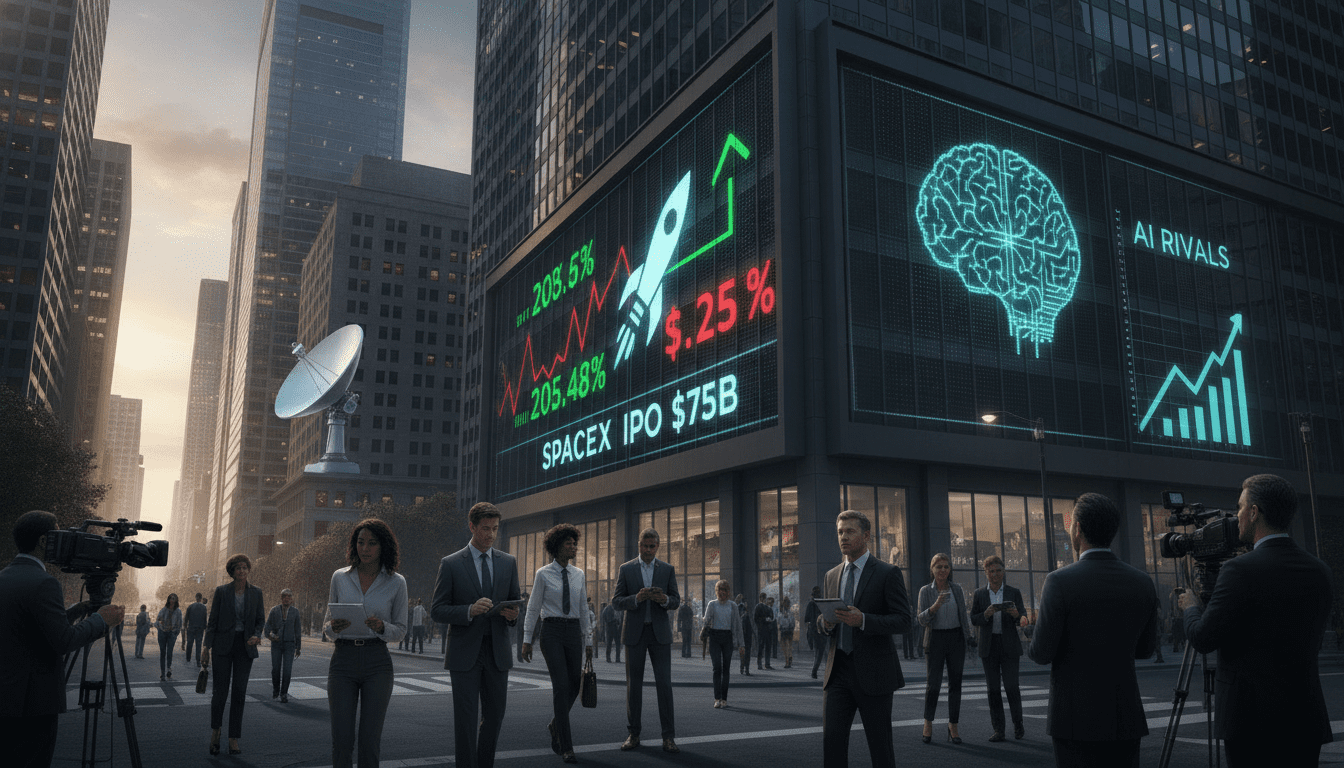
SpaceX IPO Set to Seek $75 Billion, Prompting Race Among AI Firms and Questions About Market Capacity
SpaceX IPO set to seek $75B in a potential record offering as Anthropic and OpenAI eye IPOs, raising questions about investor appetite and market capacity.
Elon Musk’s SpaceX has signaled plans for a landmark public offering that could raise roughly $75 billion, a sum that would eclipse every previous initial public offering on record and place the SpaceX IPO at the center of this year’s capital markets surge. The emergence of large technology listings from AI firms Anthropic and OpenAI has turned the float market into a focal point for investors and bankers, and prompted fresh debate over whether global markets can absorb so much new equity. Market participants now weigh valuation, timing and investor appetite as underwriters ready to place what could be the most consequential IPO wave in recent memory.
SpaceX valuation and deal size
SpaceX’s proposed $75 billion target would place the SpaceX IPO among the largest private-to-public transactions ever pursued in U.S. markets. Analysts tracking equity offerings say the proposed valuation exceeds most contemporary benchmarks for aerospace and space-technology businesses, reflecting both the company’s revenue streams from launch services and its long-term ambitions in satellite broadband and human spaceflight.
Ipox, a research house specializing in listings, has signaled that a deal of this magnitude would be the largest IPO in history, a claim rooted in the sheer dollar amount sought from public investors. Underwriters will need to balance a compelling narrative about growth with detailed financial disclosure to justify the valuation to institutional buyers.
Anthropic and OpenAI join the queue
Anthropic has submitted confidential paperwork for a public listing, and OpenAI has indicated plans to move toward an IPO as well, creating a competitive backdrop to the SpaceX IPO. These filings suggest a broader trend: companies built around artificial intelligence are now pursuing public capital at scale, eager to fund rapid development and secure market-leading positions.
Confidential filings typically precede a public registration statement and allow issuers to coordinate with regulators while maintaining strategic discretion. For investors, the filings serve as an early signal that high-profile private technology firms are preparing for public scrutiny and market pricing.
Wall Street appetite versus market digestion
Bankers on Wall Street often say “when the ducks quack, feed them,” reflecting how capital markets respond to investor demand. The current surge in planned listings has revived that mentality, with deal teams keen to meet appetite for new tech shares after years of limited supply. Yet the central question is whether the market can digest an unusually large volume of high-profile securities without destabilizing valuations.
Large offerings require deep pools of long-term capital to prevent early sell-offs and price slippage. Portfolio managers will be assessing whether these new listings diversify risk or concentrate it, particularly given sector correlations among technology and AI companies. The balance between hunger for growth exposure and caution over crowded sectors will ultimately shape pricing and aftermarket performance.
Valuation risks and investor protections
The flood of megadeals raises questions about valuation discipline and investor safeguards. High initial price tags place the onus on issuers to demonstrate credible revenue paths and margins, while underwriters must structure allocations to manage volatility after the float. For long-term investors, potential dilution from subsequent capital raises and the firms’ capital-intense roadmaps are salient risks.
Regulatory scrutiny and clear governance practices will be critical for newly public AI firms and capital-heavy space companies alike. Transparency on revenue sources, margins, loss-making segments, and related-party transactions will be key inputs for analysts building models and for fiduciaries making allocation decisions.
Timing and next steps for the planned listings
Confidential submissions typically begin a process that can take several months to reach a public offering, subject to regulatory review and market conditions. Underwriters will evaluate window-of-opportunity dynamics, looking for periods of strong investor sentiment and balanced supply-demand metrics before pricing a megadeal like the SpaceX IPO.
Market conditions, macroeconomic indicators and geopolitical events all influence the timing calculus. Issuers often wait for a clear path to stable aftermarket trading to mount the largest deals, while smaller or strategic placements may be made earlier to secure cornerstone investors.
Institutional investors will also watch lock-up arrangements and post-IPO share schedules closely, since large insider holdings or staggered selling windows can affect early trading volatility. The sequence in which Anthropic, OpenAI and SpaceX move from confidential submissions to public filings will determine how much investor capital each can attract without cannibalizing demand for the others.
Market participants say careful pacing and robust roadshows will be essential to align investor expectations. Underwriters are likely to stage targeted engagement with sovereign wealth funds, pensions and large asset managers to secure cornerstone commitments that underpin a successful opening.
The coming months will test whether the global equity market can accommodate a cluster of headline-grabbing listings without eroding returns for new investors. For now, the SpaceX IPO headline number is the clearest signal: public markets are once again a destination for some of the most capital-intensive and strategically important technology firms.
