
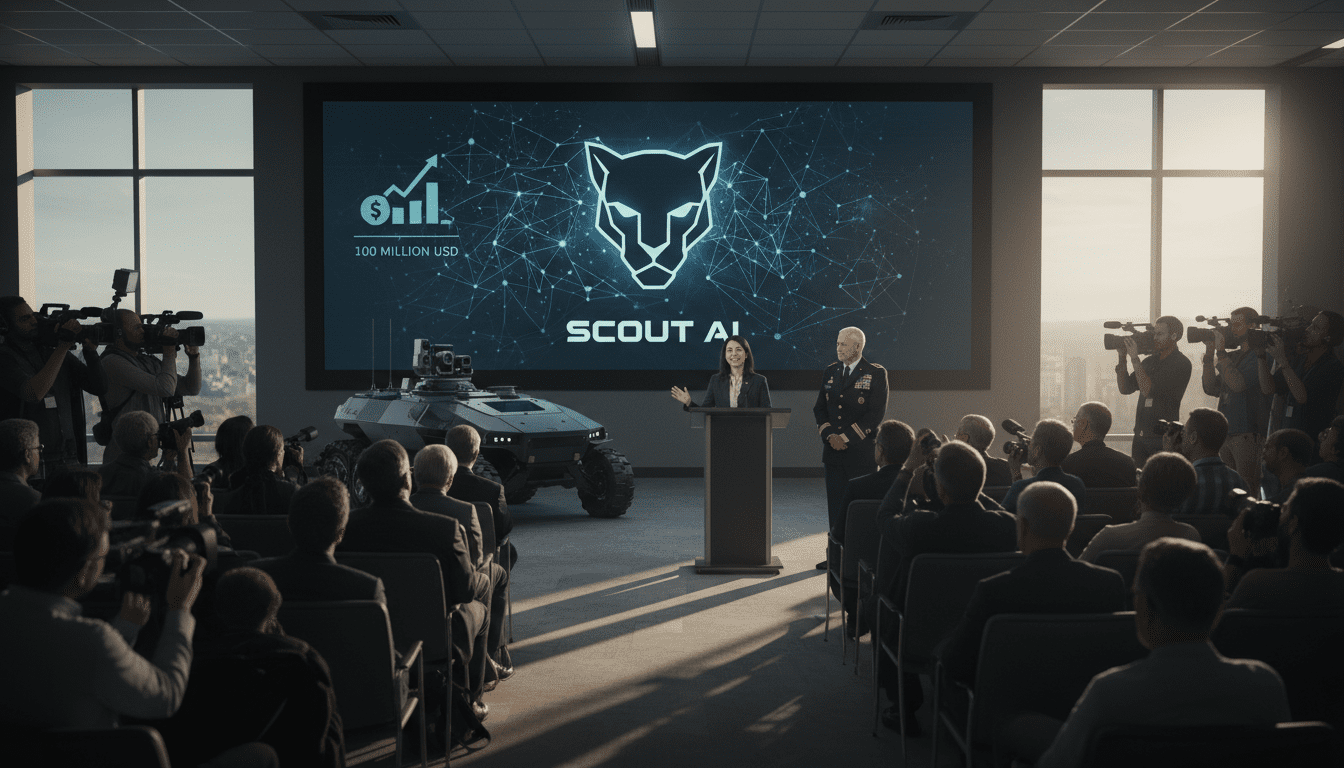
Scout AI raises $100 million to train military-grade autonomy with new “Fury” model
Scout AI has closed a $100 million Series A to fund development of its military autonomy model Fury, advancing off-road and combat-capable AI for defense.
Scout AI announced a $100 million Series A funding round in late April 2026 to accelerate development of Fury, an artificial intelligence system intended to command and operate autonomous military platforms. The startup is training the model on real-world terrain using four-seat all-terrain vehicles at a central California military range, with the goal of bringing more capable autonomy into logistics and, eventually, weapons systems. The investment follows a $15 million seed round in January 2025 and will finance compute, training and expanded testing.
Scout AI secures $100 million Series A
Scout AI said the round was led by Align Ventures and Draper Associates and will help the company scale its autonomy research and build its own foundation model over time. The founders, Coby Adcock and Collin Otis, launched the company in 2024 and position it as a “frontier lab for defense” focused on embedding intelligence into existing military assets. The startup has also won contracts worth about $11 million from defense organizations, including DARPA and the Army Applications Laboratory, to support technology development.
The company declined to name every partner but confirmed it is one of roughly 20 autonomy firms whose systems are being evaluated by the Army’s 1st Cavalry Division during regular training cycles. Scout executives said the Army expects to incorporate proven products into future deployments, with some systems slated for evaluation through 2027.
Training Fury on rugged military trails
At the company’s training range, Scout AI runs four-seat ATVs across hilly, unmarked trails to collect data and refine its models under conditions that mimic conflict zones. Former soldiers hired as instructors drive the vehicles in controlled missions, capturing human interventions and edge-case behavior for reinforcement learning. Drivers log where they must take over, and those corrections are fed back into the model to reduce error rates and improve decision-making.
Engineers say training on real vehicles helps Fury learn behaviors that are hard to simulate, such as handling loose sand, steep grades and ambiguous intersections. The company uses civilian ATVs for initial trials but has moved to military-grade platforms and hardened hardware to more closely replicate operational constraints.
Vision-language action models at the core
Scout AI is building Fury around vision-language-action architectures, a class of multimodal models that combine visual inputs with language and planning capabilities. These VLAs layer large language models with perception and control modules so an agent can interpret scenes, reason about objectives and generate actions. Founders argue that VLAs allow agents to leverage prior knowledge and generalize across tasks in ways that older, rule-based autonomy stacks cannot.
Executives say the VLA approach enables prompt-like commands from soldiers — for example, asking a vehicle to move to a waypoint and monitor for threats — and that deterministic systems remain part of the overall autonomy stack. The startup also partners with hyperscale cloud providers for pretrained models while planning to invest raised funds in building a proprietary foundation model tailored to battlefield interactions.
Early use cases: resupply, convoys and reconnaissance
Scout AI’s executives and military technologists identify automated logistics as the near-term application most likely to be fielded. The company envisions autonomous convoys that follow crewed vehicles, delivering water, ammunition and supplies to forward positions and freeing personnel for other tasks. Active-duty officers embedded with Scout during trials describe scenarios in which autonomous systems would reduce risk during night resupply and long-distance hauls.
Beyond ground vehicles, Scout is integrating VLAs into aerial systems for reconnaissance and coordinated strikes. The company demonstrated concepts in which a larger “quarterback” platform coordinates multiple smaller drones to search, identify and engage targets, though the startup says human confirmation and geographic constraints can be built into engagement policies.
Autonomous weapons debate and safeguards
Scout acknowledges the political and ethical sensitivity of equipping unmanned systems with lethal capabilities and frames its work around controlled environments and safeguards. Company representatives emphasize programming constraints such as geofencing and rules that require human approval before weapons release. Military partners and some technologists also note that autonomous targeting has precedents — from heat-seeking missiles to automated mines — and that the central question is how decision authority is allocated.
Still, critics warn of escalation risks and the challenges of ensuring robust human oversight in fast-moving scenarios. Scout contends that scalable autonomy is needed to counter massed low-cost unmanned systems and to reduce exposure of personnel, but the company says broader policy and legal frameworks will guide operational deployment.
Business model, contracts and roadmap
Scout positions itself primarily as a software and intelligence company rather than a vehicle manufacturer, offering an orchestration layer that can be bundled with hardened compute, sensors and communications. Its first commercial product, called Ox, is designed to let small units direct multiple autonomous assets using concise commands and a centralized interface. The firm expects much of the new capital to go toward training costs, compute infrastructure and building a custom model informed by continuous interaction with physical systems.
Contracts with defense agencies have funded early testing and demonstrations, and Scout plans to expand field trials across additional training units this year. Executives say the combination of real-world data and VLA architectures could accelerate their path to more advanced autonomy, though they acknowledge technical, operational and policy hurdles remain.
Scout AI’s $100 million round marks a significant bet on embedding large-model intelligence into military machines, and the company’s experiments on rugged terrain aim to test whether multimodal agents can safely perform in the unpredictable environments soldiers face. The outcome will influence both how armed forces use autonomous systems and how policymakers weigh the risks and benefits of increasingly capable battlefield AI.
