
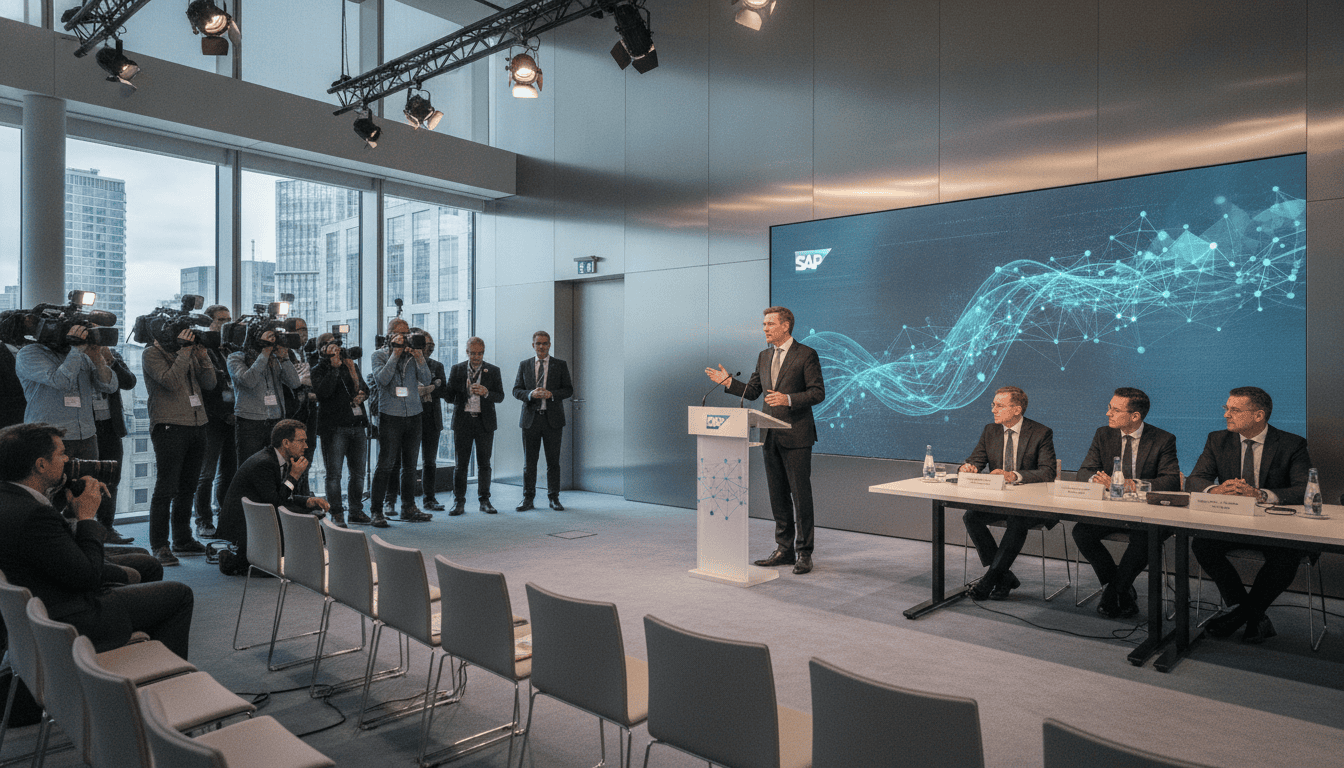
SAP Q2 results: Cloud backlog jumps 27% to €22.9bn as CFO positions SAP as AI beneficiary
SAP Q2 results: Cloud backlog up 27% to €22.9bn, revenue and operating profit rise; CFO backs AI strategy while shares lag and outlook is modestly trimmed.
SAP reported stronger-than-expected second-quarter figures, with its Current Cloud Backlog rising 27 percent to €22.9 billion and overall revenue climbing as cloud sales accelerated. The SAP Q2 results reflect continued cloud momentum and an operating profit increase even as concerns about artificial intelligence and a falling share price weigh on investor sentiment. Management signalled confidence in the company’s AI strategy and reiterated guidance for the year after a small downward revision linked to recent acquisitions.
Cloud backlog and revenue performance
The company’s Current Cloud Backlog, a key indicator of contracted cloud revenues over the next 12 months, reached €22.9 billion, marking a 27 percent year-on-year increase. Cloud revenue grew 22 percent in the quarter, while consolidated revenue expanded by nine percent to just under €9.9 billion. The stronger cloud performance contrasts with a marked decline in classical license sales, which has been tempering overall growth rates for some time.
Operating income for the quarter rose about eight percent year on year to roughly €2.7 billion, evidencing improving profitability as cloud contracts convert into recurring revenue. Management highlighted the mix shift toward subscription and cloud services as the engine behind more predictable revenue and margin stability.
CFO frames AI as strategic advantage
Finance chief Dominik Asam described the quarterly figures as evidence that SAP’s strategy is working in an uncertain macroeconomic environment. He told investors the company is using its own AI solutions to drive efficiency and productivity and that SAP’s deep experience with mission‑critical enterprise processes gives it a competitive data advantage. According to Asam, that data footprint and process expertise position SAP to offer targeted, trustworthy AI applications for corporate customers.
Asam also argued that not developing a single proprietary large language model is an asset, allowing SAP to remain vendor‑agnostic and select the best models for particular customer needs. He cited the use of multiple providers, including North American and Canadian models as well as the European third‑party provider Mistral, as part of a diversified approach to enterprise AI.
Kill switch debate and customer preferences
The so‑called kill switch debate — concerns that foreign governments could compel cloud or AI providers to shut down services — has influenced customer procurement decisions, according to SAP executives. That debate, they say, is prompting enterprises to seek flexible vendors able to switch underlying model providers while maintaining governance and data controls. SAP’s ability to operate across multiple model suppliers reportedly appealed to sensitive clients, including defence and aerospace firms such as Diehl, Thales and Airbus.
Executives also pointed to a recent, widely reported incident involving another AI developer as reinforcing demand for vendor stewardship and secure, supervised AI deployments. SAP positions itself as assuming a “guardian” role for the agents and AI tools it places with customers, arguing that responsibility for safe operation strengthens its commercial case.
Guidance adjusted after acquisitions, geopolitical caveats noted
SAP adjusted its full‑year operating profit forecast downward by €100 million following two July acquisitions, of Dremio and Prior Labs, which management described as loss‑making at the time of purchase. The board now expects operating profit to grow from last year’s €10.4 billion to a range between €11.8 billion and €12.2 billion. Management described the revision as modest and linked mainly to integration costs from the deals.
Executives cautioned that the outlook is conditioned on a de‑escalation in the Middle East, and warned that renewed geopolitical tensions could have “possibly significant negative consequences” for business. SAP said it has not yet observed a widespread pullback in investments among customers located near the conflict zone, but emphasised the difficulty of forecasting future impacts.
Market reaction and shifting valuations
Despite the solid operational metrics, SAP’s share price has remained under pressure and management’s optimism has had limited effect on market sentiment. The stock has fallen sharply over the past year, and in the last six months it lost roughly a third of its value, contributing to SAP’s slide from Germany’s top market valuation to fourth place behind Siemens, Airbus and Allianz. Siemens currently leads German blue chips by market capitalisation, with SAP’s market value reported at about €150 billion.
Investors appear to be differentiating between legacy enterprise software vendors and pure‑play AI firms, the latter fetching much higher valuations in the public and private markets. That gap was underscored in market commentary comparing traditional software capitalisations with lofty valuations assigned to prominent AI developers planning public listings.
SAP Q2 results underline a company that is transitioning toward cloud and AI while managing near‑term integration costs and geopolitical uncertainty. Management’s focus on being model‑agnostic and offering supervised, enterprise‑grade AI aims to bridge customer concerns and monetise SAP’s data strengths, even as investors weigh disruption risks and reprice expectations.
